Colour-edit reviewers
You compare colour versions and need to match the colour gamut, colour mode and calibration to your output workflow. BenQ, ASUS and EIZO outline relevant colour and calibration criteria.


When comparing colour edits, the monitor’s colour gamut should match your output workflow, and the screen should have enough room to show both views. However, a manufacturer’s coverage figures or factory calibration claims don’t prove the accuracy of an individual unit. In a quiet home office, check whether the specific model operates silently as a separate consideration: colour and connectivity specifications don’t prove that it does.
You compare colour versions and need to match the colour gamut, colour mode and calibration to your output workflow. BenQ, ASUS and EIZO outline relevant colour and calibration criteria.
You want to view your working image and a reference at the same time, so you check the usable resolution and window sizes rather than just the screen’s diagonal measurement. BenQ and ASUS list relevant display and comparison features for their models.
You work in a quiet room and don’t assume a monitor will be silent based on its colour or display specifications. BenQ, ASUS and Dell’s model details on displays and connections don’t prove how much noise a monitor makes.
First check that the colour gamut and colour mode suit your project. Then consider space for side-by-side views, noise levels and how the monitor will fit on your desk.
| What matters | What to look for | Who should pay particular attention? |
|---|---|---|
| Reliable colour reproduction | Match the target colour gamut and the appropriate colour mode; check the calibration report and consider future profiling. | If you’re assessing colour edits for a particular output workflow, you’ll want suitable colour reproduction and clear calibration details. Around 33% of consumers put colour reproduction first. |
| Two views side by side | Check the window sizes you need and how readable they are with your chosen scaling in the software you use. | If you need to view image versions or a reference side by side, the usable screen space matters more than the diagonal measurement alone. Around 27% of consumers prioritise side-by-side views. |
| Noise in your home office | Ask for model-specific evidence of silent operation and check the conditions attached to any noise claims. | If you work in a quiet room, don’t assume a monitor is silent based on its display or connectivity specifications. Around 27% of consumers place particular importance on quiet operation. |
| Fit and laptop connections | Check the stand’s dimensions against your desk, and make sure the laptop’s video output and charging needs match the monitor’s connections. | If your desk has limited space or you’re connecting a laptop, the monitor needs to fit your setup and provide the connection you need. Around 13% of consumers prioritise fit and laptop setup. |
A stated coverage figure alone doesn’t tell you how accurately your particular unit displays colour. EIZO points out that calibration can’t fix a gamut that’s too small or an uneven panel.
Match the colour gamut and mode to your output, then check the calibration report and whether you can profile the monitor later.
Profiling may require a measuring device or a calibration service.
Colour and connectivity specifications don’t tell you whether a monitor will be audible in a quiet home office.
Ask for evidence that the specific model operates silently, and check the conditions under which that claim applies.
Even a wide monitor might not fit your desk or offer the window sizes you need.
Measure your desk’s width and depth, check how your software views will fit, and compare the monitor’s dimensions, including the stand.
Depending on your desk, you may need a suitable mount.
The PD3420Q is a flat 34-inch ultrawide monitor for colour and layout work.
The ProArt PA348CGV is a flat 34-inch ultrawide monitor with creative features and a range of connections.
The UltraSharp U3425WE is a curved 34-inch monitor with a Thunderbolt hub.
The UltraWide 34U650A-B is a curved 34-inch monitor for work that’s mainly sRGB-focused.
This Joybuy selection includes ultrawide monitors for spacious work areas and comparing views side by side. Check the specific product details for colour gamut and noise information.
 No image available
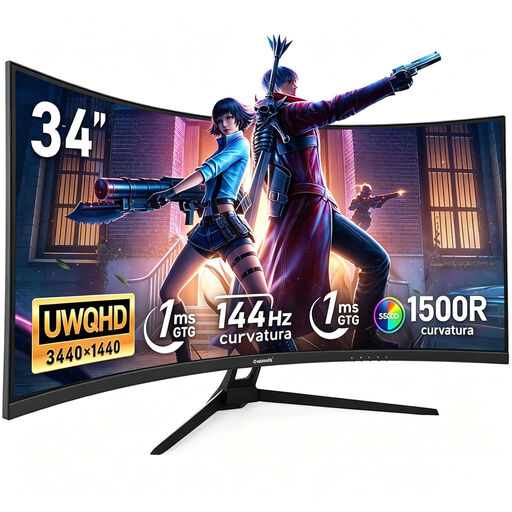
The wide 21:9 screen could work well for side-by-side views. Check that the curve suits the way you compare images.
The product title lists 1500R, 144 Hz, a Fast VA panel and 100% sRGB. These specifications don’t prove the colour accuracy of an individual unit or silent operation.
 No image available
The 21:9 format and stated resolution give you a wide area for work windows. Compare the usable display area with the software you use.
The product title lists 3440 × 1440 pixels, 1500R and 165 Hz. Before choosing, check that the curve suits your workflow.
 No image available
The product title lists PIP and PBP for displaying content from two sources at the same time. Check whether these features suit the way you compare images.
Specifications include 3440 × 1440 pixels, 21:9, 1500R and 200 Hz. These features say nothing about the colour accuracy of an individual unit.
 No image available
The stated resolution of 5120 × 2160 pixels and PIP/PBP may be useful for viewing several things at once. Check the window sizes and inputs you need.
The product title lists an IPS panel, 21:9, 100 Hz and USB-C with 65 W Power Delivery. Check that the connections suit your laptop and the video sources you use.
 No image available
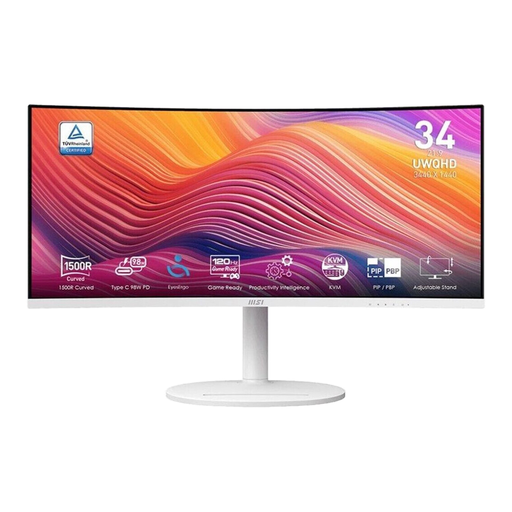
The 21:9 format gives you a wide workspace. Check the dimensions and curved design against your desk and the way you compare images.
The product title lists UWQHD, a VA panel and 120 Hz.
No. Choose a colour mode that suits your project, and take calibration and profiling into account. EIZO points out that calibration can’t fix a gamut that’s too small or an uneven panel. Manufacturer figures aren’t measurements of your specific monitor.
First, check the window sizes you need in your software at your preferred scaling. BenQ lists DualView and PIP/PBP for the PD3420Q. Whether these modes are right for you depends on whether you want to compare views from one computer or content from several sources.
If your workflow requires regular profiling, you may need a suitable measuring device or a calibration service. Also compare the energy label for the specific model. Without knowing how long you use it and your electricity tariff, it’s not possible to give a reliable annual cost in euros.
For a typical online consumer purchase, you generally have a 14-day right to cancel, although exceptions and the specific contract terms should be taken into account. The Verbraucherzentrale distinguishes statutory rights against the seller from a voluntary guarantee.
For a monitor placed on the EU market, the manufacturer is responsible for the relevant conformity assessment and required CE marking. Electronic displays covered by EU rules must also carry an energy label. Check the details and make sure they relate to the specific model in the sales listing.