Creative professionals working with multiple windows
If you want to see your design, browser preview and tools at the same time, check that the resolution and usable screen space are sufficient at your usual text size.


If you want to keep your design, browser preview and tools side by side, start by comparing resolution, text size and the space available on your desk. For colour work, documented colour modes and calibration details matter more than extra gaming hertz. If you regularly switch between laptops, suitable USB-C video output, charging power and KVM may matter more. Manufacturer claims about colour performance are no substitute for an independent test of the specific device.
If you want to see your design, browser preview and tools at the same time, check that the resolution and usable screen space are sufficient at your usual text size.
If you’re choosing colours for a website, look for documented colour modes and calibration details. BenQ and ASUS list these features for specific models.
If you regularly connect your laptop or switch between two computers, compare the video connection, the charging power you need and, where relevant, KVM support for the specific model.
First decide whether screen space, reliable colour settings, laptop connectivity or how the monitor fits into your workspace matters most to you.
| Priority | What to check before buying | Who will find it most useful? |
|---|---|---|
| Readable space for design and preview | Native resolution and preferred window layout; dimensions of the casing and stand. | If I want to read my design, preview and tools side by side at my usual text size, I look at resolution and desk space. Around 33% of consumers put readable screen space first. |
| Reliable website colours | sRGB mode and calibration details; settings for your own colour workflow. | If I’m choosing colours for a website, I want suitable colour settings rather than relying on a wide colour gamut alone. Around 27% of consumers prioritise verifiable colour settings. |
| Laptop connectivity | Laptop video output, connection and cable; charging power needed and KVM. | If I regularly connect and disconnect my laptop or use two computers, a suitable connection with enough charging power matters to me. Around 20% of consumers put laptop connectivity first. |
| Ergonomics and desk space | Desk space and stand dimensions; adjustment range and potential glare in your workspace. | If I work at a screen for long periods, I want to position it comfortably and avoid distracting glare. Around 20% of consumers prioritise positioning and adjustability. |
Screen size alone doesn’t tell you whether your design and preview will be readable side by side at your preferred text size. The dimensions, including the stand, also need to suit your desk.
Compare the native resolution and overall dimensions with your planned window layout before choosing a model.
Colour-gamut coverage and calibration figures in product specifications aren’t independent measurements of your specific device, nor do they automatically guarantee suitable software settings.
Check the sRGB mode and colour management for your intended workflow. Distinguish between manufacturer claims and independent measurements.
A USB-C port alone doesn’t guarantee that your laptop supports video output and the power supply you need.
Check the specifications for your laptop, monitor and cable, and make sure the stated charging power is sufficient for your computer.
Depending on your laptop, you may also need a suitable power adapter, cable or dock.
The DesignVue range includes models with documented features for creative work.
According to ASUS, the ProArt PA348CGV combines design-focused colour features with USB-C connectivity.
According to EIZO, the FlexScan EV3451X is designed for workspaces where docking, KVM and adjustability are priorities.
The UltraSharp U3425WE is a 34.1-inch model with a Thunderbolt hub.
LG’s UltraWide range includes 34-inch models with 3440 × 1440 pixels, including the 34U650A-B.
These Joybuy models offer different screen sizes and features for working with multiple windows. Check the specifications for your colour workflow, laptop and workspace against each specific model.
 No image available
The listed 21:9 screen and resolution are relevant for viewing your design and preview side by side; check readability at your usual text size.
34 inches; 3440 × 1440 pixels; 21:9; 1500R curvature; 165 Hz; VESA 75 × 75 mm.
 No image available
The wide 32:9 screen could be useful if you work with lots of windows; measure your available desk space first.
49 inches; 5120 × 1440 pixels; 32:9; 1500R curvature; 165 Hz; height-adjustable stand; HDMI 2.1 and DP 1.4.
If you’re wall-mounting it, make sure the VESA mount is suitable for the display’s size and weight.
 No image available
The listed resolution and 21:9 format are relevant for viewing your design and preview side by side; check that it will fit your workspace.
34 inches; 3440 × 1440 pixels; VA; 21:9; 1500R curvature; 200 Hz; PIP and PBP; height-adjustable stand.
 No image available
The product specifications list features for colour-related creative work; calibration figures are no substitute for an independent check of the specific device.
40 inches; 5120 × 2160 pixels; IPS; 21:9; height-adjustable stand; USB-C with 65 W Power Delivery.
Product specifications list 99% sRGB, a calibration report and Delta E < 2. Whether 65 W is enough for a particular laptop depends on its power requirements.
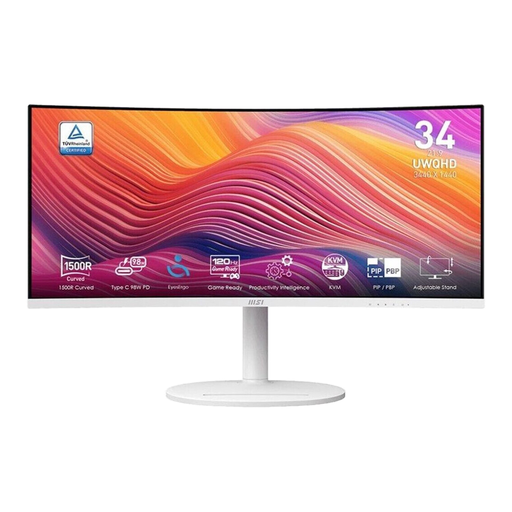 No image available
The listed 21:9 screen is useful for working with multiple windows; check that the resolution and footprint suit your workspace.
34 inches; 3440 × 1440 pixels; VA; 21:9; 120 Hz; matte finish; two USB ports.
No, screen size alone isn’t enough. Compare the native resolution and the dimensions including the stand, and check that there’s room for your preview and tools at your usual text size.
Allow for the space it takes up and the stand’s adjustment range, then position the screen so that lighting and glare don’t get in the way of your work. The German Social Accident Insurance (DGUV) lists glare and a non-ergonomic workspace as potential sources of strain.
Your statutory rights against the seller are separate from a voluntary manufacturer’s warranty, as explained by the consumer advice centre in its guidance dated 28 September 2026. When consumers buy online, they generally have a 14-day right to cancel, starting from the conclusion of the contract or receipt of the goods ordered; the consumer advice centre explains this in its guidance dated 13 August 2026.
The EU energy label for electronic displays uses a scale from A to G, as explained by the European Commission. Compare the label for the specific model.