People who reconcile invoices
If you often have your account summary and an invoice open at the same time, you need enough usable width and a text size that keeps both views easy to read.


First, choose a screen with enough space to read your account summary and invoice side by side at your preferred text size. Beside a bright window, positioning and suitable sun protection also matter: the DGUV recommends looking parallel to the window when working at a screen, and an anti-glare surface alone cannot prevent direct sunlight. USB-C docking is useful in particular if your laptop supports video output over USB-C and the monitor provides enough power to charge it.
If you often have your account summary and an invoice open at the same time, you need enough usable width and a text size that keeps both views easy to read.
If you experience reflections or direct sunlight, consider the screen surface, desk position and sun protection together.
If you regularly connect a laptop, check in advance whether it supports video over USB-C and can provide the power needed to charge it.
First, check that your documents are easy to read at the text size you need. Then consider the window’s position, the connections you need and the space required by the specific monitor.
| Buying priority | What to check | Who it matters most to |
|---|---|---|
| Reading two documents | Check how the windows fit side by side at your preferred text size, and measure the screen. | If I keep my account summary and invoice open at the same time, both need to remain readable at my usual text size. This is the main priority for around 36 % of consumers. |
| Reducing glare | Check the screen’s position in relation to the window and the sun protection in your workspace. | Beside a bright window, I want to account for reflections and direct sunlight rather than rely on the monitor’s screen surface alone. This is the main priority for around 29 % of consumers. |
| Connecting a laptop | Check the monitor’s USB-C video output, your laptop’s power requirements and the cable’s suitability against the monitor specifications. | If I connect my laptop frequently, the connection needs to work with my device for video and, if needed, power. Around 21 % of consumers make this their main connection priority. |
| Setup and running costs | Compare the space required, including the stand, and check the EU energy label for the specific model. | For my workspace, a suitable setup and clear information about running costs matter. Around 14 % of consumers put these considerations first. |
Direct sunlight and reflections can make the screen harder to see; a brightness rating does not tell you how it will look beside your particular window.
As well as checking the monitor specifications, consider your desk position, reflections and suitable sun protection.
Video output and charging depend on whether your laptop, cable and monitor are compatible, and whether the available charging power is enough for your laptop.
Check the video output, power requirements and cable against the specifications for the exact monitor model.
Depending on the connection, you may also need an extra cable or a separate power supply.
Screen size and resolution alone do not tell you how large text will appear in your applications at your chosen scaling setting.
Plan to view your account summary and invoice side by side at your usual text size, and check the monitor’s dimensions, including the stand.
The P3425WE is a 34.1-inch UWQHD business monitor with USB-C docking, designed for laptops that are frequently connected.
According to EIZO, the FlexScan EV3451X is designed for office workspaces that need an ultrawide screen and docking.
The CU34P3CV is a 34-inch UWQHD VA monitor with USB-C docking.
The 34WN80C-B is an ultrawide IPS option with USB-C for working with documents.
According to the manufacturer, the 34B2U3600CH/00 features USB-C, Smart KVM and a webcam for workspaces with multiple devices.
The following Joybuy products offer ultrawide workspaces for viewing documents side by side; their format, resolution and features vary by model.
 No image available
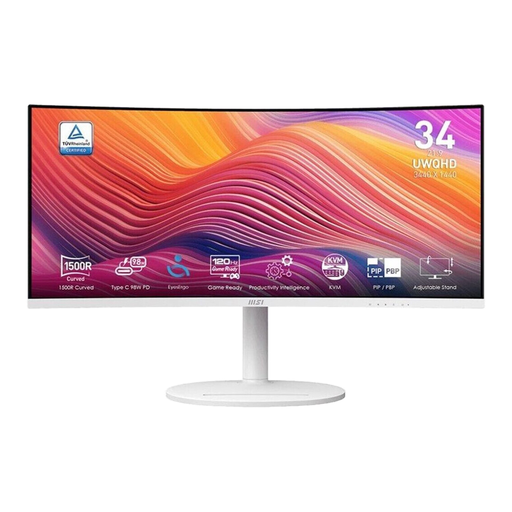
The 34-inch UWQHD screen is designed for viewing documents side by side.
34 inches, 3440 × 1440 pixels, 21:9, curved VA LED and 120 Hz.
 No image available
The ultrawide format provides a broad workspace for multiple windows; check that everything is readable at your preferred text size.
34 inches, 3440 × 1440 pixels, 21:9, VA panel and 180 Hz.
 No image available
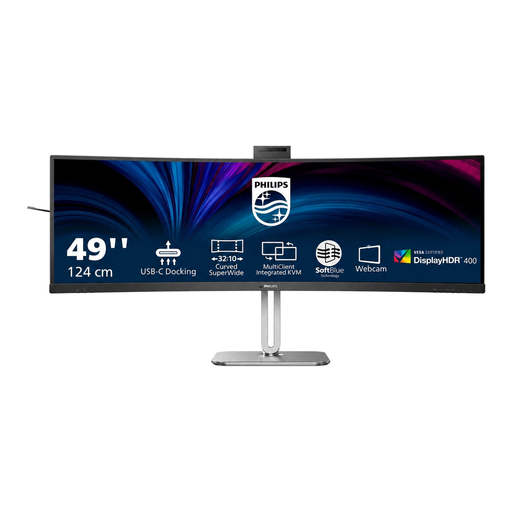
The 32:9 format offers an especially wide screen for multiple windows; measure your desk space first.
49 inches, 5120 × 1440 pixels, 32:9, VA, 450 cd/m², 75 Hz and two HDMI ports.
The stated width with the stand is 1193 mm.
 No image available
The 3440 × 1440 resolution supports a side-by-side window layout; text size also depends on your scaling settings.
34 inches, 3440 × 1440 pixels, 21:9, VA, 100 Hz and 1500R.
 No image available
The UWQHD resolution gives you a broad workspace for multiple windows; check that documents are readable at your preferred text size.
34 inches, 3440 × 1440 pixels, VA panel, 120 Hz and 1500R; 135 Hz in OC mode.
34-inch models with a resolution of 3440 × 1440 pixels offer a broad workspace for multiple windows. Whether your spreadsheet and invoice remain readable at the same time also depends on how you arrange the windows and your chosen text scaling, so check both before deciding.
The DGUV recommends looking parallel to the window when working at a screen, and suggests using sun protection to reduce glare. Check the setup at the times of day when you work; the monitor’s screen surface alone cannot prevent direct sunlight.
This only works if your laptop and connection support the required video output and the monitor provides enough power to charge it. Dell specifies up to 90 W for the P3425WE, while AOC specifies up to 65 W for the CU34P3CV; compare these figures with your laptop’s requirements and the cable you plan to use.
Compare the EU energy label for the specific monitor and the terms of any warranty offered. When you buy from a business seller in the EU as a consumer, you have a legal guarantee of at least two years from the date you receive the goods; this is separate from any voluntary warranty.
Yes. According to the European Commission, energy labelling for electronic displays also covers computer monitors and uses a scale from A to G. The label does not tell you whether the screen will be easy to read without glare beside your window.