For side-by-side 2D and 3D views, a 34-inch ultrawide with 3440 × 1440 pixels could be a good fit. If you also need more vertical pixels, compare 39.7-inch models with 5120 × 2160 pixels. At a shared desk, the right connections, KVM or docking, and an adjustable setup also matter. For reliable colour judgements, the display profile and colour management need to work together across your entire workflow.
Who is an ultrawide monitor for?
3D artists checking seams
When comparing a texture with a model view, placing windows side by side can save you from repeatedly switching between views. Adobe notes that viewport settings affect how an image is displayed, but do not directly change the exported texture.
Teams sharing a workspace
If people or computers take turns at the same desk, easy connection switching, shared peripherals and an adjustable screen position are important things to consider. EIZO lists KVM and USB-C docking for the FlexScan EV3451X.
Creatives checking colour
If you need to judge whether colour differences come from the texture or the display, consider the profile, colour management and panel uniformity. Adobe documents different colour management behaviour for different channels in Substance 3D Painter.
What should you look for when buying?
First, decide which requirement matters most at your shared workspace. Then compare the display, connectivity and setup features that meet that need.
| Criteria |
What to check before buying |
Who is it especially important to? |
| Seam detail and viewing area |
Resolution, screen size and window layout; check the detail at your usual scaling and with the viewport settings you use. |
If I want to check fine seams in 2D and 3D views side by side, I need enough visible detail at my chosen scaling. Around 33% of consumers prioritise checking detail. |
| Colour assessment |
Display profile, colour modes, calibration options and screen uniformity; colour gamut coverage alone does not answer these questions. |
If you need to tell texture colour differences apart from display effects, you need a consistent profile and calibration workflow. Around 27% of consumers put colour assessment first. |
| Switching between computers |
Video output, USB data connection and charging requirements for each computer; also check which devices the KVM switches. |
If I switch between computers and peripherals at a shared desk, I don’t want to reconnect everything each time. Around 20% of consumers prioritise switching between computers. |
| Setup for multiple people |
Available desk space, height adjustment, tilt and reflections in the actual workspace. |
If you need to adjust the screen for different people, you need a setup that suits the space and each person’s seating position. Around 20% of consumers consider adapting the workspace their top priority. |
Ultrawide monitor buying pitfalls
-
Confusing colour gamut coverage with guaranteed colour accuracy
Colour gamut coverage alone does not prove that the entire panel is uniform or that different applications will display colours consistently.
Check the calibration options and agree on consistent views and display settings for shared colour checks.
-
Assuming USB-C guarantees full single-cable docking
Video transmission, USB switching and laptop charging are separate requirements. A USB-C port does not confirm that every feature will work with every computer.
Compare the connections and charging requirements of each computer with the specifications for the specific monitor. Depending on the setup, you may need extra cables or a separate power supply.
-
Assuming all ports offer the same performance
On the Philips 40B1U6903CH/00, the available refresh rate varies depending on the connection.
Check which resolution and refresh rate are supported by the port you actually plan to use.
Key brands at a glance
BenQ
The DesignVue range is represented here by the flat 34-inch PD3420Q.
- BenQ lists a resolution of 3440 × 1440 pixels, 100% sRGB, 98% DCI-P3, USB-C and KVM for the PD3420Q.
- Colour gamut coverage alone does not prove the uniformity of an individual display.
Dell
The UltraSharp U3425WE and U4025QW offer different sizes and resolutions.
- Dell lists a resolution of 3440 × 1440 pixels and height adjustment for the U3425WE; the U4025QW is specified at 5120 × 2160 pixels.
- These features apply to the models listed and are not automatically available on every UltraSharp monitor.
LG
The UltraWide 40WP95XP-W is a 39.7-inch model with 5K2K resolution.
- LG lists a resolution of 5120 × 2160 pixels and typically 98% DCI-P3.
- According to LG, a hardware calibrator is not included. HDR10 support and colour gamut coverage do not, on their own, guarantee a colour-accurate setup.
Philips
According to Philips, the 40B1U6903CH/00 business monitor combines a 39.7-inch 5K2K display with Thunderbolt docking and conferencing features.
- Philips specifies Thunderbolt 4 and a resolution of 5120 × 2160 pixels.
- The supported refresh rate depends on the connection used. Conferencing features are only relevant if you need them at your shared workspace.
EIZO
The FlexScan EV3451X is a 34.1-inch ultrawide option with an adjustable stand and docking.
- For this model, EIZO lists KVM, USB-C docking with 94 W and a seven-year manufacturer’s warranty.
- FlexScan is not the same as the ColorEdge range, which is designed for colour-critical graphics work.
Ultrawide monitors at Joybuy
This selection includes 34-inch UWQHD models for side-by-side views, as well as a larger monitor with 5120 × 2160 pixels for extra vertical screen space.
 No image available
INNOCN E34A1R 34-inch
The wide UWQHD screen can accommodate side-by-side views for checking seams.
3440 × 1440 pixels, VA panel, 1500R curvature, 200 Hz, PIP/PBP and height-adjustable stand.
View at Joybuy
 No image available
INNOCN 40C1U 40-inch
Its stated resolution offers more vertical pixels than the UWQHD models listed.
5120 × 2160 pixels, IPS panel, 100 Hz, PIP/PBP, USB-C with 65 W Power Delivery and height-adjustable stand.
View at Joybuy
 No image available
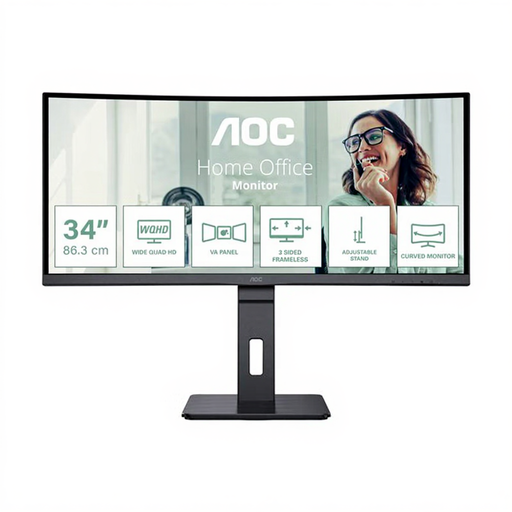
AOC Pro-line CU34P3CV 34-inch
The 34-inch UWQHD format offers a wide workspace, with KVM specified for switching between devices.
3440 × 1440 pixels, VA panel, 1500R curvature, 100 Hz, USB-C with up to 65 W Power Delivery, KVM and 150 mm height adjustment.
View at Joybuy
 No image available
Philips 345B1C 34-inch
The 3440 × 1440-pixel resolution offers a wide workspace for multiple views and windows.
VA panel, 1500R curvature, 100 Hz, MultiView PIP/PBP, USB hub and 180 mm height adjustment.
View at Joybuy
 No image available
GIGABYTE GS34WQCA 34-inch
The UWQHD resolution provides a wide workspace for side-by-side texture views.
3440 × 1440 pixels, VA panel, 1500R curvature, 120 Hz (OC 135 Hz), stated 95% DCI-P3 colour gamut coverage, plus height and tilt adjustment.
View at Joybuy
Frequently asked questions
Is a high monitor resolution enough to spot every seam in a texture?
No. Also check the zoom level, filtering and the 2D or 3D view you have selected. Adobe describes viewport settings in Substance 3D Painter that change how an image is displayed without changing the exported texture itself.
What should several people set up before checking colours together?
Use a consistent display workflow and check the monitor profile and display transform in the application. According to Adobe, base colours are colour-managed in Substance 3D Painter, while normal and height channels are not.
Which resolution is right for side-by-side views?
A 34-inch model with 3440 × 1440 pixels offers a wide workspace for multiple views; 39.7-inch models with 5120 × 2160 pixels provide more vertical pixels as well. What matters is whether the workspace is large enough at your usual scaling and with your preferred window layout.
What does the EU energy label tell you about a monitor?
The European Commission classifies computer monitors as electronic displays covered by the scheme. The label uses an A to G efficiency scale; when making a purchase, check the label for the specific model.


