An ultrawide monitor makes sense for checking fine texture seams by a bright window if its screen height and workspace suit the way you work, and you can keep distracting light under control. Look for a suitable colour mode and consistent image quality. A high brightness rating or wide colour gamut alone does not guarantee freedom from reflections or an even picture across the screen. Also check the surface finish, space available for the monitor and the specific model’s connections.
Who is an ultrawide monitor right for?
Checking texture seams by a window
If you assess fine transitions in changing daylight, plan the screen position and glare protection together. The German Social Accident Insurance (DGUV) and the Federal Institute for Occupational Safety and Health recommend arranging your workspace so the window is to the side and, where possible, parallel to your line of sight.
Comparing 3D views and textures
If you want to see the model, texture and tools at the same time, a wide workspace can be useful. For small seams, screen height and an appropriate zoom level matter too. Adobe Substance 3D Stager describes UV-based workflows as a way to edit seams precisely.
Assessing colour transitions in SDR
If you compare transitions across the whole screen, consider the right colour mode and how consistently the specific model displays images. PRAD’s tests and manufacturers’ colour gamut claims answer different questions; neither replaces checking image quality across the screen.
What should you look for when buying?
| Buying priority |
What to check |
Who is it particularly relevant to? |
| Window light and reflections |
Screen finish and positioning options; position yourself so your line of sight is as parallel to the window as possible. |
If I need to spot fine seams in changing daylight, I’ll plan the screen position and glare protection together. Around 33% of shoppers are likely to have this as their main priority. |
| Workspace for detail and screen height |
Native resolution and vertical pixel count; arrange views and tools in your own application. |
If I want to compare small seams alongside the model view and tools, I’ll look for enough screen height and room to place them side by side. Around 27% of shoppers are likely to prioritise this workspace for detail. |
| Colour and consistency |
Colour mode for your SDR output target and findings on consistency across the screen. |
If I assess colour transitions across the full width, I need a suitable colour mode and consistent image quality. Around 27% of shoppers are likely to have this as their main priority. |
| Connections and docking |
Check the connection type, video output and required charging power against your computer. |
If I regularly connect my laptop to a monitor, suitable video and power connections are important. Around 13% of shoppers are likely to prioritise docking. |
Common buying mistakes
-
Assuming a high brightness rating means good glare protection
Window light and reflections can make the screen harder to see, regardless of its stated brightness.
Before choosing a model, check the window’s position, the direction of the sun, the screen finish and whether you can adjust the blinds or other sun protection.
Depending on your workspace, you may need additional glare protection or a different monitor position.
-
Assuming an ultrawide screen gives you unlimited detail
A wide workspace gives you room for several views, but that alone says nothing about screen height. For example, the models considered here offer 1.440 or 1.600 vertical pixels.
Compare resolution and screen height, and check how textures and tools appear in your application.
-
Treating colour gamut coverage as a guarantee of consistent colour
Colour gamut coverage and consistency answer different questions. Modes can also vary on the same monitor. In its test of the ASUS PA34VCNV, PRAD is cautious about the sRGB mode and highlights the Rec.709 mode for video editing.
Check which mode suits your output target and look for independent findings on the specific model’s image uniformity.
Key brands to consider
ASUS
The ProArt range includes ultrawide models for creative SDR work. ASUS lists a resolution of 3.440 × 1.440 pixels and sRGB and Rec.709 modes for the PA34VCNV.
- Its features may suit you if you need room for a texture view, a 3D view and tools side by side.
- In its test of the PA34VCNV, PRAD notes limitations in sRGB mode and with HDR. This should not be taken as a general statement about other ASUS models.
Dell
According to Dell and PRAD, the UltraSharp U3425WE combines a 21:9 format with Thunderbolt docking.
- It could be a good option for a laptop workspace if docking matters as well as assessing images.
- PRAD notes limitations with monitor scaling on the U3425WE it tested. This does not necessarily apply to other Dell models.
EIZO
The FlexScan EV3895 is a larger office ultrawide option, with a 37,5-inch screen and 3.840 × 1.600 pixels.
- Its specifications list an sRGB mode, USB-C and automatic brightness control.
- These specifications do not guarantee a clear view in direct window light or that you’ll be able to assess seams effectively at your own workspace.
LG
The 34U650A-B is a 34-inch IPS ultrawide with 3.440 × 1.440 pixels; LG typically lists 99% sRGB.
- Factory colour calibration and HDR10 are listed as features of this model.
- Manufacturer claims do not guarantee consistent image quality on every unit or good visibility in direct window light.
Ultrawide monitors at Joybuy
This selection of ultrawide monitors at Joybuy includes options for comparing textures across multiple views, with different resolutions and, in some cases, details about colour or connections. Check how each model handles reflections and whether it can be positioned suitably in your workspace.
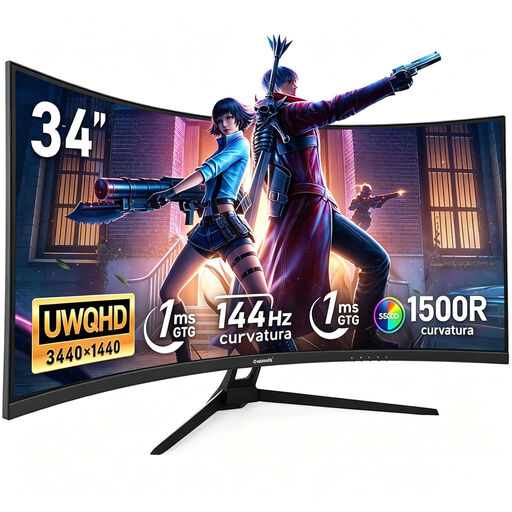 No image available
Gawfolk 34-inch Curved UWQHD Monitor
The wide workspace can help you arrange a texture view and other windows side by side.
34 inches, 21:9, 3.440 × 1.440 pixels, Fast-VA panel and 100% sRGB according to the product details.
View at Joybuy
 No image available
INNOCN E34A1R 34-inch Curved Monitor
If you want to adjust the screen position at your workspace, the listed height-adjustable stand is worth noting.
34 inches, 21:9, 3.440 × 1.440 pixels, VA panel, PIP/PBP and height-adjustable stand. The product description lists 90% DCI-P3.
View at Joybuy
 No image available
INNOCN 40C1U 40-inch Ultrawide Monitor
The stated extra screen height could be useful for texture details and additional work windows.
40 inches, 21:9, 5.120 × 2.160 pixels and IPS panel. The product details list a matt finish, 99% sRGB and DeltaE < 2; these figures do not guarantee consistency on every unit.
View at Joybuy
 No image available
MSI MAG 341CQPDE QD-OLED Monitor
The product details list a wide colour gamut. When choosing, also consider whether the monitor is suited to your intended use with static images.
34 inches, 21:9 and 3.440 × 1.440 pixels. The description lists 99,3% DCI-P3 and 10-bit colour depth. It warns that when displaying static images at maximum brightness for extended periods, you should not overlook the OLED protection features.
View at Joybuy
 No image available
ASUS TUF Gaming VG34VQ3B 34-inch Monitor
The listed matt finish and ergonomic stand are worth checking for a workspace near a window.
34 inches, 21:9, 3.440 × 1.440 pixels and VA panel. The product description lists 90% DCI-P3 and a matt finish.
View at Joybuy
Frequently asked questions
Can a bright monitor replace glare protection at the window?
No. A brightness rating alone doesn’t tell you that. The DGUV notes that glare and reflections can be problems at screen workstations near windows, and recommends measures including suitable positioning and adjustable sun protection.
How should I position my workspace to check seams?
Where possible, position yourself so your line of sight is parallel to the window, and check whether sun protection can reduce distracting light. The Federal Institute for Occupational Safety and Health recommends daylight coming from the side rather than having a window directly in front of or behind the screen.
Is a factory-calibrated colour mode enough for every texture check?
Not necessarily. Choose a mode that suits your output target and consider consistency across the screen. PRAD’s assessment of the ASUS PA34VCNV it tested varies between colour modes; manufacturers’ colour coverage claims are no substitute for checking this.
What ongoing costs can I compare before buying?
For the specific model, compare its energy consumption and efficiency rating on the EU energy label or in EPREL. An energy rating alone cannot tell you your personal cost in euros without knowing how long you’ll use the monitor and your electricity tariff.


