Choose an ultrawide monitor to suit your main task. For fine seams, vertical resolution and a suitable zoom level matter; for judging colour differences, you’ll need a colour workflow that’s properly matched to your output. A wide display is most useful when you want to view things side by side. Changing your monitor won’t fix errors in your texture data: the Blender Manual covers Texture Paint in the 3D Viewport and Image Editor, while Adobe Substance 3D Painter explains padding around UV islands. Also check that your desk, graphics output and cables support the resolution you want.
Who is an ultrawide monitor suited to?
Checking seam details
If you check small transitions on UV islands in both the texture and the 3D model, the usable resolution and a suitable zoom level are important. The Blender Manual covers Texture Paint in both the 3D Viewport and the Image Editor; Adobe Substance 3D Painter explains padding around UV islands.
Colour-critical texture work
If you need to assess colour differences as well as visible seams, match the colour space and colour mode to your output target and the rest of your colour workflow. Figures published by BenQ and ASUS apply to specific models and are manufacturer claims.
Multiple work windows at home
If you want the UV view, 3D preview and tools to stay visible at the same time, consider how you’ll arrange your windows and how much vertical resolution you actually need. Also check that the connections and dimensions suit your computer and workspace.
What should you look for when choosing one?
When checking texture and UV seams at home, first decide whether your main priority is viewing fine detail, assessing colour, working with multiple windows, connecting a laptop or fitting the monitor onto your desk.
| Criterion |
What to check before buying |
Who it matters most to |
| Spotting fine seams |
Match the native resolution, vertical pixel count and desired zoom level to your computer’s graphics output. |
If you need to assess small transitions at a particular zoom level, detail reproduction is key. Around 31% of consumers make fine seams their top priority. |
| Assessing colour differences |
Check the colour space, colour mode, calibration details and software settings for your own output workflow. |
If colour shifts at texture transitions matter, don’t base your whole decision on a single colour space figure. Around 25% of consumers prioritise colour differences. |
| Viewing UV and 3D side by side |
Plan your window layout and the viewing size you need; compare 21:9 and 32:9 by more than just screen size. |
If you want to see the UV view, 3D model and tools at the same time, you’ll need the right balance of width and vertical resolution. Around 19% of consumers make side-by-side views their top priority. |
| Connecting a laptop |
Check USB-C or Thunderbolt video support, the charging power you need, and the ports on both the monitor and laptop. |
If you want to connect your laptop to your workspace with one cable, video and power delivery need to be compatible. Around 13% of consumers make laptop connectivity their top priority. |
| Fitting it on your desk |
Check the dimensions of the case and stand, the space on your desk and any adjustment options. |
If your existing workspace limits the size or position of the display, its actual dimensions are what matter. Around 12% of consumers make desk placement their top priority. |
Common pitfalls when choosing a monitor
-
Assuming maximum width means maximum detail
A 32:9 display can offer plenty of horizontal workspace and still have a height of just 1440 pixels. Vertical resolution matters too when you’re checking fine transitions.
Compare the pixel height and a useful zoom level with the detail you need to see, rather than focusing only on width or screen size.
-
Taking a wide colour gamut as proof of accurate colour
Colour gamut and accuracy figures are manufacturer claims for specific models. On their own, they don’t prove that the whole colour workflow is right for your output target.
Set your output target and colour mode, then check the complete workflow, including software settings, if colour accuracy is critical.
-
Choosing OLED without checking how it handles static toolbars
ASUS notes that static, high-contrast images displayed for long periods can cause burn-in on OLED displays.
Check whether your usage suits the protection features and warranty terms of the specific model.
Monitor brands to consider
BenQ
The DesignVue PD3420Q is a flat 34-inch, 21:9 monitor designed for creative work.
- BenQ lists 100% sRGB and 98% DCI-P3 for this model, along with USB-C, a hub and KVM.
- These colour gamut figures are manufacturer claims and don’t replace matching the monitor to your specific colour workflow.
ASUS
The ProArt PA348CGV is a 34-inch IPS ultrawide with a resolution of 3440 × 1440 pixels and documented colour modes.
- ASUS lists 100% sRGB, 98% DCI-P3, ΔE ≤ 2 and 90 W USB-C for this model.
- ASUS notes that specifications may vary by country, so check the model and version on offer.
Dell
The UltraSharp U3425WE is a curved 34.1-inch IPS Black monitor with hub features for working across multiple windows.
- Dell lists a resolution of 3440 × 1440 pixels at 120 Hz, plus a Thunderbolt hub and 90 W power delivery.
- For a colour-critical workflow, check the colour modes of the specific device too.
LG
The UltraWide models listed differ in aspect ratio and pixel height: the 34U650A-B offers 3440 × 1440 pixels, while the 40WP95XP-W offers 5120 × 2160 pixels.
- LG typically lists 99% sRGB and factory calibration for the 34U650A-B; the 40WP95XP-W offers additional pixel height.
- These figures relate to different models and shouldn’t be combined as if they were features of one monitor.
Lenovo
The ThinkVision P49w-30 is a 49-inch 32:9 docking monitor for those who prioritise horizontal workspace.
- Lenovo lists a resolution of 5120 × 1440 pixels, IPS Black and Thunderbolt 4.
- The resolution gives you 1440 vertical pixels, and the wide display needs enough space on your desk.
Joybuy monitors for texture and UV work
The models below range from 34-inch formats with 3440 × 1440 pixels to 40-inch 5K2K and 49-inch 32:9 displays. When checking seams, pay particular attention to the vertical pixel count, window layout and desk space you’ll need.
 No image available
INNOCN 40C1U 40-inch 5K2K monitor
If extra pixel height matters for fine detail and working across multiple windows, this 21:9 format is worth considering.
Listed specifications include 5120 × 2160 pixels, IPS, 100 Hz and USB-C with 65 W Power Delivery. Check that your computer’s graphics output supports the resolution you want.
View at Joybuy
 No image available
CRUA 49-inch DQHD monitor
If you want to keep lots of windows open side by side and have enough desk space, this model offers a wide 32:9 format.
Listed specifications include 5120 × 1440 pixels, a curved display and 165 Hz. The resolution gives you 1440 vertical pixels; if you need more pixel height, compare it with a model offering 5120 × 2160 pixels.
View at Joybuy
 No image available
INNOCN E34A1R 34-inch ultrawide monitor
If you want to check a texture and 3D model on one wide display, compare the stated resolution and side-by-side views with your workflow.
Listed specifications include 3440 × 1440 pixels, a VA panel, 21:9 and PIP/PBP. The resolution gives you 1440 vertical pixels.
View at Joybuy
 No image available
Xiaomi G34WQi 34-inch ultrawide monitor
If a side-by-side workspace is all you need, compare this 21:9 format with the level of detail you need to see.
Listed specifications include 3440 × 1440 pixels, a VA panel and 180 Hz. The product details also state 100% sRGB; check how that fits with your colour workflow.
View at Joybuy
 No image available
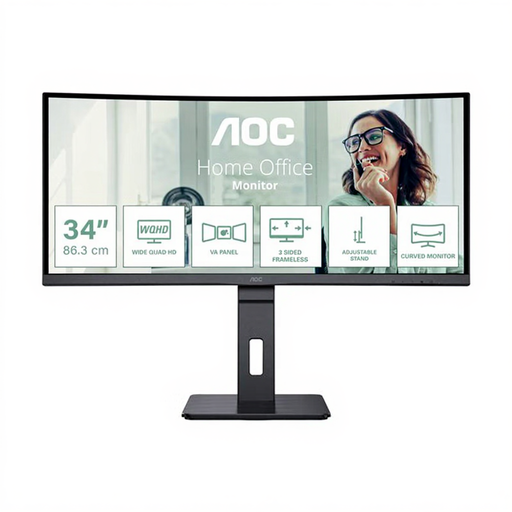
AOC Pro-Line CU34P3CV 34-inch ultrawide monitor
If you want to work with multiple windows side by side and connect a laptop at your desk, check the resolution and ports together.
Listed specifications include 3440 × 1440 pixels, a VA panel and 100 Hz. USB-C with 65 W, KVM, RJ45 and a USB hub are also listed; check that the connection suits your laptop.
View at Joybuy
Frequently asked questions
Will a sharper monitor remove texture seams?
No. A higher resolution can make it easier to inspect your textures, but it won’t change the texture data. If you can see edges, also check the UV islands and padding or bleed in the software you’re using.
What should I check when connecting a laptop?
Match your laptop’s video output to the monitor resolution you want. If you’re connecting it with one cable, also check the charging power required. A USB-C connector alone doesn’t confirm that video output is compatible or that enough power is supplied.
How do I compare monitor energy consumption?
Compare the EU energy label and product information for the specific models. The European Commission describes an A-to-G efficiency scale for electronic displays, with additional information on operation with HDR. Running costs also depend on how you use the monitor and your electricity tariff.
What are my rights when buying a monitor online in Germany?
For a standard online purchase from a business seller, you generally have 14 days from delivery to cancel your order; exceptions and any return postage costs should be considered. If the goods are faulty, you have a statutory minimum warranty period of two years against the seller. An additional manufacturer’s warranty does not replace these rights.
Do workplace screen regulations automatically apply to my home desk?
No. The Federal Institute for Occupational Safety and Health describes the scope of ASR A6 as covering workplaces and teleworking workplaces; screen use at home outside teleworking workplaces is excluded. Whether a particular home workspace falls within its scope depends on how it is classified in practice.


