Students doing colour-critical editing
If you compare colour variations, match the colour gamut and colour management workflow to your output format. EIZO Germany explains why a monitor’s limitations can’t be fixed through calibration.


For regular colour editing, an ultrawide monitor should suit your output format and colour management workflow. Extra screen space alone won’t make colours reliable to judge. EIZO Germany points out that calibration cannot compensate for a limited colour gamut or panel uniformity issues. So also check the actual dimensions, including the stand, as well as your laptop’s video output and charging requirements.
If you compare colour variations, match the colour gamut and colour management workflow to your output format. EIZO Germany explains why a monitor’s limitations can’t be fixed through calibration.
If you want to see previews, variations and tools at the same time, a wide display can make it easier to arrange several windows. Also check that the screen and stand will fit on your desk.
If you regularly connect your laptop, its video output and charging requirements must be compatible with the monitor. USB-C alone doesn’t tell you whether both functions will work together.
First decide which output format you’ll be judging colours for. Then compare the workspace on screen with the desk space required, and check which laptop connections you actually need.
| What matters | What to look for | Who it matters most to |
|---|---|---|
| Judging colours accurately | Check the output colour gamut, suitable colour modes and profiling together; don’t treat the manufacturer’s specifications as a measurement of the individual unit. | If I’m judging colour variations for a specific output format, I need suitable modes and a clear, reliable workflow. Around 28 % of consumers put colour judgement first. |
| Seeing variations and tools at the same time | Compare the native resolution with the window layout you’ll actually use. BenQ Europe lists 3,440 × 1,440 pixels for the PD3420Q, as does AOC Germany for the CU34P3CV. | If I need previews and tool panels side by side, usable pixel space matters. Around 22 % of consumers prioritise viewing several editing windows at once. |
| Desk space in your room | Compare the available desk width and depth with the model’s dimensions, including the stand. BenQ Europe lists a width of 825.8 mm and a depth of 244.3 mm with the stand for the PD3420Q; these dimensions don’t apply to other models. | If I share a limited desk with my laptop and study materials, the monitor and stand need to fit in the available space. Around 17 % of consumers prioritise the space it takes up. |
| Connecting and charging a laptop | Check your laptop’s video output and the charging power you need. BenQ Europe lists USB-C with DisplayPort Alt Mode and 65 W Power Delivery for the PD3420Q; AOC Germany lists up to 65 W for the CU34P3CV. | If I want to connect my laptop, monitor and, where needed, peripherals, the functions must be compatible across both devices. Around 17 % of consumers prioritise laptop connectivity and charging. |
| Energy use and purchase protection | Check the product label and energy consumption information for the specific model. Distinguish a voluntary guarantee from your statutory rights against the seller. | If I’m considering running costs and purchase protection, I check both for the specific offer. Around 16 % of consumers put these considerations first. |
A high stated colour gamut coverage doesn’t prove that every colour variation will be displayed accurately, or that the monitor is suitable for every output format. EIZO Germany also points out that calibration can’t fix a limited colour gamut or panel uniformity issues.
Decide on your output format, then consider colour gamut, colour modes and profiling together.
A suitable colour management workflow can involve extra set-up and may require the right equipment.
Even if the screen size seems right, a monitor may be too wide or, with the stand, too deep for your desk.
Measure the space available and compare it with the specific model’s width and depth, including the stand.
The monitor’s connection must be compatible with your laptop’s video output and power requirements.
Check the supported video mode and charging power required by both devices before planning to connect them with a single cable.
The DesignVue range includes the flat 34-inch PD3420Q ultrawide monitor, designed for creative workflows.
The ProArt range includes the slightly curved 34.1-inch PA34VCNV, a monitor with a creative focus and docking features.
The Pro-Line range includes the 34-inch CU34P3CV ultrawide monitor, with a curved display and laptop docking.
The FlexScan EV3450XC is a 34.1-inch ultrawide monitor with office, docking and conferencing features.
The UltraSharp range includes the curved 34-inch U3425WE, with a Thunderbolt hub.
This selection features ultrawide monitors for editing windows side by side. Consider stated colour gamut figures in relation to your output format, and don’t treat them as proof of colour accuracy on the individual unit.
 No image available
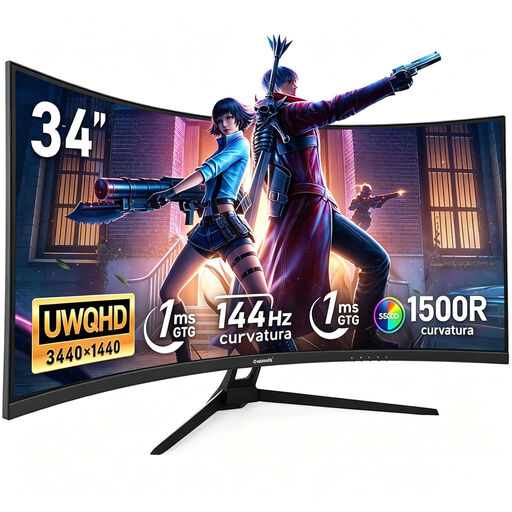
The 34-inch format is designed to provide a wide workspace for editing windows side by side.
The product specifications list 3,440 × 1,440 pixels, 144 Hz and 100 % sRGB. Colour gamut coverage alone doesn’t prove accurate display on the individual unit.
 No image available
The 34-inch ultrawide format can provide space for several editing windows side by side. Measure your desk first to make sure it fits.
The product specifications list 3,440 × 1,440 pixels, a VA panel and 1500R curvature. An adjustable tilt angle is also listed.
 No image available
The 49-inch format offers an especially wide workspace. Check carefully that the display and stand will fit on your desk.
The product specifications list 5,120 × 1,440 pixels, a 32:9 format and 120 % sRGB. The colour gamut figure isn’t a substitute for checking the display on the individual unit.
 No image available
The 34-inch format is designed to provide a wide workspace for multiple windows.
The specifications list 3,440 × 1,440 pixels and PIP and PBP modes for picture signals from two sources. A height-, tilt- and swivel-adjustable stand is also listed.
 No image available
The higher stated resolution could make this a good option for a wide workspace with several editing windows. Check the space it needs before choosing.
The product specifications list an IPS panel, 5,120 × 2,160 pixels, 99 % sRGB, 87 % Adobe RGB and USB-C Power Delivery with 65 W. Delta E < 2 is also listed. These specifications aren’t an independent measurement of the individual unit.
No. Colour gamut coverage doesn’t describe the entire colour management workflow. EIZO Germany points out that calibration can’t overcome a limited colour gamut or panel uniformity issues. So choose a monitor to suit your output format and set up the display accordingly.
Compare the available width and depth with the dimensions of the specific monitor, including the stand. BenQ Europe lists 825.8 × 244.3 mm for the PD3420Q, measuring width × depth with the stand; don’t apply these figures to other models.
That depends on whether the monitor’s video output and charging power are compatible with your laptop. Check the supported features on both devices before planning a single-cable connection.
The European Commission includes electronic displays, including computer monitors, within its scope. Check the label and product information for the specific model.
For a distance sale covered by the rules, you generally have a 14-day right to cancel; exceptions and the specific terms of the contract may apply. If goods are faulty, you have statutory rights against the seller. The EU’s Your Europe portal distinguishes these rights from a voluntary manufacturer’s guarantee.