First, measure the usable width and depth of your desk, then compare these with the monitor’s overall dimensions, including its stand. Screen size alone won’t tell you whether it will fit. For vector graphics, you’ll also need a colour space suited to your output and an appropriate colour-management workflow. The wide format gives you room for your design and references, but it also takes up more desk space.
Who is an ultrawide monitor suitable for?
Creatives with limited desk space
If your desk has little room to spare, compare the monitor’s width and stand depth with the space you actually have available. The Federal Institute for Occupational Safety and Health covers the design of computer workstations, while ASUS publishes the dimensions of the PA348CGV, including its stand.
Those checking colour variations
If you assess digital designs or print-ready artwork, your output requirements and suitable colour management matter more than a single colour gamut figure. Adobe explains the role of colour profiles, while BenQ and ASUS list colour gamut coverage for specific models.
Creatives using a laptop setup
If you need your canvas and references side by side and want to use as few cables as possible, check the ports and charging requirements of your specific laptop. LG, Dell and EIZO list different connectivity and docking features on selected models.
What should you look for when buying?
When choosing a monitor for vector graphics on a small desk, first check how much space it will take up. Then weigh up colour workflow, window layout and laptop connectivity to suit the way you work.
| Consideration |
What to look for when buying |
Who will find this especially important? |
| Desk space |
Measure the available width and depth; check the dimensions including the stand, as well as any mounting option for the specific model. |
If my desk is small, I want to know whether the monitor and input devices will fit together. Around 36% of consumers put how well it fits on their desk first. |
| Assessing colour |
Compare your output requirements with the colour gamut coverage of the specific model; for more demanding checks, consider profiling or calibration. |
If I need to assess colour variations reliably, I’ll choose a monitor based on my output requirements and a suitable monitor profile. Around 29% of consumers put colour assessment first. |
| Design and references |
Compare the resolution and desired display size with the software you use and your preferred window layout. |
If I want to see my tools and references alongside my design, extra horizontal workspace is my main priority. Around 21% of consumers prioritise side-by-side views. |
| Laptop connectivity |
Compare video transmission, data functions, cables and required charging power with the specifications of your laptop and monitor. |
If I want to use my laptop with as few cables as possible, the connection needs to support the display, peripherals and power supply I need. Around 14% of consumers put easy laptop connectivity first. |
Common buying decisions that can backfire
-
Choosing by screen size alone
The screen diagonal doesn’t tell you how much desk space the monitor and stand will take up. ASUS lists the flat ProArt PA348CGV as 81,76 cm wide and 24,50 cm deep, including its stand.
Measure the space available on your desk and compare it with the overall dimensions of the specific model, including its stand, before buying.
You may also need a compatible mount that works with both the monitor and your desk.
-
Assuming colour gamut coverage guarantees colour accuracy
A colour gamut figure alone doesn’t tell you how the display will reproduce colours for your output requirements. The monitor profile and working environment also affect how you assess colour.
Start by defining your output requirements. For more demanding colour checks, you should profile the specific monitor under your usual working conditions.
More accurate profiling may require a measuring device and extra time.
-
Assuming USB-C automatically means a one-cable setup
Whether a monitor can deliver a display signal, data and enough power through one connection depends on the features of your specific laptop port and its charging requirements.
Check video transmission, data functions, cables and the power you need against the specifications of both devices.
Depending on your laptop, you may need extra cables or a separate power supply.
Notable brands and their approaches
ASUS
The flat ProArt PA348CGV is a 34-inch model designed for graphic work.
- ASUS lists a resolution of 3440 × 1440 pixels, along with 100% sRGB and 98% DCI-P3 coverage for this model.
- ASUS lists the dimensions with the stand as 81,76 × 56,89 × 24,50 cm. Colour gamut coverage is no substitute for checking colour management; compare the monitor’s footprint with your desk.
BenQ
The flat DesignVue PD3420Q is designed for graphic workflows.
- BenQ lists 100% sRGB, 98% DCI-P3, USB-C, a hub and KVM for the PD3420Q.
- Manufacturer specifications aren’t an independent test and don’t prove colour-accurate reproduction. Also check the monitor’s footprint against your desk.
LG
The curved UltraWide 34U650A-B offers a wide format for viewing multiple windows.
- LG lists a resolution of 3440 × 1440 pixels, an IPS panel and 99% sRGB (typical) for this model.
- Whether a curved screen suits your layout checks depends on your workflow. The sRGB figure alone doesn’t prove colour-accurate reproduction.
Dell
The curved UltraSharp U3425WE is a docking option for a laptop setup.
- Dell lists a resolution of 3440 × 1440 pixels, IPS Black and 90 W power delivery.
- The features don’t answer the question of whether it will fit. Check that your laptop supports the required display signal and charging power through the intended connection.
EIZO
The curved FlexScan EV3451X combines an ultrawide format with docking features.
- EIZO promotes USB-C docking, KVM, 94 W Power Delivery and a seven-year manufacturer’s warranty for this model.
- These specifications apply to this specific model and don’t prove that it will fit your desk or be compatible with every laptop.
Joybuy models for wide workspaces
The Joybuy models below include flat and curved ultrawide options, with different connections and colour gamut specifications. If you have a small desk, check the footprint of the specific model and make sure its connections suit your workflow.
 No image available
INNOCN 40C1U, 40-inch 5K monitor
The flat 40-inch model provides a wide workspace for your design and other views; check the space it will take up first.
5K resolution with 5120 × 2160 pixels, IPS and a 21:9 format. It also lists 99% sRGB, 87% Adobe RGB, USB-C with 65 W Power Delivery, plus PIP and PBP.
The dimensions with the stand are 944,1 × 573,5 × 241,1 mm, so compare them with the desk space available.
View at Joybuy
 No image available
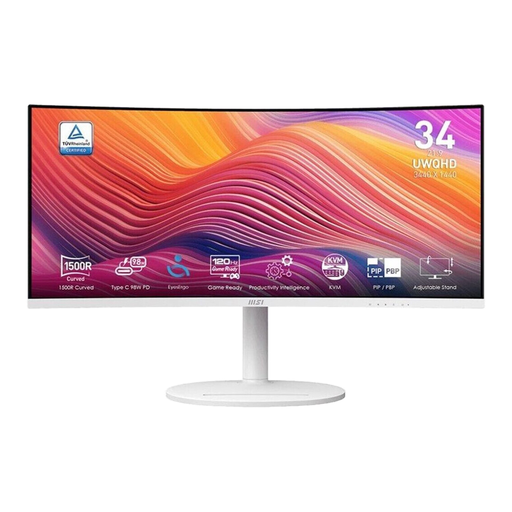
MSI Modern MD342CQPWDE, 34-inch UWQHD curved monitor
The curved 21:9 format is an option if you want to arrange your design and other windows side by side.
3440 × 1440 pixels, VA display, HDMI, DisplayPort and two USB 3.0 ports.
Tilt adjustment and VESA 100 × 100 mm are listed for mounting.
View at Joybuy
 No image available
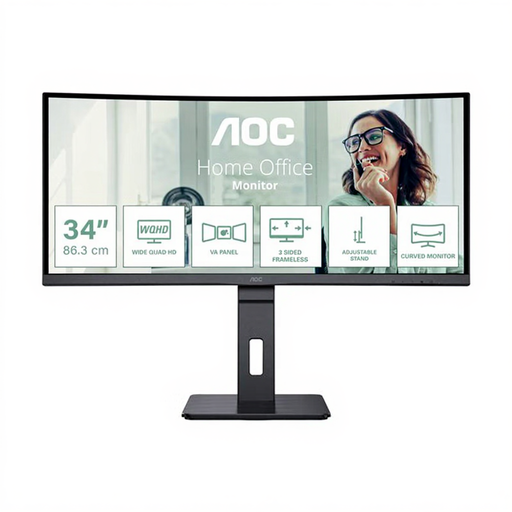
AOC Pro-line CU34P3CV, 34-inch curved ultrawide monitor
This model combines a wide workspace with connectivity features for a laptop setup; check compatibility with your computer.
UWQHD with 3440 × 1440 pixels and a 21:9 format. It lists USB-C with up to 65 W Power Delivery, KVM, a USB hub and Gigabit Ethernet.
The stand is height-adjustable by 150 mm.
View at Joybuy
 No image available
Philips 345B1C, 34-inch curved ultrawide monitor
The wide view can fit your design and references side by side; the layout you can achieve depends on your software and preferred display size.
3440 × 1440 pixels, a 21:9 format and a USB hub with HDMI and DisplayPort connections. PIP and PBP are listed for multiple sources.
The stand is height-adjustable by 180 mm.
View at Joybuy
 No image available
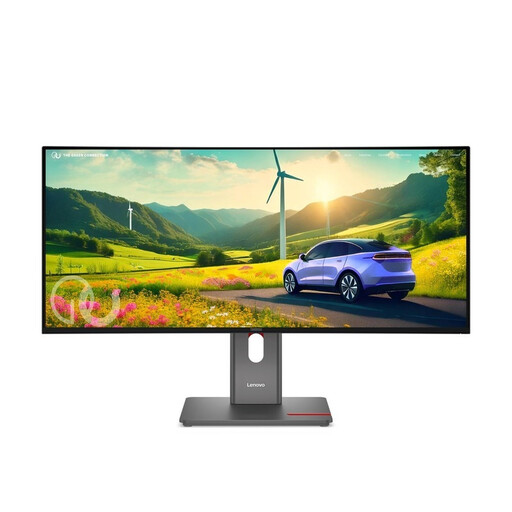
Lenovo ThinkVision P34WD-40, 34-inch WQHD IPS monitor
If you want to pair wide views with a laptop dock, compare your laptop’s connection and charging requirements with this model.
3440 × 1440 pixels in a 21:9 format, IPS, with listed coverage of 98% DCI-P3 and 99% sRGB. USB-C with up to 140 W Power Delivery is specified.
The dimensions with the stand are 817,1 × 548,8 × 220 mm. Colour gamut figures alone don’t prove colour-accurate reproduction.
View at Joybuy
Frequently asked questions
Is a figure such as 99% sRGB enough to approve colours reliably?
No. Colour gamut coverage alone doesn’t describe how colours will actually be reproduced. Clarify your output requirements and, for more demanding colour checks, consider a suitable monitor profile or profiling; Adobe explains the role of colour profiles.
What should I check first when setting up on a small desk?
Measure the available desk space and compare it with the dimensions including the stand. Then check whether you can position the monitor and input devices suitably. For workplace computer stations, the Federal Institute for Occupational Safety and Health sets out design requirements in ASR A6; these don’t apply universally to personal use.
How can I keep colour assessments consistent when checking regularly?
Keep lighting conditions as similar as possible when making comparisons. If you need objectively accurate colours, check the monitor profile with a suitable measuring device. Adobe describes calibration and profiling as separate steps.
What ongoing costs and rights should I consider when buying?
Compare power consumption using the energy label for the specific monitor; the European Commission lists electronic displays such as monitors among products with an energy label. When you buy online as a consumer, you generally have a 14-day right to cancel. The Verbraucherzentrale distinguishes the statutory warranty against the seller from a voluntary manufacturer’s guarantee.


