
Lieferung heute & morgen

Qualitätsgarantie

Willkommens-Angebote freischalten: KOSTENLOSE Lieferung | Bis zu 80 % RABATT | Kostenlose 30-Tage-JoyPlus-Testphase
App herunterladen
Dark corners in the kitchen, cluttered wardrobes, or poorly lit hallways are common everyday annoyances. An LED under-cabinet light with a motion sensor promises a simple and effective solution: light exactly when it's needed, without flipping a switch or performing complex electrical work. However, the market is flooded with products whose real-world performance often falls short of their marketing claims.
As your Joybuy Product Recommendation Officer, I'll help you identify the crucial features and avoid typical bad buys. This guide focuses on the technical facts that truly matter.
Many products look identical at first glance, but the differences are in the details. Pay attention to these three points to avoid disappointment:
To avoid the problems mentioned above, you should check three technical aspects before buying. These define the real-world usability and longevity of your lighting solution.
The runtime of a wireless light depends directly on its battery capacity. A higher mAh value generally means a longer operating time between charges.
A good motion detector combines two technologies: a PIR (Passive Infrared) sensor for motion detection and a dusk sensor.
The right lighting mood is crucial for the intended application, whether it's for wardrobe lighting or display cabinet lighting.
Based on the criteria above, we have identified some products that are suitable for different user profiles.

Why this product is a match: This 2-pack is a cost-effective solution for a first-time setup or for illuminating smaller areas like drawers, shoe cabinets, or small compartments. The compact 20 cm size is highly versatile.
With a solid 800mAh battery capacity per light, it offers reliable runtime. The three selectable colour temperatures (Warm, Neutral, and Cool White) prevent the problem of unsuitable light quality.
The ultra-slim design (10 mm height) and simple adhesive mounting allow for a discreet, tool-free installation. The 2-pack offers excellent value for money.
Why this product is a match: Ideal for longer kitchen worktops, large wardrobes, or hallways. The 30 cm length ensures broader, more even illumination, while the larger battery meets the demands of frequent use.
The 1100mAh battery capacity directly addresses the weak point of many competing products. The specified PIR sensor with a 3-5 metre range and 41 LEDs provide reliable and bright illumination.
The combination of a larger battery capacity and higher luminosity (from more LEDs) ensures longer runtime and better illumination, significantly extending the intervals between charges.
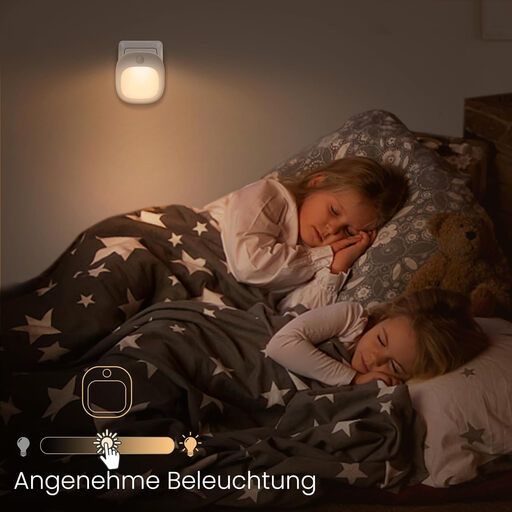
Why this product is a match: This compact, round night light is not a strip but a portable solution. It's perfect for bedside tables, as a guide light in the hallway, or in a nursery where a fixed installation is not desired.
It offers 5-level dimming and three colour temperatures, allowing for precise control over light quality. The dual operating mode (sensor or always-on) gives the user full control and prevents sensor-related frustration.
The compact, freestanding design requires no installation at all. It can be placed anywhere and moved as needed. The CRI value of >85 ensures natural colour rendering.
We have compiled a complete, up-to-date list of products that fully meet these strict selection criteria and rigorous safety standards.
The battery life heavily depends on the battery capacity (mAh) and the frequency of use. A model with 800-1100 mAh, activated about 10 times a day for 20 seconds, can last for several weeks to months. In continuous operation ("ON" mode), the runtime is limited to a few hours.
Most models are designed for tool-free installation. They typically come with a magnetic strip that has a self-adhesive backing. You stick the strip to the desired location (e.g., under a wall cabinet), and the light attaches to it magnetically. This allows for easy removal for recharging.
High-quality models have an integrated dusk sensor (often called a LUX sensor). This prevents the light from turning on in sufficient ambient light, even when motion is detected. This is an important feature for saving energy and avoiding unnecessary activation. Check the product description to see if such a sensor is included.