
Lieferung heute & morgen

Qualitätsgarantie

Willkommens-Angebote freischalten: KOSTENLOSE Lieferung | Bis zu 80 % RABATT | Kostenlose 30-Tage-JoyPlus-Testphase
App herunterladen
Integrating more movement into the workday is a common goal for many who work from home or in an office. An under-desk treadmill, often called a walking pad, seems like an ideal solution. However, the market is flooded with devices whose marketing promises often fall short in practice. Before you make a decision, it's crucial to understand the common pitfalls that lead to disappointment and an unused device collecting dust in a corner.
Many buyers report three central problems:
This guide will help you navigate these pitfalls and find a device that truly meets the demands of your workday.
To find the right under-desk treadmill, let objective technical specifications—not marketing buzzwords—guide your decision. Three factors are non-negotiable.
The motor's power and type are the primary determinants of noise level and durability. Look for models with a brushless motor. These are significantly quieter and require less maintenance than conventional brushed motors. A meaningful noise level specification should be under 60 decibels (dB) under load—roughly equivalent to a normal conversation and acceptable for a work environment. A quiet treadmill is essential for staying focused and participating in meetings.
The stated maximum weight capacity is a key indicator of the device's stability. A solid rule of thumb is to choose a model with a maximum weight capacity at least 15-20 kg (33-44 lbs) above your own body weight. This ensures the motor and frame aren't constantly operating at their performance limit, which significantly extends the treadmill's lifespan. A frame made of alloy steel generally offers greater stability and durability than purely plastic constructions.
It's easy to call a treadmill foldable. The real question is how practical the mechanism is for daily use. Check the folded dimensions. A height of under 15 cm (approx. 6 inches) generally allows the device to be stored easily under most sofas or beds. Integrated transport wheels are essential for moving the often 20-30 kg (44-66 lbs) mini-treadmill without significant effort.
Based on these objective criteria, we have curated a selection of devices suitable for various user profiles in a home office setting.
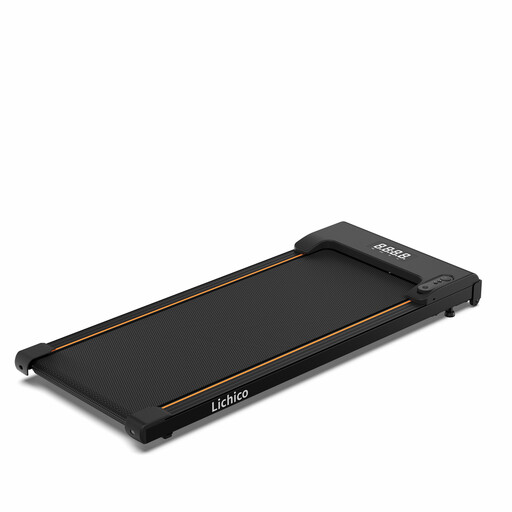
Why This Fits Their Persona: Ideal for users seeking a straightforward, space-saving solution for more movement while working. It focuses on core functions without complex extra features and is ready to use out of the box.
The 2.5 HP brushless motor ensures quiet operation. Its solid weight capacity of 130 kg (approx. 286 lbs) and compact design with transport wheels address the most common weaknesses of budget models.
No assembly required, ready to use immediately. The dual cushioning system is easy on the joints, which is important for extended walking sessions.
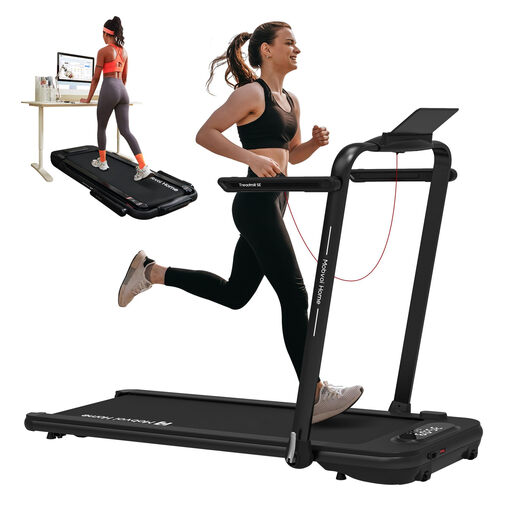
Why This Fits Their Persona: Perfect for anyone who wants more than just walking. This device combines the function of a walking pad with that of a full-fledged treadmill for jogging sessions and offers smart features for workout management.
With a noise level of under 60 dB (according to the manufacturer), it remains office-friendly even at higher speeds. The slim folding design (approx. 13 cm / 5.1 in height) makes it easy to store despite its expanded functionality.
3-in-1 functionality (walking, jogging, and running up to 12 km/h or 7.5 mph). The connection to the TicSports App with AI coaching and virtual routes provides extra motivation.

Why This Fits Their Persona: For users who want to vary and intensify their workouts without increasing speed. The incline function is ideal for boosting calorie burn and targeting different muscle groups.
This model avoids the plateau of walk-only workouts. The high weight capacity of 130 kg (ca. 286 lbs) provides a sturdy base that remains stable even when using the incline feature.
The key differentiator is the 9% incline function, a rarity in compact under-desk devices. This allows for a more challenging workout for the cardiovascular system and leg muscles.
We have compiled a complete, up-to-date list of products that fully meet these strict selection criteria and all applicable safety regulations.
Yes, it's possible for many users, but it requires a short adjustment period. Start at a low speed (1-2 km/h or 0.6-1.2 mph) for tasks requiring high concentration, like writing or reading. For phone calls or video conferences without intense interaction, the speed can often be comfortably increased to 3-4 km/h (1.8-2.5 mph). It's a personal preference that develops over time.
Maintenance is generally minimal. The most important steps are:
Power consumption is relatively low. A typical walking pad uses about 200-400 watts at a walking speed of 3-4 km/h (1.8-2.5 mph). With two hours of daily use on 20 workdays a month and an electricity price of 30 cents/kWh, the monthly electricity costs would only amount to a few dollars. The exact consumption depends on the motor type, speed, and the user's weight.