
Lieferung heute & morgen

Qualitätsgarantie

Willkommens-Angebote freischalten: KOSTENLOSE Lieferung | Bis zu 80 % RABATT | Kostenlose 30-Tage-JoyPlus-Testphase
App herunterladen
As a Joybuy Product Recommendation Officer, I analyse market data to provide you with objective, practical buying advice. The goal is to help you see through marketing hype and make the right choice.
The desire to integrate more movement into a sedentary workday leads many to an under-desk treadmill. But the market is flooded with devices whose promises often don't hold up in practice. Before you make a decision, you should know the three most common pitfalls that lead to disappointment and an unused machine in the corner.
To avoid a bad purchase, focus on the technical fundamentals. These three parameters determine the quality and longevity of your device.
Motor power, specified in horsepower (HP), is an indicator of load capacity and smoothness. A motor with a continuous-duty rating of 2.5 HP is a solid foundation for a quiet treadmill for apartments. It ensures smooth and quiet operation even at slow walking speeds, without overheating or becoming loud. Pay attention to the continuous-duty rating, not the often-advertised, higher peak horsepower, as the former reflects performance in everyday use.
For a treadmill for under a desk, the deck height is crucial. A good walking pad should not exceed a height of under 16 cm, so it can easily fit under most height-adjustable desks without your knees hitting the tabletop. Also, check the overall length and width to ensure you can easily store the device when not in use, for example, under a sofa or bed.
A walking pad with an incline offers significant added value. A fixed or manually adjustable incline increases the training intensity without you having to increase your speed. This is ideal for walking while working, as you can boost your calorie burn and muscle activation (especially in the calves and glutes) while still being able to concentrate on your tasks. Even a fixed incline of 9% simulates a gentle uphill walk and makes the workout significantly more effective.
Based on these objective criteria, we have identified products that are suitable for specific user profiles.
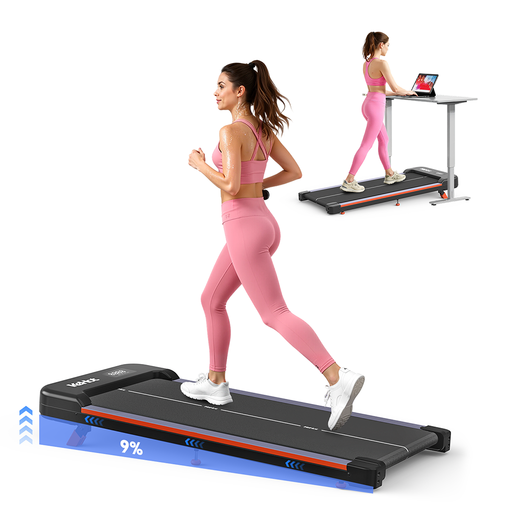
Why This Fits Their Persona: Ideal for users looking for a dedicated walking pad for use under a desk. The focus is on a compact design and an effective workout at low speeds.
Its very low deck height of 15 cm and the 2.5 HP motor optimised for walking speeds (1–6 km/h) avoid the pitfalls of instability and noise in a compact size.
The fixed 9% incline provides an intense walking workout. Compatibility with apps like Zwift and Kinomap is a useful extra for workout tracking.
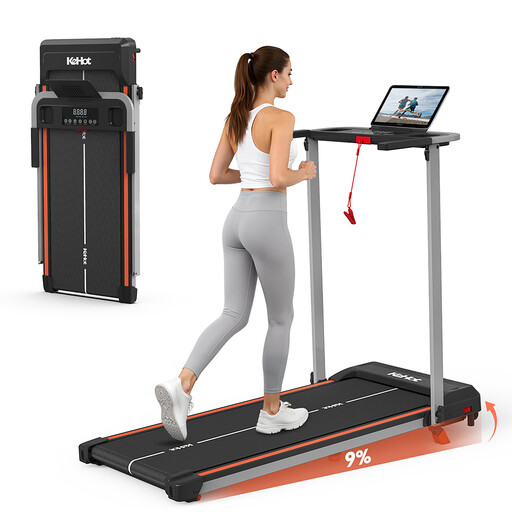
Why This Fits Their Persona: Suitable for users who want a versatile machine for the home office that allows for both slow walking during work and light jogging during leisure time.
The sturdy construction is designed for speeds up to 12 km/h and a maximum weight capacity of 150 kg, which avoids the stability trap. The foldable design solves the space problem.
The combination of a 1–12 km/h speed range and a 9% incline offers great flexibility for various training goals. The larger running surface (38 × 100 cm) increases comfort.
We have compiled a complete, up-to-date list of products that meet these strict selection criteria and safety standards.
The actual noise level depends on the motor design, speed, user weight, and cushioning. A high-quality, quiet treadmill for apartments should not exceed a noise level of 60 decibels (dB) during operation at walking speed. This is comparable to a normal conversation or a quiet office and should not interfere with phone calls.
A walking pad with an incline is not strictly necessary, but it is highly recommended. The incline significantly increases the intensity of the workout and calorie burn without requiring you to walk faster. This is particularly beneficial if you are walking while working and need to concentrate. Additionally, the incline targets additional muscle groups more intensely, such as the glutes and hamstrings.
Maintenance is straightforward but important. Keep the running deck clean and free of dust. Regularly check the tension of the running belt. The most important thing is to lubricate the running deck with silicone oil as specified by the manufacturer (usually every 30 to 50 hours of operation). This reduces friction, protects the motor, and ensures quiet, long-lasting operation.