
Lieferung heute & morgen

Qualitätsgarantie

Willkommens-Angebote freischalten: KOSTENLOSE Lieferung | Bis zu 80 % RABATT | Kostenlose 30-Tage-JoyPlus-Testphase
App herunterladen
An under-sink cabinet is a smart solution for keeping your bathroom tidy. It not only creates valuable storage space for towels and cleaning supplies but also conceals unsightly water pipes and the P-trap. However, the sheer number of options can quickly become overwhelming. Before you make a decision, you should be aware of the three most common pitfalls that can lead to a bad purchase.
The Fit Mistake: Ignored Measurements and Incorrect P-Trap Cutout A common problem is a cabinet that doesn't fit under the sink. Many buyers only measure the width, forgetting the depth and the exact position of the P-trap. An ill-fitting P-trap cutout will render the cabinet useless or require cumbersome modifications.
The Material Mistake: Swelling Particleboard from Moisture The bathroom is the most humid room in the house. A bathroom vanity unit made from unsealed or low-quality engineered wood can quickly swell, warp, and grow mould. A water-resistant surface is therefore not an option, but a necessity.
The Stability Mistake: Wobbly Construction and Low Load Capacity Some models look appealing but turn out to be unstable. If the cabinet cannot safely support heavy cleaning bottles or a supply of towels, it quickly loses its practical use and can even become a safety hazard.
To avoid these mistakes, you should check three key parameters before buying. These will help you find a functional and long-lasting cabinet for your sink.
The material is crucial for moisture resistance. Look for the following features:
Measure carefully before you buy. Note down three values:
Consider what you want to store. The internal layout determines the cabinet's practical utility.
Based on these criteria, we have identified several models suitable for different needs and bathroom layouts.
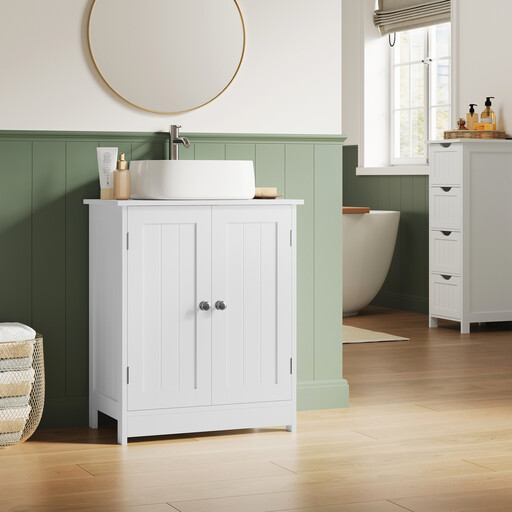
Why It's a Good Fit: Ideal for renters or homeowners looking for a straightforward, space-saving solution for smaller bathrooms. The simple design and compact 50 cm width fit well even in tight spaces.
The UV lacquer finish protects the MDF boards from moisture and prevents swelling (avoids the Material Mistake). The adjustable shelf allows for flexible use of the limited space.
Compact dimensions for small bathrooms; 180° hinges for easy access.
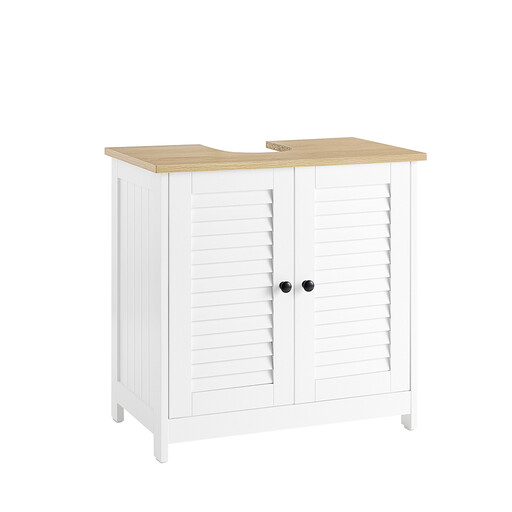
Why It's a Good Fit: Perfect for users who appreciate a mix of practical storage and thoughtful design. The adjustable shelves adapt flexibly to both tall bottles and flat towels.
The louvered doors promote air circulation, reducing moisture and odour build-up inside the cabinet (avoids the Material Mistake from trapped moisture). The sturdy E1-MDF construction supports up to 25 kg, according to the manufacturer.
Louvered doors for better ventilation; adjustable shelves for flexible storage use.
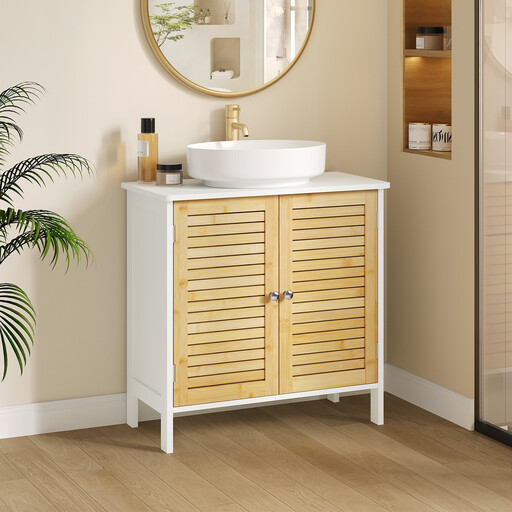
Why It's a Good Fit: Appeals to users who want to add a natural accent to their bathroom without sacrificing functionality. The combination of a white body and bamboo doors creates a warm, modern atmosphere.
The use of natural bamboo for the doors and water-repellent treated E1-MDF boards ensures high resistance to moisture (avoids the Material Mistake). The precise P-trap cutout is clearly defined, which minimises the Fit Mistake.
Combination of moisture-resistant bamboo and lacquered MDF; adjustable shelf.
We have compiled a complete, up-to-date list of products that fully meet these strict selection criteria and safety standards.
Measure two distances: 1. The distance from the wall to the centre of the drain pipe (this determines the depth of the cutout). 2. The distance from the side (left or right) to the centre of the pipe (this determines the lateral position). Additionally, measure the diameter of the pipe itself. Compare these measurements with the product sketch or the manufacturer's specifications.
Yes, a freestanding under-sink cabinet can typically be placed on tiles with underfloor heating. Models with feet are advantageous here as they maintain a small gap to the floor, allowing air to circulate. Ensure the material is suitable for moderate temperature fluctuations, which is the case for most lacquered MDF or bamboo furniture.
A freestanding vanity unit stands directly on the floor and can be easily placed and moved if needed. It requires no mounting to the wall. A wall-mounted bathroom cabinet under the sink is fixed to the wall. This creates a floating look, makes cleaning the floor easier, and can make the room appear larger, but it requires a sturdy wall and secure mounting.