
Lieferung heute & morgen

Qualitätsgarantie

Willkommens-Angebote freischalten: KOSTENLOSE Lieferung | Bis zu 80 % RABATT | Kostenlose 30-Tage-JoyPlus-Testphase
App herunterladen
In many bathrooms, the unused area under the sink is wasted space. Towels, cleaning supplies, and cosmetics pile up on open shelves or the edge of the bathtub, creating clutter. An under-sink cabinet is a practical and cost-effective solution to this problem, eliminating the need for a full bathroom renovation. It creates dedicated storage where there was none before, contributing to a tidy, organized aesthetic.
This article serves as your guide. We will introduce various models and explain the key criteria to help you find the perfect vanity cabinet for your needs and your bathroom.
Choosing the right cabinet depends on several objective factors. A careful review of these points ensures that your new piece of furniture is not only a visual but also a functional fit.
The most important step before buying is to measure precisely. Measure the maximum width, height, and depth of the available space under your sink. Also, account for any water connections or pipes that might limit the space.
A key feature is the bathroom cabinet with a p-trap cut-out. This opening in the top panel allows you to slide the cabinet directly under the sink without having to dismantle the siphon. Compare the dimensions of the cabinet's p-trap cut-out with the size and position of your p-trap. A 60 cm under-sink cabinet is a common size that fits many standard bathrooms, but narrower or wider versions are also available.
Bathrooms are damp spaces, so the cabinet's material must be resistant to moisture and steam.
To ensure the material's longevity, always wipe away any standing water from the surfaces.
Consider what you plan to store to choose the most suitable interior layout.
Here is a selection of models that stand out for their functional features and design.
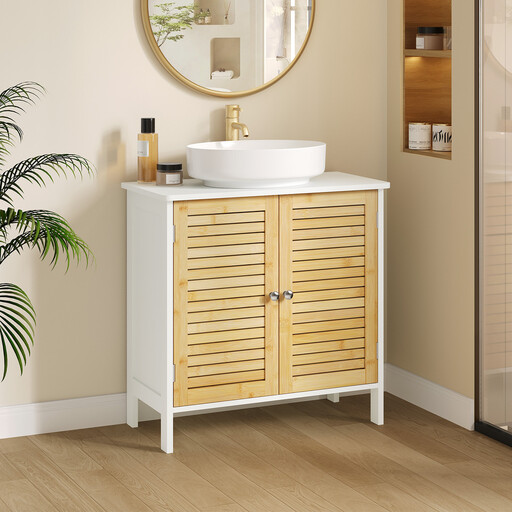
Why it stands out: This model combines the natural look of bamboo with a classic white finish. Its dimensions of 60 x 60 x 30 cm make it a suitable solution for many standard sinks. The interior can be flexibly configured thanks to a removable and adjustable shelf.
Advantages:
Who it's for: Users who prefer a modern, natural aesthetic and need flexible storage in the standard 60 cm width.
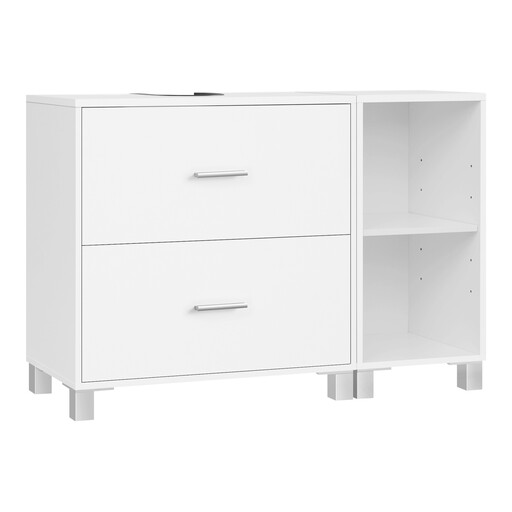
Why it stands out: This solution offers a high degree of flexibility and storage with an additional side cabinet. With a total width of 90 cm, this set is designed for larger bathrooms. The side cabinet can be placed on the left, right, or even separately.
Advantages:
Who it's for: Those with more bathroom space who are looking for an expandable and highly customizable storage solution that goes beyond just the area under the sink.
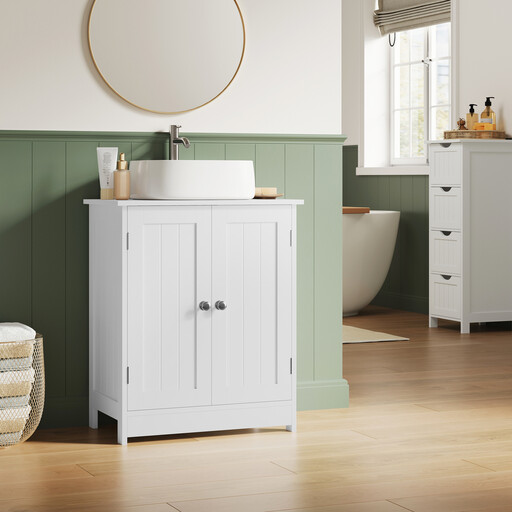
Why it stands out: With its compact width of just 50 cm, this under-sink bathroom cabinet is specifically designed for smaller bathrooms or guest toilets. Despite its small footprint, it provides well-organized storage thanks to an adjustable shelf.
Advantages:
Who it's for: Ideal for renters or homeowners with small bathrooms who need an efficient and discreet storage solution.
An under-sink cabinet is an excellent way to create order. If these models don't perfectly match your vision or if you're looking for other clever storage ideas, there are additional options. Furniture that utilizes the space above the toilet is another space-saving alternative.
Explore our selection of other bathroom furniture, such as a white wooden over-the-toilet storage cabinet, to make the most of the space in your bathroom.
Measure three values: 1. the width from wall to wall or to the next obstacle, 2. the height from the floor to the bottom edge of the sink, and 3. the depth from the wall to the front edge where you want the cabinet to end. Additionally, measure the width and depth of the p-trap and its distance from the wall to check for compatibility with the p-trap cut-out.
No. Freestanding under-sink cabinets are designed for wall-mounted sinks. They will not fit under pedestal sinks with a ceramic column. Furthermore, as mentioned, the cabinet's p-trap cut-out must match the dimensions and position of your p-trap.
Always wipe up water spots or splashes immediately with a soft, dry cloth to prevent moisture from penetrating the material. Ensure good ventilation in the bathroom to reduce humidity. Do not use abrasive or harsh cleaning agents, as they can damage the protective surface.