People with little time before the working week
If you only wash your underwear shortly before the working week, you’ll need to consider drying time, the available floor space and the best place to hang it all.


If you regularly need to dry underwear in a short window before the working week, a heated clothes airer could be worth considering. However, its heating power alone won’t tell you exactly how long drying will take. If you have enough time, an unheated airer lets you dry clothes without using electricity for heat. Either way, make sure the room is well ventilated and follow the care instructions on your garments. For a mains-powered heated appliance, you should also check the relevant safety requirements and the CE marking for the specific product.
If you only wash your underwear shortly before the working week, you’ll need to consider drying time, the available floor space and the best place to hang it all.
If you want to hang up several pairs of pants or socks, look for plenty of separate, practical hanging spaces. Compare winged and tiered designs, as well as models with holders for smaller items.
Consider the airer’s dimensions when open, its height, how easy it is to reach the rails and how much room you have to store it.
A good fit if: You have a short window for drying and enough space for the unfolded wings.
Things to weigh up: The heating function uses electricity and doesn’t guarantee a specific drying time.
A good fit if: Floor space is limited and the tiers are easy to reach.
Things to weigh up: More heating elements don’t mean more usable space between the rails or a shorter drying time.
A good fit if: You can wash your laundry early enough for it to dry without extra electric heat.
Things to weigh up: You can’t switch on a heating function if you’re short on time.
A good fit if: You have a suitable place to mount it and an electrical connection, and want to keep the floor clear.
Things to weigh up: Installation and an electrical connection are extra requirements; the Foxydry Pro’s warm-air function is rated at 750 W.
| Priority | What to check when buying | Who is this important to? |
|---|---|---|
| Underwear dry in time | Check the number of hanging spaces you need and the distance between items. Don’t treat the manufacturer’s drying-time claims as a guarantee. | If I have little time before the working week starts, a short drying window matters; around 29% of consumers similarly prioritise having dry underwear in time. |
| Separate hanging spaces | Check the rail layout, holders for smaller items and how easy the tiers are to reach, based on the amount of laundry you usually have. | If I need to dry several pairs of pants and socks at once, I need enough separate spaces; around 23% of consumers prioritise having enough hanging capacity. |
| Floor and storage space | Measure the airer when open and folded, as well as its height and accessibility in the space where you plan to use it. | If the airer is in a walkway, it needs to fit when in use and be easy to store away; around 18% of consumers prioritise a good fit and storage space. |
| Electricity costs | To calculate energy use at continuous rated power: power in kW × operating hours = kWh. Multiply by your own electricity price per kWh to work out the cost in euros. | If I switch on the heat, I want to estimate the electricity use based on how long it runs; around 18% of consumers prioritise ongoing electricity costs. |
| Fabric care | Check the care label on the garment and the appliance instructions. A tumble-drying symbol doesn’t specifically mean the item is suitable for heated rails. | For delicate underwear, I check the care label and instructions before using heated rails; around 12% of consumers put suitable fabric care first. |
The manufacturer’s rated power or number of heating elements doesn’t prove how long it will take to dry a particular amount of underwear.
Start by comparing the hanging space with the time you have available. To estimate the cost, you can multiply the rated power by the actual running time, but this won’t tell you how long drying will take.
When you dry laundry indoors, moisture gets into the room’s air. A heating function doesn’t remove this moisture from your home.
Choose a suitable place to dry your laundry and make sure the room is ventilated regularly. Germany’s Federal Environment Agency recommends particularly regular ventilation when drying wet laundry indoors.
An airer might fit when folded away, but take up floor space when open or make it harder to get through a walkway.
Measure the space where you plan to use and store it. Winged and tiered models need different amounts of floor and vertical space.
The details below relate to specific product ranges and come from the manufacturers themselves; they aren’t independent assessments of performance.
Heated, foldable models in winged and tiered designs.
Warmmat is a heated winged airer with adjustable temperature and a timer.
The Pegasus Family Maxx is an unheated alternative with holders for smaller items.
The Pro is a fixed airer with air circulation and a warm-air function.
These products are for anyone looking for a foldable heated clothes airer or foldable hot-air drying solution for underwear before the working week.
 No image available
For a short drying window, if a foldable airer with a central section and extendable side wings suits the space you have.
The product description lists 45–55 °C, 230 W and dimensions of 144 × 53 × 96 cm.
Ventilate regularly when drying laundry indoors. Check the care label and appliance instructions; the temperature range doesn’t mean the airer is suitable for every fabric.
Mains-powered appliances within the scope of the EU Low Voltage Directive must meet the relevant safety requirements. Check the markings and the exact model identity; a CE mark alone isn’t independent proof of safety.
 No image available
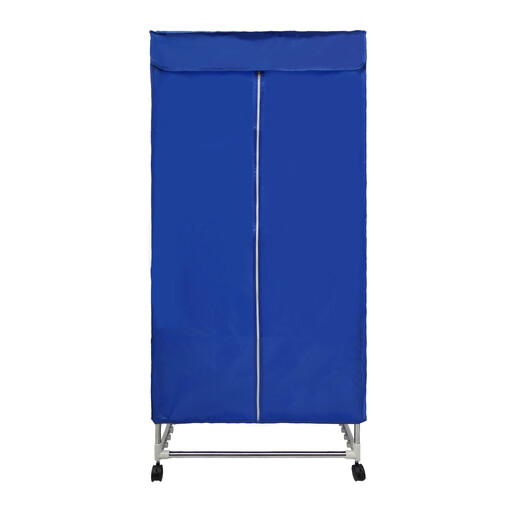
For a short drying window, if hot air, adjustable running times and adjustable tiers suit the place where you plan to dry your clothes.
The product description lists 1,200–1,500 W, timer settings of 60, 120, 180 or 240 minutes, wheels, and adjustable single or double tiers.
Ventilate regularly when drying laundry indoors. Follow the care label and appliance instructions; a general tumble-drying symbol doesn’t specifically mean an item is suitable for a heated appliance.
Mains-powered appliances within the scope of the EU Low Voltage Directive must meet the relevant safety requirements. Check the markings and the exact model identity; a CE mark alone isn’t independent proof of safety.
Yes. Wet laundry adds moisture to your home, so Germany’s Federal Environment Agency recommends ventilating particularly regularly. A heating function doesn’t remove moisture from the room.
That symbol doesn’t specifically approve contact with heated rails. Check the garment’s other care instructions and the appliance manual.
Multiply the rated power in kilowatts by the operating time in hours to calculate the energy used in kilowatt-hours, assuming the airer runs continuously at its rated power. Then multiply this by your tariff per kilowatt-hour. Based on the 220 W listed by the manufacturer for the Adler AD 7821, one assumed hour would use 0.22 kWh. This is neither a measured consumption figure nor a promised drying time.
Electrical appliances with an AC voltage between 50 and 1,000 V fall within the scope of the EU Low Voltage Directive. The European Commission sets out the relevant safety requirements. According to Your Europe, the CE mark is a declaration by the manufacturer, not a safety certificate issued by a central EU body. Check the markings, the exact model identity and the appliance instructions.
No. Germany’s consumer advice centre distinguishes statutory rights against the seller when goods are faulty from an additional voluntary guarantee, whose terms are set by the provider. Online purchases in Germany are also generally covered by a 14-day right to cancel, starting from the day you receive the goods. The consumer advice centre explains this period in its information dated 13 August 2026.