
Lieferung heute & morgen

Qualitätsgarantie

Willkommens-Angebote freischalten: KOSTENLOSE Lieferung | Bis zu 80 % RABATT | Kostenlose 30-Tage-JoyPlus-Testphase
App herunterladen
A universal travel adapter is designed to power several devices while you are away, without requiring a separate plug for every destination. In practice, however, problems often arise not from choosing the right countries, but from overlooking important technical details. International travellers, business travellers, digital nomads and families in particular should check which sockets, power ratings and safety features they actually need before buying.
An international travel adapter generally only changes the shape of the plug. It does not automatically convert mains voltage from 110 volts to 220–240 volts, or vice versa. Many modern chargers for smartphones, tablets and laptops support an input range of 100–240 volts. However, the rating on hairdryers, electric shavers and other high-powered devices must be checked separately.
A travel adapter with USB-C can connect several devices, but the number and naming of the ports alone say little about charging speed. Important factors include the total power output in watts, the supported charging standard and how power is distributed when several ports are used at the same time. A USB-A port is not equivalent to a USB-C PD port.
A compact travel plug is easy to pack away, but it can cause space issues when several power supplies or large chargers are connected. Mechanical stability in the wall socket is also important. Families should additionally look for travel adapter child protection and position the adapter so that children cannot reach any connected cables.
Start by checking your specific destinations. Depending on its design, a worldwide universal travel adapter supports various socket standards, but not every model works in every country. Travel plugs for the UK, USA, Europe and Australia are among the most commonly sought options. For trips to the United Kingdom, Singapore, Malaysia, Dubai or the United Arab Emirates, a model with a suitable UK outlet may be a sensible choice.
Also check whether the adapter only accepts devices with Europlugs or supports earthed plugs as well. Earthing is important for devices with the relevant protection class. Always follow the manufacturer's information on usage and maximum load.
The power supply for a device will show information such as “Input: 100–240 V” or a fixed voltage. A plug adapter does not replace a voltage converter. For devices with high power consumption, such as heaters or hairdryers, the adapter's permitted output must be suitable for the device.
When assessing materials and safety features, pressure-resistant, flame-retardant or impact-resistant materials may be additional selection criteria. Such details should be stated in the product listing or instruction manual and should not simply be assumed.
For smartphones, tablets, cameras and laptops, the available ports are crucial. A multi-country travel adapter with several USB-C ports can help reduce cable clutter. For more demanding use, a specified PD output, such as 65 watts, is an objectively verifiable parameter. Bear in mind that the available total output may be shared between several devices connected at the same time.
For products intended for the European market, information about applicable safety requirements, manufacturer details and instructions for use should be clear and verifiable. According to the product name, Ochama's UK model features CE and UKCA markings. This is product information and does not replace checking the specific technical data.
Never use an adapter in damp areas, open it or operate it beyond the stated load limit. Stop using it if there is any visible damage.
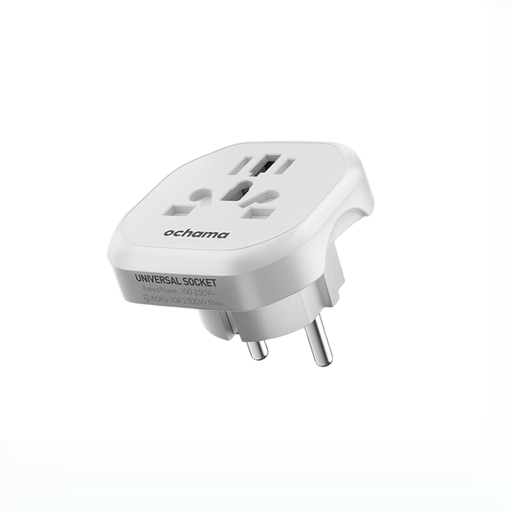
Why this product suits the profile: The stated country coverage includes the USA, Europe, Australia, the UK, China and Germany, among others. This makes the model suitable for travellers looking for a single travel plug adapter for several typical destinations.
The countries are listed specifically, so you can compare compatibility with your own route before travelling. According to the product description, integrated child safety protection is included.
Multi-country compatibility, plus stated pressure-resistant, fireproof material and child safety protection.
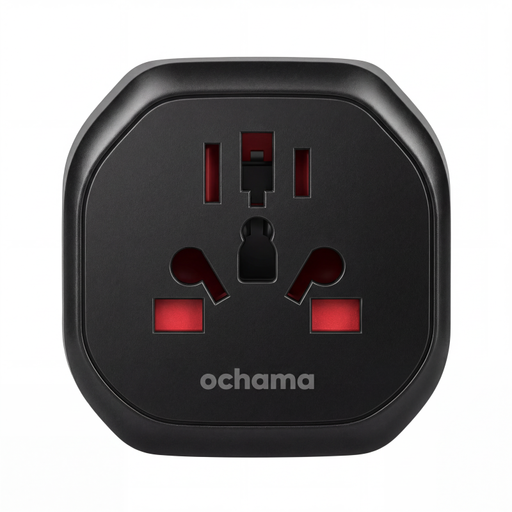
Why this product suits the profile: This model is designed for travellers heading to destinations such as the UK, Singapore, Malaysia, Dubai or the United Arab Emirates. The product name mentions child safety, pressure-resistant material and CE and UKCA markings.
The intended destination region is clearly stated. This means you can check before buying whether the UK plug type matches your travel route, rather than relying solely on the term “worldwide”.
Child safety function, plus the CE and UKCA markings stated in the product name.
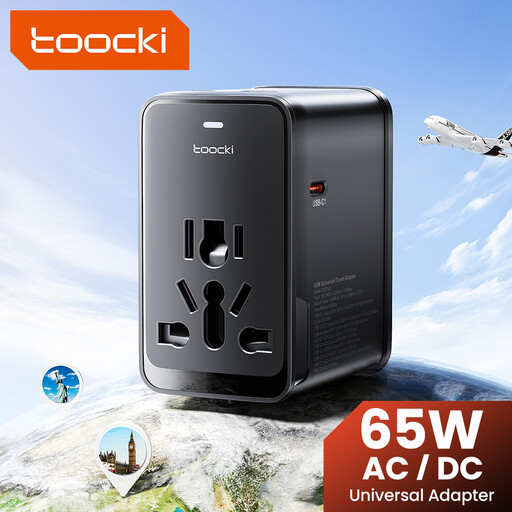
Why this product suits the profile: With 65-watt PD, one USB-A port and three USB-C ports, this model is designed for users who want to charge several devices in a hotel or mobile office.
The stated PD output and precise port configuration make the charging capabilities easier to understand than a vague claim such as “fast charging”.
65 W PD output, plus four charging ports: one USB-A and three USB-C ports.
We have put together a complete, regularly updated list of products that fully meet these strict selection criteria and the safety regulations applicable in the EU.
Not necessarily. A multi-country travel adapter can support several plug types. The key considerations are whether it supports your specific destinations and whether it is suitable for the power requirements of your devices. Devices with a fixed voltage range may also require a voltage converter.
Its lifespan depends on the materials, how often it is plugged in, transportation and the load placed on it. Store the adapter in a dry place, avoid pulling on the cable and do not exceed the stated maximum output. Before every trip, check the casing, contacts and sliding mechanisms for cracks or faults.
A passive plug adapter without charging electronics generally has no significant power consumption of its own. Models with USB charging functionality may use a small amount of power in standby mode. If you will be away for an extended period, remove the adapter from the socket.