
Lieferung heute & morgen

Qualitätsgarantie

Willkommens-Angebote freischalten: KOSTENLOSE Lieferung | Bis zu 80 % RABATT | Kostenlose 30-Tage-JoyPlus-Testphase
App herunterladen
A universal travel adapter should support multiple plug types when you are travelling, connect electronic devices safely and take up as little space as possible in your luggage. In practice, unclear power ratings, missing USB ports or an overly bulky design often lead to disappointing purchases. This applies to holidays as well as business trips, round-the-world travel and everyday life as a digital nomad.
Before buying, it is therefore worth checking the technical specifications rather than relying solely on terms such as “worldwide” or “fast charging”.
An international socket adapter normally changes neither the voltage nor the frequency. It simply adapts the shape of the plug to the socket in your destination country. Devices with an input range of 100–240 V and 50/60 Hz are designed for many international power networks. This information should be shown on the device’s charger or power supply.
For devices designed exclusively for German mains voltage, a travel adapter alone may not be sufficient. With hairdryers, curling tongs and kitchen appliances in particular, you should check the input range and power consumption.
A USB-A port and a USB-C port do not automatically offer the same performance. The key factors are:
A travel adapter with USB-C is suitable for newer smartphones, tablets and compatible laptops. A travel adapter with USB-A remains useful when you use older cables, headphones or power banks. If you charge several devices, you should also check whether the total output is reduced when they are used simultaneously.
A very small adapter may be easy to pack away, but it may not provide a secure fit for bulky power supplies. Fold-out plugs should also lock firmly into place and must not feel loose inside the housing. For families or frequent users, the number of ports is often more important than an especially slim design.
A suitable international mains adapter should support the plug types required at your destination. A universal plug for the EU, UK, USA and Australia is frequently sought after. Depending on the model, plug types for China, Japan or Hong Kong may also be included.
Sockets of types E and F are common in Germany and many European countries. Type G is used in the United Kingdom, type A or B in the USA and type I in Australia. The product description should state this compatibility explicitly. “Worldwide” on its own is too vague.
For smartphones, a compact charger with moderate power is often sufficient. Tablets and multiple devices benefit from greater capacity. A 65 W PD charger can deliver more charging power to compatible devices than a basic USB charger. However, the actual charging speed always depends on the device and cable.
Look out for:
Before use, a travel adapter should be checked for cracks, loose parts or discolouration. According to the manufacturer’s specifications, integrated protection against overheating, overvoltage and overcharging is useful. For families, an integrated child safety feature may also be relevant.
The adapter must not be covered, used in damp environments or operated with damaged cables. You should also observe the permitted total load. An adapter is not a substitute for a properly approved extension block and should not be connected to other multi-way adapters.
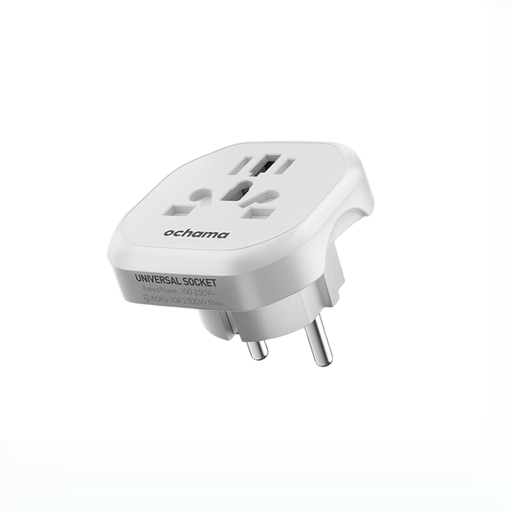
Why this product suits this profile: According to the product description, the adapter covers several regions, including the USA, Europe, Australia, the UK, China and Germany, and focuses on basic connection compatibility.
The countries listed are more specific than a blanket “worldwide” claim. However, the information provided does not specify a USB charging function, so this should not be assumed.
Several listed socket standards; according to the product description, a pressure-resistant, impact-resistant and fire-retardant housing.
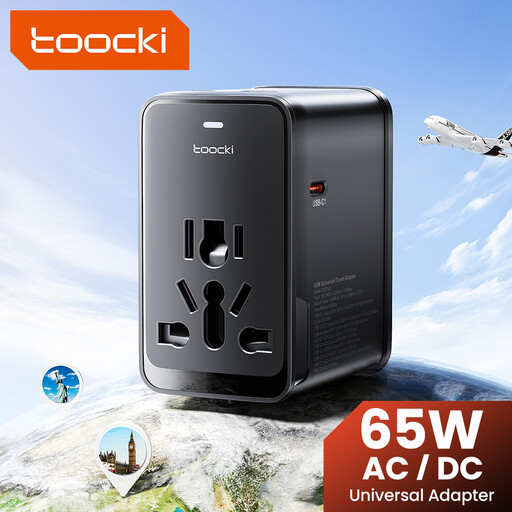
Why this product suits this profile: For travellers with a smartphone, tablet and laptop, the model’s product name indicates a combination of international adapter and multiple charging ports.
The stated 65 W output and PD reference make the charging performance clearer than a general fast-charging claim. Actual performance must be checked against the device and cable.
According to the product name, one USB-A and three USB-C ports; support for EU, UK, US and AUS plugs.
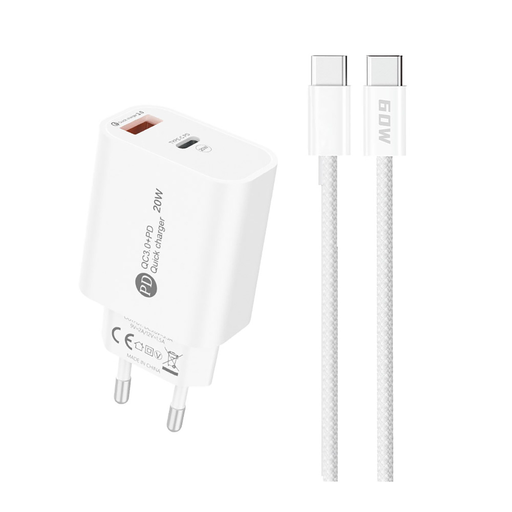
Why this product suits this profile: As an addition for accommodation with an EU socket, this charger is suitable for users who need USB-A and USB-C but are not looking for a full international travel adapter.
The technical specifications state 20 W, USB-A, USB-C, QC 3.0 and PD. This makes it easier to assess how the charger can be used; the EU plug is not designed for different socket shapes.
20 W output; 1 m USB-C-to-USB-C cable included; according to the product information, protection against overheating, overvoltage and overcharging.
We have put together a complete, regularly updated list of products that fully meet these strict selection criteria and the safety regulations applicable in the EU.
Not necessarily. A model with several fold-out or integrated plug types can cover multiple countries. What matters is whether the specific combination of EU, UK, US and Australian plugs is supported at your destination. For countries with different standards, check the manufacturer’s information.
That depends on the output power, charging protocol and laptop. A 65 W PD charger may be suitable for compatible devices, while a 20 W charger is generally designed for smartphones and smaller electronics. The USB-C cable must also support the required power.
It is not possible to give a reliable fixed lifespan. This depends on the materials, transport, number of plug cycles and load. Cracks, loose contacts, unusual heat, discolouration or a burning smell are all reasons to stop using the adapter. Regular visual checks are particularly sensible if you travel frequently.