
Lieferung heute & morgen

Qualitätsgarantie

Willkommens-Angebote freischalten: KOSTENLOSE Lieferung | Bis zu 80 % RABATT | Kostenlose 30-Tage-JoyPlus-Testphase
App herunterladen
A spilled glass of juice on the new sofa, muddy paw prints on the carpet, or the unavoidable traces of daily life on car seats—stains on upholstery and textiles are a nuisance. A powerful upholstery cleaner promises a quick solution, but the market is overwhelming. Many devices fail to deliver on their advertising claims, leading to frustration instead of cleanliness.
Before you make a purchasing decision, it's important to recognise common marketing traps. Features are often promoted that are of little practical use, while crucial quality characteristics remain hidden in the fine print.
To avoid these pitfalls and find a device that truly meets your needs, you should pay attention to a few fundamental technical parameters.
Choosing the right device depends less on advertising promises and more on verifiable technical specifications. Three criteria are crucial for thorough stain removal on upholstery and carpets.
A key quality feature is the dual-tank system. This design keeps fresh water (often mixed with a cleaning solution) and the extracted dirty water in two separate containers. This ensures that you are always cleaning with fresh water, which significantly increases effectiveness and improves hygiene. Pay attention to the tank capacity: larger containers allow for longer cleaning intervals without interruption. The tanks should also be easy to remove, fill, and clean.
For most everyday stains, a wet vacuum cleaner with cold water is sufficient. However, for stubborn, greasy, or oily messes, an integrated heating function can substantially boost cleaning performance. The heated water helps to dissolve dirt faster and more effectively. Models with this feature often offer selectable modes, allowing you to switch between a normal and a heated clean depending on the level of soiling. This is particularly beneficial for households with children or pets, as well as for cleaning car seats.
The performance of an upholstery cleaner lives and dies by its accessories. A narrow upholstery nozzle concentrates suction power on a small area and is ideal to clean a sofa. A wider nozzle is better suited for larger surfaces, acting as a carpet cleaner. The length of the hose and power cord determines your reach and flexibility. A long hose is essential for conveniently reaching car seats or staircases.
Instead of recommending a single device, we have identified models tailored to specific needs and households.
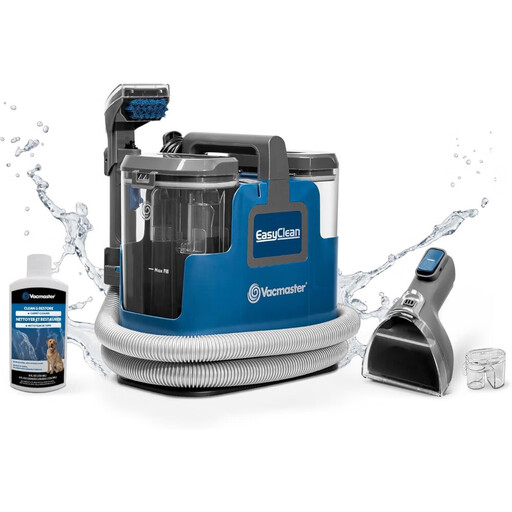
Why this model fits: This device offers a solid set of basic features for occasional stain removal. It is ideal for smaller households or as a first-time unit to tackle spills and everyday dirt on upholstery and in the car without breaking the bank.
It features a clear dual-tank system that consistently separates clean and dirty water, thus avoiding the unhygienic trap of single-tank models.
Compact design and low weight (3.4 kg) for easy handling and storage. The 1.8-metre hose provides good reach for the car and home.
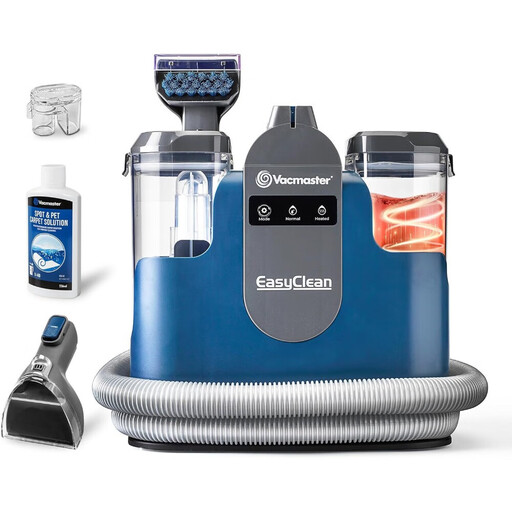
Why this model fits: For households with children and pets where stubborn stains are a daily occurrence. The heating function dissolves dried-on food residue, dirt, or organic stains much more effectively than cold-water devices.
This model specifically addresses the trap of lacking special features. The selectable heating function provides the necessary power for demanding cleaning tasks that standard devices cannot handle.
Large tank capacities (1.6 L fresh water, 0.95 L dirty water) reduce refill breaks. A self-cleaning function for the hose ensures better hygiene after use.
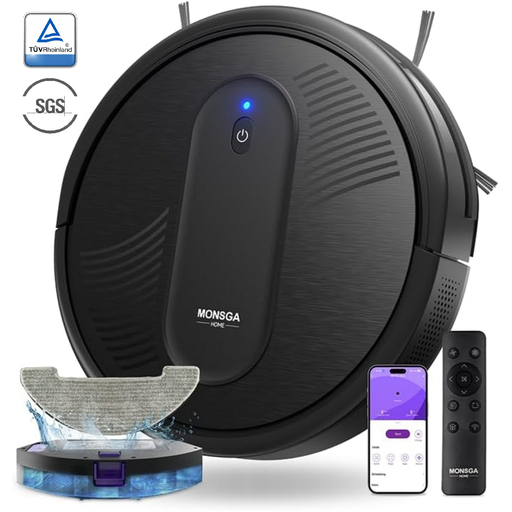
Why this model fits: This is not an upholstery cleaner, but a supplement for daily cleanliness. It is ideal for the automated maintenance of hard floors and low-pile carpets to remove pet hair, dust, and light dirt before they set in.
This device sets clear expectations: it is a robot vacuum for carpets and hard floors for daily maintenance, not for deep stain removal. It complements an upholstery cleaner but does not replace it.
Combined vacuuming and mopping function, control via app or voice, and a slim design (approx. 8.1 cm) to clean under furniture. The runtime is up to 140 minutes according to the manufacturer.
A good upholstery cleaner is versatile, but the material of the surface being cleaned also plays a role. On robust synthetic fibres, often found in sofas or car seats, wet vacuums can unleash their full power. For more delicate surfaces like a low-pile carpet made of polyester or a non-slip bath mat, it is advisable to test for colourfastness in an inconspicuous area first.
Natural materials require special attention. A hand-woven wool rug, like the Premier Kids Lion Rug, should only be spot-treated with suitable agents to avoid damaging the fibres. Choosing durable and easy-care textiles from the start can significantly reduce the cleaning effort.
We've compiled a full, up-to-date list of products that fully meet these strict selection criteria and UK safety regulations.
1. How long does it take for a sofa to dry after cleaning with a wet vacuum? The drying time depends on the device's suction power, room temperature, and ventilation. A device with strong suction removes more water, which speeds up drying. On average, you should expect a drying time of 4 to 8 hours. Open windows or use a fan to accelerate the process.
2. Can I use any upholstery cleaner for car seats? Most compact upholstery cleaners are well-suited for car seats. Look for a device with a sufficiently long hose and a narrow nozzle to reach difficult spots. Models with a 12V connection for the cigarette lighter are particularly convenient, but corded 230V devices generally offer higher and more consistent performance.
3. Which cleaner is suitable for a household with pets? In households with pets, models with strong suction power and a heating function are recommended. The heat helps to eliminate organic stains and odours more effectively. A dual-tank system is essential here for hygienic operation. Also, look for special brush attachments that can pick up pet hair well.