
Lieferung heute & morgen

Qualitätsgarantie

Willkommens-Angebote freischalten: KOSTENLOSE Lieferung | Bis zu 80 % RABATT | Kostenlose 30-Tage-JoyPlus-Testphase
App herunterladen
An upper arm blood pressure monitor should record readings quickly, display them clearly and be dependable in everyday use. When buying one, many people initially focus on terms such as “smart”, “precise” or “clinically tested”. However, these claims alone are not enough to base your choice on. The most important factors are the right cuff, straightforward operation and features that genuinely suit the way you intend to use the monitor.
A cuff that is too tight or too loose can make it difficult to take an accurate reading. The description “for adults” is therefore not enough. Measure the circumference of your bare upper arm and compare it with the stated range. Models covering 22–42 cm are widely available. For larger upper arms, a 22–45 cm blood pressure monitor may be a more suitable choice.
Bluetooth, voice prompts, an app and multiple memory profiles can all be useful. However, if the menus are complicated or the display is difficult to read, an automatic blood pressure monitor may end up going unused. For older people, large digits, a small number of buttons and clear instructions are often more important than a long list of features.
A blood pressure monitor with arrhythmia detection can display irregular heartbeats detected during the measurement. The result does not replace a medical examination. Coloured classifications and average readings are also intended as guidance only and should not be interpreted independently as medical information.
The cuff should be placed on the bare upper arm, approximately at heart level. Before taking a measurement, sit quietly for a few minutes, do not talk and keep your legs uncrossed. Check the following:
A blood pressure monitor with a large cuff covering 22–42 cm is suitable for many adults. If your arm circumference is up to 45 cm, a model with a corresponding range is the better choice.
A digital blood pressure monitor should show systolic and diastolic blood pressure, as well as your pulse, clearly and separately. For older people, a large LCD display, high-contrast digits and an easy-to-identify start button are practical features. A voice function can provide additional support, provided it can be switched off or adjusted.
Separate user profiles are important when several people take measurements. Depending on the model, you may have 2 × 90, 2 × 100 or 2 × 120 memory slots available. For monitoring your readings over a longer period, a blood pressure monitor with an app can be helpful. Bluetooth transfers readings to a compatible app, so check in advance whether your smartphone’s operating system is supported.
For use at home, batteries or a mains adapter are suitable. A rechargeable device is convenient when travelling, while models using standard batteries remain ready to use even without a charger. Check the contents listed with the product: batteries, a power adapter and USB cable are not included with every product.
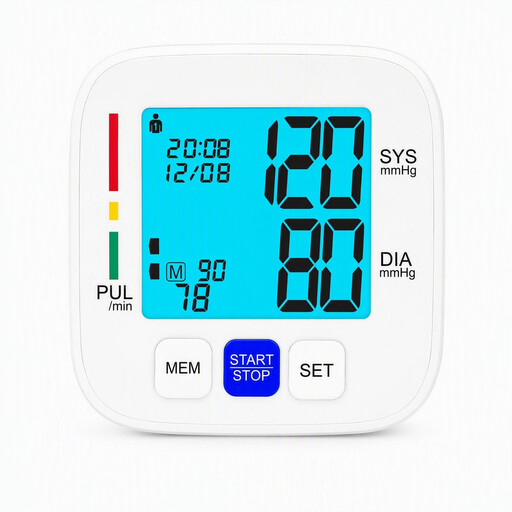
Why this product suits this profile: This compact automatic blood pressure monitor focuses on daily checks at home and provides two separate memory banks with 90 slots each.
The cuff is specified for 22–42 cm. The date and time are saved, and the average of the last three readings is calculated automatically.
Compact dimensions of approximately 104 × 104 × 65 mm, 2 × 90 memory slots and automatic switch-off.
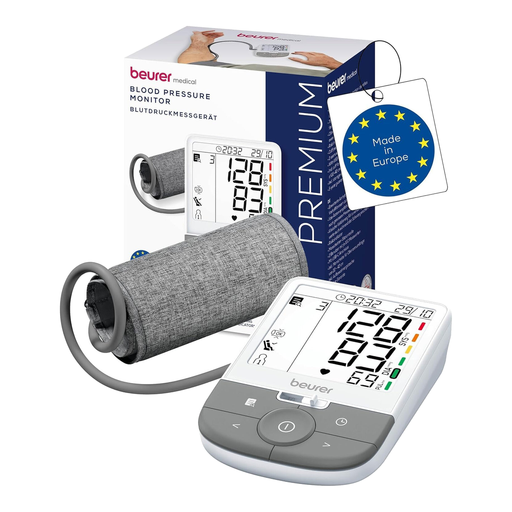
Why this product suits this profile: This model combines a backlit XL display with multiple measurements, memory profiles and app synchronisation.
The product details specify a 22–42 cm cuff, a resting indicator and a cuff-fit check. This does not automatically turn a single reading into a diagnosis.
2 × 100 memory slots, a 7-day average, AFib or arrhythmia detection according to the product description, and synchronisation with health apps.
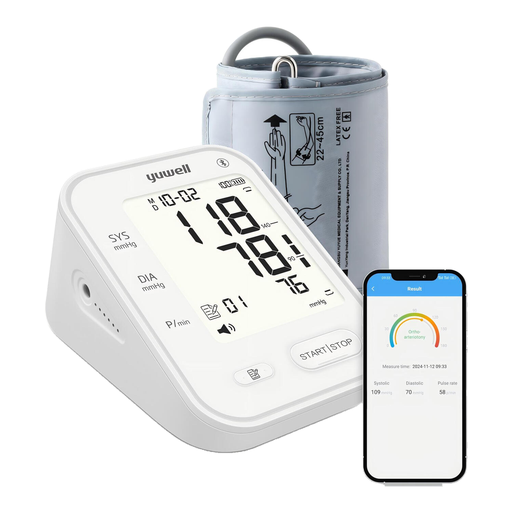
Why this product suits this profile: This device is aimed at users looking for a blood pressure monitor with Bluetooth, app-based tracking and a larger cuff for use at home and while travelling.
The cuff is specified for 22–45 cm. Nevertheless, you should measure your own upper arm and check app compatibility before buying.
Rechargeable battery, backlit display, voice readout, and PDF and CSV export according to the product details.

Why this product suits this profile: The two-button operation and 22–45 cm cuff are suitable for families with different upper arm circumferences.
The stated cuff range reduces the risk of accidentally choosing a standard cuff that is too small. Movement detection indicates when your posture may be incorrect.
90 stored readings, an average of the last three measurements, arrhythmia alert, mains adapter and carry case according to the product description.
For comparable readings, it is best to follow a consistent routine:
If unusual readings occur repeatedly or the device displays an arrhythmia alert, seek medical advice. The device is intended to record readings and does not replace a diagnosis or treatment.
We have put together a complete, regularly updated list of products that fully meet these strict selection criteria and the safety regulations applicable in the EU.
Its service life depends on the build quality, storage conditions, batteries and cuff. Store the device in a dry place, protected from knocks and in accordance with the operating instructions. If the tube or cuff shows visible damage, stop using the accessory.
For battery-powered models, the main ongoing cost is replacement batteries. Devices with a USB connection or rechargeable battery can reduce these expenses, but they require a suitable cable or regular charging. Also check whether the app is available free of charge and which smartphone version is required.
Upper arm monitors are often chosen for regular home use because the measurement is taken at a defined position on the upper arm. Regardless of the device type, the correct cuff size, body position and operation are crucial. When choosing a monitor, the specific instructions for use are therefore just as important as the technical features.