
Lieferung heute & morgen

Qualitätsgarantie

Willkommens-Angebote freischalten: KOSTENLOSE Lieferung | Bis zu 80 % RABATT | Kostenlose 30-Tage-JoyPlus-Testphase
App herunterladen
An upper-arm blood pressure monitor can make it easier to check your blood pressure regularly at home. But there are important differences between models with large displays, app features and claims of especially accurate readings. To make the right choice, focus less on marketing promises and more on a well-fitting cuff, correct use and clear memory features.
A cuff that is too tight or too loose can affect the reading. So what matters is not whether it is described as “large”, but the stated arm circumference in centimetres. Many models, for example, fit arm circumferences of 22 to 42 cm or 22 to 45 cm. If you have particularly slim or broad upper arms, choose a cuff that is specifically suited to your measurements.
A Bluetooth blood pressure monitor or one with an app can store readings and show trends. That’s useful if you take readings regularly. But if you have to connect it each time or use a smartphone, you may rarely use the feature. For older people and families, an easy-to-read display, one-button operation and built-in memory are often more important than extra software.
An arrhythmia detection blood pressure monitor can flag an irregular heartbeat during a reading. These alerts should not be taken as a medical diagnosis. If you repeatedly notice irregularities or your readings remain high, seek medical advice. An automatic blood pressure monitor is no substitute for professional guidance.
An upper-arm blood pressure monitor is generally positioned at heart level. Before taking a reading, sit quietly for a few minutes, place both feet flat on the floor, and avoid talking or moving during the measurement. Put the cuff on your bare upper arm, not over thick clothing.
Look for:
A wrist monitor such as the medisana BW 360 connect may be more compact, but it requires you to keep your wrist carefully positioned at heart level. That’s why many people prefer an upper-arm blood pressure monitor for daily checks at home, provided the cuff fits correctly.
A digital blood pressure monitor should clearly show your systolic and diastolic readings, as well as your pulse. Large numbers, a backlit display or spoken readings can be helpful if your eyesight is limited. Separate user profiles are useful for households with more than one person. Depending on the model, memory capacity may be 2 × 90, 2 × 99 or 2 × 120 readings.
An average of your last three readings can make it easier to keep track of your results. However, it is no substitute for an individual assessment by a healthcare professional, and should always be considered alongside a consistent measuring routine.
Battery-powered monitors are handy for flexible use. Rechargeable models reduce the need for regular battery changes. Some versions also support USB power. Before buying, check whether batteries, a mains adaptor or a USB cable are actually included.
A blood pressure monitor with an app is worth considering if you want to keep a long-term record of your readings or export them. Some models can transfer data via Bluetooth and let you review it on iOS or Android. Check that your smartphone and the app you want to use are compatible before making this feature a deciding factor.

Why this product suits this profile: This model combines one-button operation with a 22–45 cm cuff, making it a straightforward choice for taking readings at home with the family.
The cuff size is clearly stated, and the monitor also gives alerts for body movement and a possible arrhythmia.
Memory for 90 readings and an average of the last three measurements; batteries, mains adaptor and storage case included.
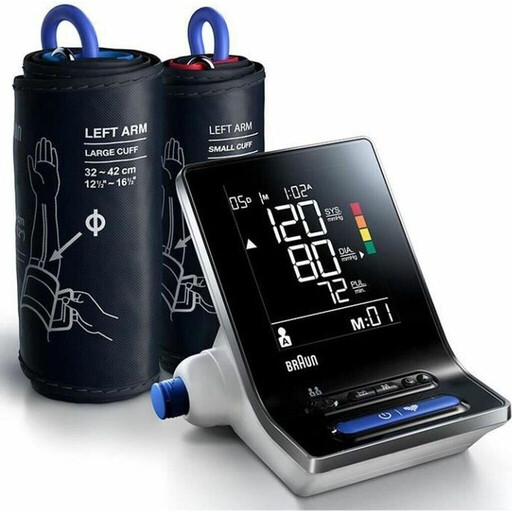
Why this product suits this profile: Two cuffs for 21 cm and 33–43 cm, a large backlit display and separate memory for two users support a well-organised measuring routine at home.
The two cuff sizes reduce the risk of a poor fit. Three consecutive readings with an average display make it easier to keep track of your results.
Memory for 40 readings per user, automatic pulse display and an irregular heartbeat alert, according to the product description.
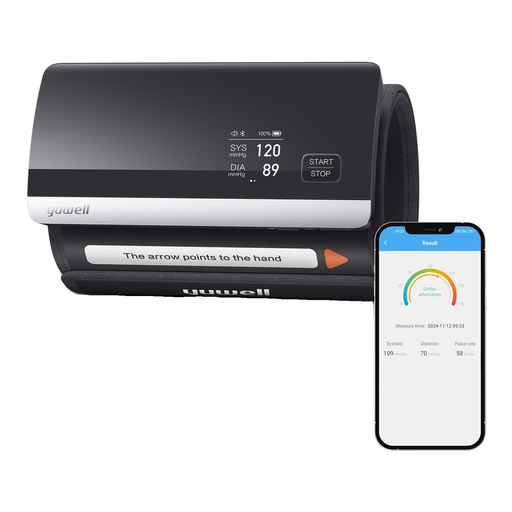
Why this product suits this profile: If you take lots of readings, you can use Bluetooth, app synchronisation and the 22–45 cm cuff to keep a digital record of your results over time.
The app is an extra feature, not the only way to view your readings: the monitor has its own display and spoken readings. The AFib feature should be treated as an alert.
Rechargeable battery, Bluetooth data transfer, spoken readings and detection of possible atrial fibrillation alerts, according to the product description.
We’ve put together a complete, regularly updated list of products that meet these strict selection criteria and fully comply with the safety regulations in force in the EU.
Sit down quietly and, ideally, wait a few minutes. Put the cuff on your bare upper arm, with its lower edge just above the bend of your elbow. Rest your arm comfortably on a surface at heart level. Don’t talk or move during the measurement. Always follow the instructions from the manufacturer of your monitor.
How long it lasts depends on the model, how it is stored, the cuff, the batteries and how often it is used. Keep the monitor dry and protected, and follow the manufacturer’s storage instructions. Check the cuff, tube and display regularly for visible damage. If the monitor shows signs of wear or produces unusually inconsistent readings, don’t simply carry on using it: have it checked or replace it.
With a battery-powered model, the main ongoing cost is replacement batteries. Rechargeable monitors need electricity to charge, while USB models can offer flexible power options, depending on the version. Families should also consider the number of memory slots and user profiles. More storage can make it easier to keep each person’s readings separate without having to write them down by hand.