
Lieferung heute & morgen

Qualitätsgarantie

Willkommens-Angebote freischalten: KOSTENLOSE Lieferung | Bis zu 80 % RABATT | Kostenlose 30-Tage-JoyPlus-Testphase
App herunterladen
An upper arm blood pressure monitor needs to be suitable for regular use, easy to read and simple to operate. In practice, however, it’s not just technical differences that lead to a wrong purchase. Often, devices are chosen based on long lists of features, even though the cuff, operation or power supply don’t fit your daily routine. This buying guide shows which criteria for a blood pressure monitor for home use really matter, and which models may suit different user profiles.
The cuff must match your arm circumference. If it’s too tight or not fitted correctly, readings can become unusable. A device with a cuff for 22–42 cm is suitable for many adults, but it doesn’t cover every arm size. If you need a wider range, you should specifically look for a blood pressure monitor with a 22–45 cm cuff.
Bluetooth, an app, averages and extra displays can be useful. For older people or those with impaired vision, however, the first priority is whether the device has a clear start button and an easy-to-read display. A blood pressure monitor with a large display can be more practical in daily use than a model with a comprehensive app that’s rarely used.
An arrhythmia detection feature or an indicator of irregular heartbeats is an additional display, not a diagnosis. Colour-coded scales are also for guidance only. Readings should not be used on their own to change medication or treatment. If measurements are repeatedly unusual, you should seek medical advice.
An automatic upper arm blood pressure monitor is fitted to the bare upper arm at heart level. Before measuring, it’s advisable to rest for about five minutes. During the measurement, you should not speak and should sit as still as possible.
Check before you buy:
A digital blood pressure monitor should clearly show the systolic and diastolic values as well as the pulse. For older people, large digits, high contrast and simple one-button operation are relevant features. A backlight can be helpful in low room lighting.
Voice output is also a comfort feature. However, it does not replace checking that the cuff is correctly positioned and the measuring posture is maintained.
If you measure in the morning and evening, you’ll benefit from internal memory. For a single user, 90 to 100 memory slots can be sufficient. A blood pressure monitor for 2 people should have separate memory areas so that readings don’t get mixed up.
The automatic calculation of the average of the last three measurements makes it easier to track trends. Bluetooth and app connectivity are useful if you want to document readings on your smartphone long-term or present them in a structured way at a doctor’s appointment. Before buying, check whether the app is compatible with your iPhone or Android smartphone.
Battery-operated models are suitable for flexible use. USB or mains operation can be useful if the device is permanently kept in one place. Check whether batteries, USB cable, mains adapter and storage case are actually included. This prevents additional costs straight after purchase.
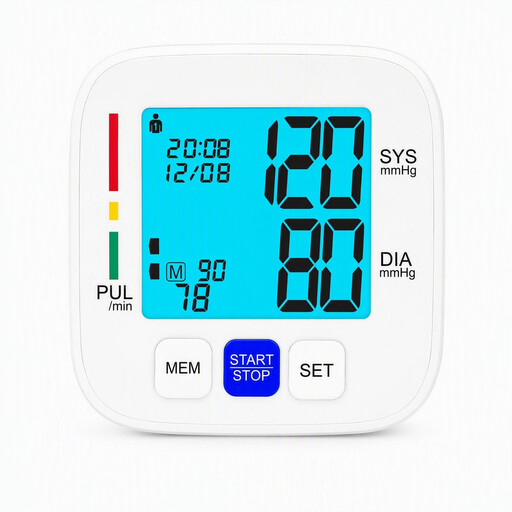
Why this product fits the profile: This compact automatic blood pressure monitor focuses on the essential functions for daily home use.
The cuff covers 22–42 cm according to the product specification. Memory for 2 users with 90 entries each and the average calculation of the last three readings avoid the need for handwritten records.
Compact design, date and time stamp, and automatic shut-off. Power is supplied by four AAA batteries.
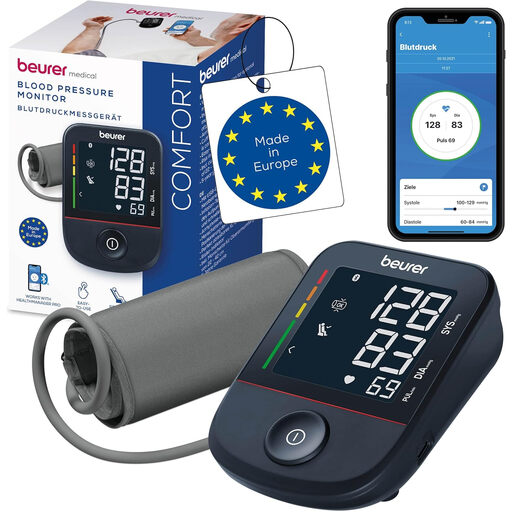
Why this product fits the profile: The one-button operation, large display and app connectivity combine straightforward use with digital documentation.
The cuff is designed for 22–42 cm according to the product specification. A cuff fit check and a rest indicator highlight important application steps.
Arrhythmia display, Bluetooth transfer to the beurer HealthManager Pro app and compatibility with Apple Health, Samsung Health and Health Connect.
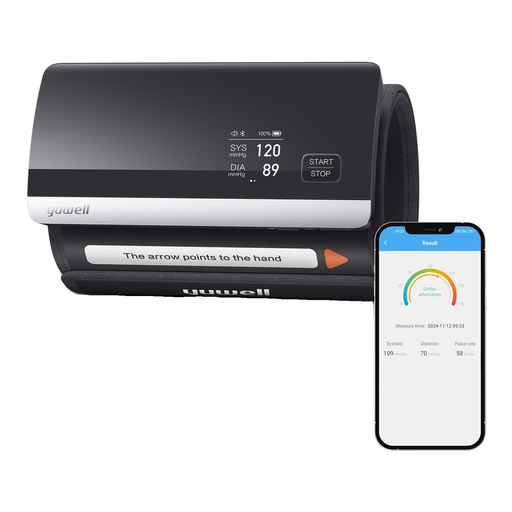
Why this product fits the profile: For users who measure frequently, document on the go and need a wide cuff, this model combines app connectivity, voice output and rechargeable power.
The 360° cuff covers 22–45 cm according to the product specification. This means the cuff size can be clearly matched to your own arm circumference before purchase.
Bluetooth synchronisation with the yuwell app, voice output, AFib indicator and a display for clearly visible readings.
We’ve put together a complete, regularly updated list of products that fully meet these strict selection criteria and the safety regulations in force in the EU.
The displayed readings are for health monitoring and do not replace a medical diagnosis. An indicator of an irregular heartbeat is also not a medical diagnosis.
The lifespan depends on the model, batteries, cuff and frequency of use. With daily use, you should regularly check the housing, tube and Velcro fastening for damage. Store the device in a dry place, protected from direct sunlight and in accordance with the relevant instruction manual.
With battery models, the main costs are for replacement batteries. USB or rechargeable models can reduce these expenses, but still need a charging source. Therefore, check what’s included and the specified power supply before you buy.
That depends on the specific use. A large display, one-button operation or voice output can make measuring easier. The app is only an advantage if you or your family members have a compatible smartphone and want to manage readings digitally on a regular basis.