
Lieferung heute & morgen

Qualitätsgarantie

Willkommens-Angebote freischalten: KOSTENLOSE Lieferung | Bis zu 80 % RABATT | Kostenlose 30-Tage-JoyPlus-Testphase
App herunterladen
An upper arm blood pressure monitor is more practical for many households than a wrist model, because when used correctly, the measurement on the upper arm is less affected by arm position. Nevertheless, automatic devices differ significantly in terms of cuff, operation, memory and extra features. Anyone who only focuses on a low price or lots of symbols on the packaging will overlook important details.
The cuff must match your upper arm circumference. If it’s too tight, the reading can be affected and using it becomes uncomfortable. Many standard models cover roughly 22 to 42 cm. For larger upper arms, you should specifically look for a blood pressure monitor with a large cuff or a model that covers 22 to 45 cm.
Important: this measurement refers to the circumference of your upper arm, not your sleeve length or height. Before buying, measure your upper arm with a tape measure halfway between your shoulder and elbow.
A blood pressure monitor with arrhythmia detection, Bluetooth or voice output can make using it easier. However, these features are not a diagnosis. A symbol for irregular heartbeats is an indicator that should be assessed by a doctor if it appears repeatedly.
A colour-coded classification according to blood pressure ranges is also for guidance only. It should not lead you to change your medication independently or ignore symptoms.
With a blood pressure monitor with Bluetooth and app, several points are crucial:
If you don’t want to use an app, make sure the display is easy to read and there are enough internal memory slots. Digital management is helpful, but not essential.
An upper arm blood pressure monitor should sit as accurately as possible at the intended measuring point. The cuff is placed directly on the skin, not over thick clothing. Models covering 22 to 42 cm are suitable for many adults. For larger circumferences, devices offering 22 to 45 cm give you more leeway.
A large LCD display with clear digits is especially relevant for a blood pressure monitor for seniors. One-button operation reduces the number of steps needed. Voice output can provide extra guidance, but it isn’t activated by default on every product.
For power, models may use AAA or AA batteries, a USB cable or a built-in rechargeable battery. For a device you take on the go, a model with a carry case and rechargeable battery is worthwhile. For permanent home use, battery operation can be sufficient.
If you measure regularly, pay attention to separate memory for two people and the number of memory slots. Features like the average of the last three readings or multi-measurement can make documentation easier. What remains crucial is a consistent routine: sit quietly for a few minutes before measuring, rest your arm at heart level, don’t speak and keep still during the measurement.
A clinically validated blood pressure monitor should be identified by verifiable manufacturer or testing information. Simply using the term “clinical” in an advert is not sufficient proof. For specific medical requirements, suitability should be clarified with a doctor’s surgery or a healthcare professional.
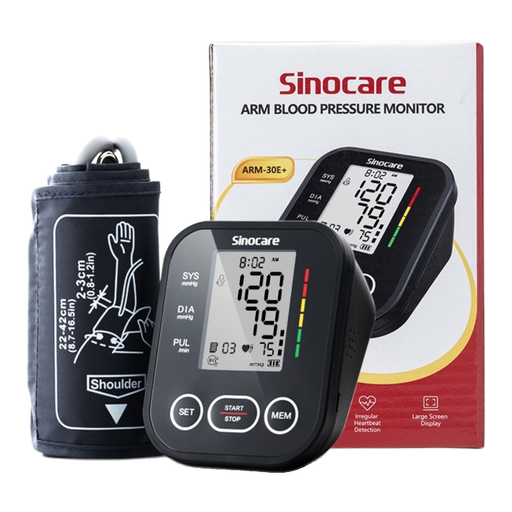
Why this product suits the profile: The one-button operation and 3.6-inch LCD display are designed for a straightforward measuring process. The package includes a cuff, four AAA batteries and an instruction manual.
The range of features remains manageable. Arrhythmia detection is included according to the product description; this model does without an app or voice output, according to the specification.
One-button control, large display and automatic inflation function for daily monitoring at home.
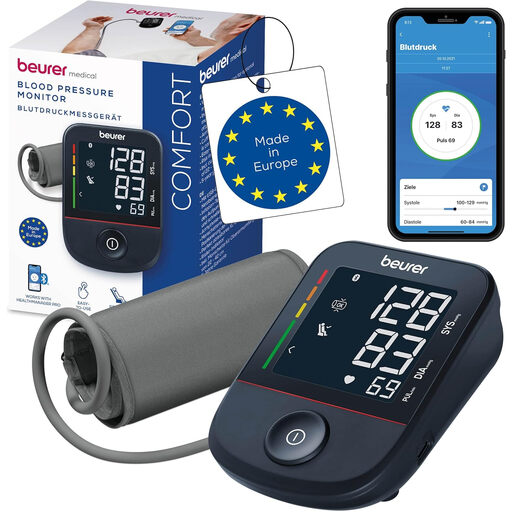
Why this product suits the profile: This model combines one-button operation with Bluetooth transfer to the beurer HealthManager Pro app. The cuff is designed for an upper arm circumference of 22 to 42 cm.
The app compatibility is clearly stated. In addition, the product description mentions cuff fit check and rest indicator, which support the measuring process.
Bluetooth synchronisation, support for Apple Health, Samsung Health and Health Connect, plus arrhythmia detection according to the product information.
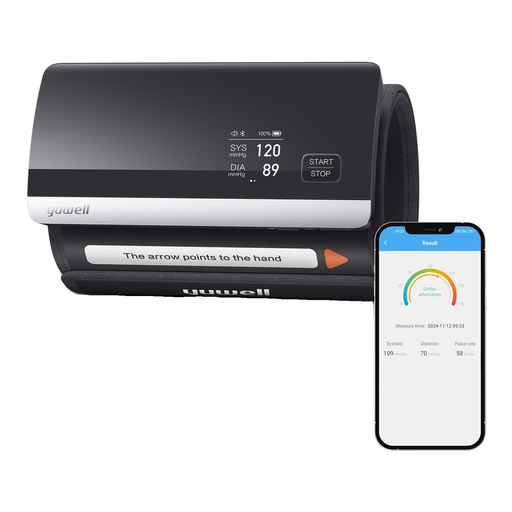
Why this product suits the profile: For users interested in app documentation, voice output and a larger cuff range, this model offers Bluetooth, a 22–45 cm cuff and a rechargeable battery.
The cuff range is clearly stated before purchase. The AFib function should be understood as an indicator and not used for self-diagnosis.
AFib and arrhythmia indicator according to the product description, voice output, Bluetooth app and rechargeable battery for regular use.
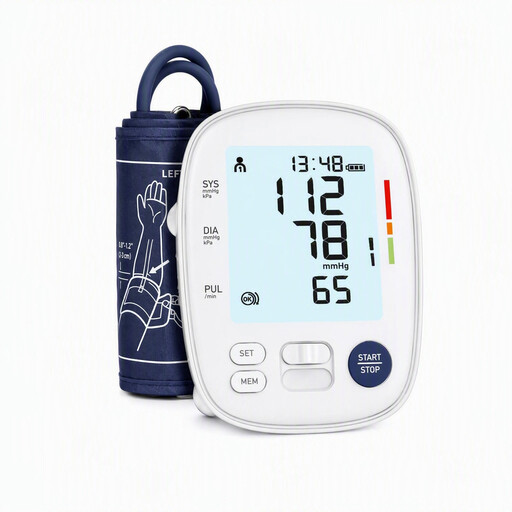
Why this product suits the profile: Two separate memories with 120 slots each make it easy for two people to use. The 63 × 81 mm display and 22–42 cm cuff are designed for everyday family life.
The cuff size and memory allocation are clearly stated. Movement and cuff indicators can highlight operating errors before the measurement.
Two memories with 120 readings each, average of the last three readings, USB-C or battery operation and arrhythmia indicator according to the description.
We’ve put together a complete, regularly updated list of products that fully meet these strict selection criteria and the safety regulations in force in the EU.
The readings from a digital blood pressure monitor are for guidance and do not replace a diagnosis. If you have acute symptoms, seek medical help immediately.
The lifespan depends on the model, cuff, batteries and how it’s handled. For the Sinocare device, the product description states a product lifespan of five years. In general, you should regularly check the cuff, cable and display for wear and tear. A damaged cuff should not be used further.
Yes, provided the display, cuff and operation suit the user. Large digits, few buttons, clear symbols and, if needed, voice output are useful. Before buying, check that the cuff covers the actual upper arm circumference and that batteries or the rechargeable battery can be easily changed or charged.
Battery-operated models mainly incur costs for replacement batteries. Devices with a USB port or rechargeable battery can reduce these expenses, but need a suitable cable or charger. With app models, you should also check whether a smartphone is required for data management and which operating systems are supported.