
Lieferung heute & morgen

Qualitätsgarantie

Willkommens-Angebote freischalten: KOSTENLOSE Lieferung | Bis zu 80 % RABATT | Kostenlose 30-Tage-JoyPlus-Testphase
App herunterladen
An upper arm blood pressure monitor should measure your readings regularly without making everyday use unnecessarily complicated. Many buyers, however, look first at app features, colour displays or especially low prices. Other factors often matter more in day-to-day use: a well-fitting cuff, easy-to-read numbers and controls that work reliably, even with frequent use.
As a Joybuy Product Recommendation Officer, I filter the key product details according to practical criteria. This can help you avoid common mistakes when buying a blood pressure monitor for home use.
The cuff must fit your upper arm. A cuff that is too tight or too loose can affect the reading and feel uncomfortable. So a claim such as ‘suitable for adults’ is not enough. Measure your upper arm and compare the result with the stated range.
For larger upper arms, models with cuffs measuring 22 to 42 cm or 22 to 45 cm may be suitable. A blood pressure monitor for larger upper arms will not automatically fit everyone: your actual arm circumference is what matters.
Bluetooth, app connectivity and multiple memory profiles can be useful. But if the features are awkward to set up, they often go unused in everyday life. For older people and their family members, a large display, a clearly marked start button and easy-to-understand instructions are often more important than a long list of features.
An automatic blood pressure monitor should make it as easy as possible to start a reading once the cuff is in place. Guidance on cuff positioning or movement can also help you take a reading correctly.
Colour-coded classifications can make readings easier to understand, but they are no substitute for a doctor’s assessment. An arrhythmia detection feature only indicates irregular heartbeats during a reading. It does not provide a diagnosis. If you repeatedly get unusual readings or experience symptoms, seek medical advice.
A blood pressure monitor with an upper arm cuff is fitted around your bare upper arm, usually a few centimetres above the bend of your elbow. The device should not be used over clothing. Before you buy, check the following:
Models with a range of 22 to 45 cm fit a wider range of users than devices with a narrower range. Even so, always check your actual arm circumference.
A digital blood pressure monitor should clearly show your systolic and diastolic readings, as well as your pulse. Large numbers, a backlit screen or a high-contrast display can be helpful for older users. One-button operation and automatic shut-off help reduce operating errors.
Memory functions are useful if you want to compare readings over a longer period. Two user profiles help keep different people’s readings separate. Depending on the model, memory capacity can range from 40 to 199 readings.
A blood pressure monitor with Bluetooth and an app is a good choice if you want to store your readings digitally or keep track of changes over time. Before you buy, check:
An app is no substitute for medical assessment, but it can make it easier to keep records for your own reference or to discuss with a healthcare professional.
The selection below compares specific models based on their controls, cuffs and memory or app features.
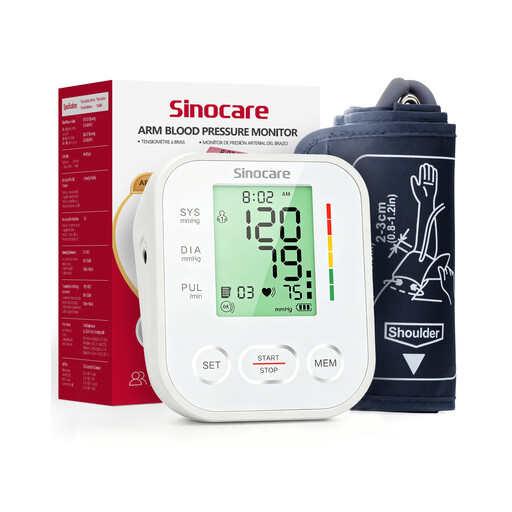
Why this product suits this profile: One-button operation and a 3.6-inch LCD display make this a good option if you want a straightforward device for regular readings.
The product details specify an upper arm cuff for adults and automatic measurement. This makes it easier to check whether the cuff will fit before you buy.
Automatic upper arm measurement, a large LCD display and an arrhythmia alert, according to the product description.
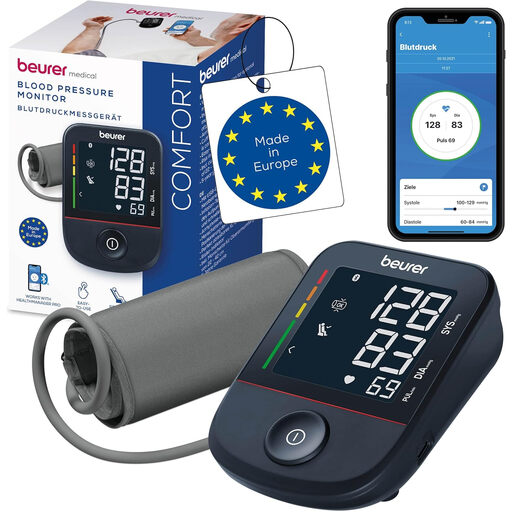
Why this product suits this profile: This model combines one-button operation, a large display and Bluetooth with a cuff for upper arm circumferences of 22 to 42 cm.
The cuff size is clearly specified. Cuff position monitoring and a rest indicator can also help flag potential errors when taking a reading.
Bluetooth data transfer to the Beurer HealthManager Pro app, with support for Apple Health, Samsung Health and Health Connect.
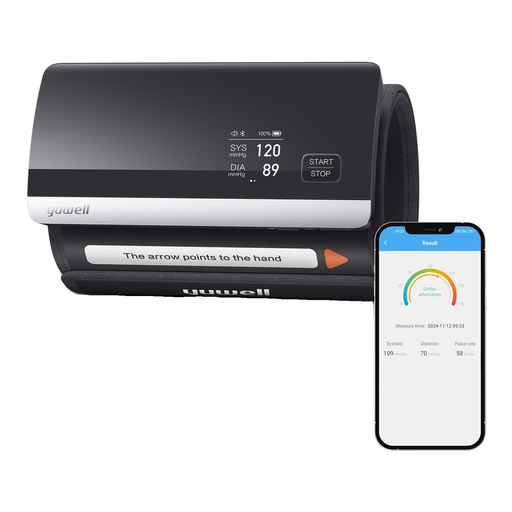
Why this product suits this profile: The 22 to 45 cm cuff, voice function, rechargeable battery and app connectivity make it suitable for frequent readings at home or on the go.
The wide cuff range reduces the risk of choosing the wrong size. Voice playback and guidance in the app can help you use the device, but they are no substitute for the instructions for use.
Bluetooth synchronisation, a rechargeable battery, voice function and AFib detection, as stated in the product description.
We’ve put together a comprehensive, regularly updated list of products that meet these strict selection criteria and comply fully with the safety regulations in force in the EU.
Sit with your back supported and both feet flat on the floor. Wait a few minutes before taking a reading, then fit the cuff around your bare upper arm and keep your arm roughly level with your heart. Don’t speak or move during the reading. Always follow the instructions for use supplied with your device.
How long it lasts depends on the model, cuff, batteries and how well it is looked after. Store the main unit in a dry, protected place. Don’t crease or twist the cuff excessively. Replace the device or its accessories if you notice visible damage, unclear readings or a cuff that no longer fits.
For battery-powered devices, ongoing costs mainly come from replacing the batteries. Models with a mains adapter or rechargeable battery can reduce battery use. If you choose a Bluetooth device, also check that the app you want to use will remain compatible with your smartphone.