
Lieferung heute & morgen

Qualitätsgarantie

Willkommens-Angebote freischalten: KOSTENLOSE Lieferung | Bis zu 80 % RABATT | Kostenlose 30-Tage-JoyPlus-Testphase
App herunterladen
Author: Joybuy Product Recommendation Officer
An upper-arm blood pressure monitor can make regular checks at home easier. However, to ensure your purchase is genuinely useful in everyday life, you should look beyond display size, brand name and advertising claims. The most important factors are a suitable cuff, straightforward operation and features that match the way you intend to use the device.
A cuff that is too small or too large can make the device more difficult to use and affect the results. Details such as ‘suitable for adults’ are therefore less useful than the specific upper-arm circumference in centimetres. Many devices cover a range of 22 to 42 cm. For larger upper arms, models covering 22 to 45 cm or those supplied with special XL cuffs may be suitable.
A blood pressure monitor with Bluetooth, an app and voice prompts can be convenient. However, if you only want to read your readings in the morning and evening, you do not necessarily need smartphone connectivity. Conversely, internal memory for several people is useful when parents and children share the same device.
An arrhythmia detection feature indicates irregular heartbeats during the measurement. It does not replace medical assessment and is not a diagnosis. Coloured classifications on the display are also intended for guidance only.
A blood pressure monitor with a large display should offer more than easy-to-read figures. It should also have clearly recognisable buttons, understandable symbols and an uncluttered display. For older users, one-button operation, automatic switch-off and a clearly labelled start button are often more important than numerous additional menus.
When measuring blood pressure on the upper arm, the cuff should sit directly on the skin and approximately level with the heart. Measure your upper-arm circumference while relaxed and compare it with the manufacturer’s specification. Common ranges include:
Correct positioning, sitting still and taking a short rest before measuring are required regardless of the model.
For some of the devices listed, the stated technical tolerances are ±3 mmHg for blood pressure and ±5 % of the measured value for pulse. These figures come from the respective product specifications and should not be equated with an individual medical accuracy guarantee.
An automatic blood pressure monitor should take the measurement at the press of a button and display systolic pressure, diastolic pressure and pulse separately. A blood pressure monitor with memory stores readings together with the date and time. Two memory profiles prevent different users’ records from being mixed up. Depending on the model, there may be 90, 99, 100 or 120 memory slots per person, for example.
Digital devices often run on AAA or AA batteries. Some models also support USB or feature a rechargeable battery. Before buying, check whether batteries, a mains adapter or a USB cable are included. Automatic switch-off reduces power consumption if you forget to turn the device off after measuring.
The following selection matches specific models to different everyday situations based on their stated features. Details such as arrhythmia detection and app compatibility refer to the respective product descriptions.
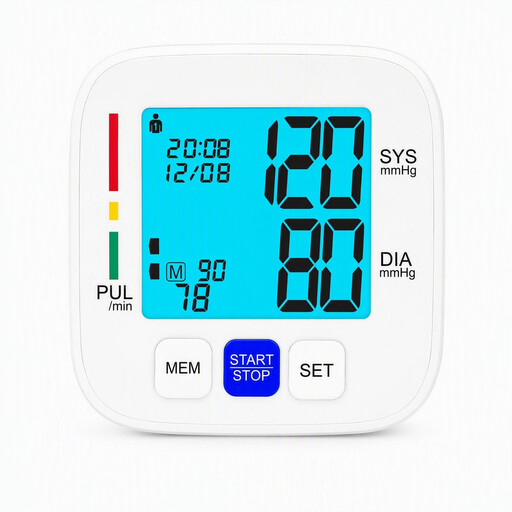
Why this product suits this profile: This compact automatic digital blood pressure monitor is designed for users who want to measure at home without an app or complicated settings.
The 22–42 cm cuff range is clearly specified. Two memory profiles with 90 slots each help keep readings separate.
Automatic calculation of the average from three readings, date and time display, and automatic switch-off after three minutes.
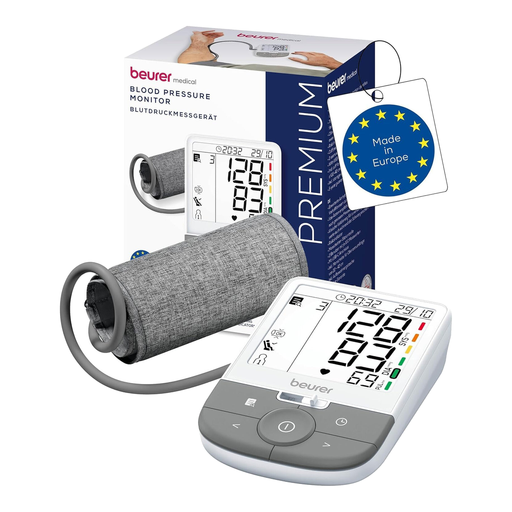
Why this product suits this profile: Suitable for users who want to combine a larger display, several usage checks and digital storage.
The product description mentions cuff-fit detection, a resting indicator and an illuminated XL display. This makes key operating points easy to see.
Two user profiles with 100 memory slots each, a 7-day average and synchronisation with the HealthManager-Pro app and selected health platforms.
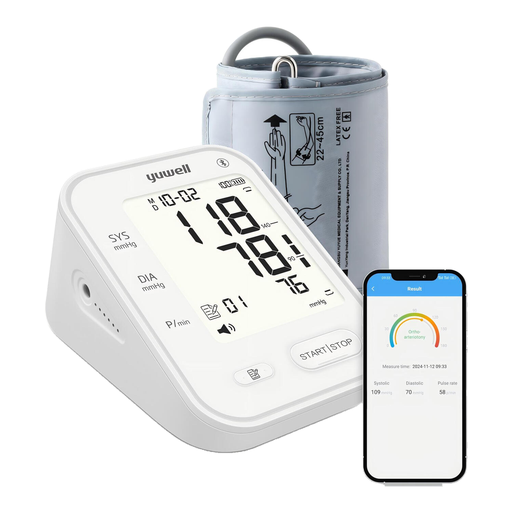
Why this product suits this profile: This model is aimed at users who measure frequently, manage their readings digitally and need a wider cuff range.
The 22–45 cm cuff range is designed for larger upper arms. App connectivity reduces the need to transfer numerous readings manually.
Bluetooth, rechargeable battery, illuminated display and export options via the yuwell HealthCare+ app, according to the product description.
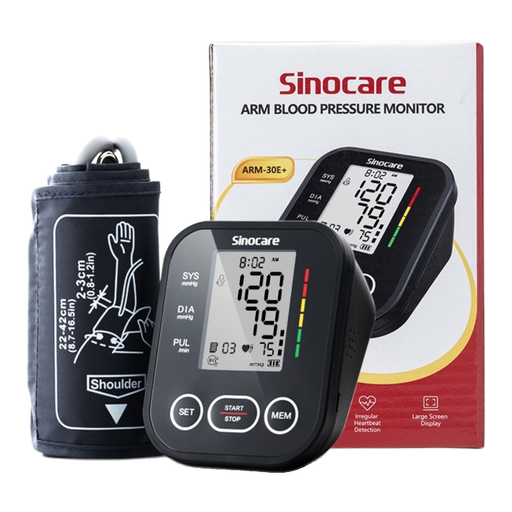
Why this product suits this profile: One-button operation and the 3.6-inch LCD display are suitable for users who prefer a straightforward measuring routine.
The arrhythmia alert function is explicitly listed. Nevertheless, you should check that the cuff is suitable and follow the instructions for use.
Generous display, automatic inflation and a package containing an upper-arm cuff, four AAA batteries and instructions.
We have compiled a complete, regularly updated list of products that fully meet these strict selection criteria and the safety regulations applicable in the EU.
For comparable readings, the following routine is recommended:
Readings are intended as a guide to your health and do not replace a diagnosis. If readings are repeatedly unusual or the device indicates an irregular heartbeat, seek medical advice. Do not change medication yourself based on individual readings.
Service life depends on usage, the power supply, the cuff and storage conditions. Keep the device dry, protected from impacts and within the specified temperature ranges. The cuff should not be folded or pulled unnecessarily hard. Specific product lifespans may vary from model to model.
For battery-powered devices, the main ongoing cost is AA or AAA batteries. Models with a USB connection or rechargeable battery can reduce the need to replace batteries. Check whether a mains adapter is included and whether the device can alternatively be operated with batteries.
No. The function can indicate certain irregularities during measurement, but it is not a medical diagnosis. It should be treated as an alert. If irregularities are shown repeatedly or you have symptoms, medical assessment is required.