
Lieferung heute & morgen

Qualitätsgarantie

Willkommens-Angebote freischalten: KOSTENLOSE Lieferung | Bis zu 80 % RABATT | Kostenlose 30-Tage-JoyPlus-Testphase
App herunterladen
An upper arm blood pressure monitor can make regular home checks much easier. But not every digital blood pressure monitor suits every household. Poor purchases often happen not because of the price, but because of an ill-fitting cuff, hard-to-read displays, or features that never get used in daily life.
A cuff that is too tight or too loose can make the device difficult to use and affect the reading. What matters is not the label “large”, but the specific circumference stated. For many adults and families, a blood pressure monitor with a cuff of 22–42 cm is a practical choice. Some models even cover 22–45 cm.
Before buying, measure your upper arm circumference at the intended measurement point. The cuff must fit securely without digging in uncomfortably.
A blood pressure monitor with a large display is not automatically senior-friendly. You also need clearly visible digits, strong contrast, and a well-organised layout of blood pressure and pulse symbols. Voice guidance or a backlight can be helpful depending on your daily routine, but not every model includes them.
A blood pressure monitor with memory is handy if you want to record several readings. For a single-person household, 60 to 90 memory slots are often enough. With two users, separate profiles make sense so that readings don’t get mixed up.
A Bluetooth blood pressure monitor can send data to an app. Before buying, check whether your smartphone is compatible, which app is required, and whether the data remains accessible on the device even without regular syncing.
For home use, an automatic upper arm blood pressure monitor is generally recommended, because the cuff is positioned on the upper arm rather than the wrist. Look for:
The product data should state a blood pressure measurement range and a pulse range. For several of the devices featured here, a blood pressure accuracy of ±3 mmHg and a pulse accuracy of ±5 % of the reading are given. These figures come from the respective product descriptions and should not be taken as individual medical advice.
Always take measurements under comparable conditions. Your body should be relaxed and still during the measurement. The results are for health information purposes and do not replace a doctor’s diagnosis.
The arrhythmia detection function, or IHB indicator, points to irregular heartbeats during the measurement. Such an indicator is not proof of a medical condition. If irregularities occur repeatedly, you should seek medical advice.
Also useful is the automatic calculation of the average from three readings. It helps you get an overview of several consecutive measurements, but it does not replace a medical evaluation.
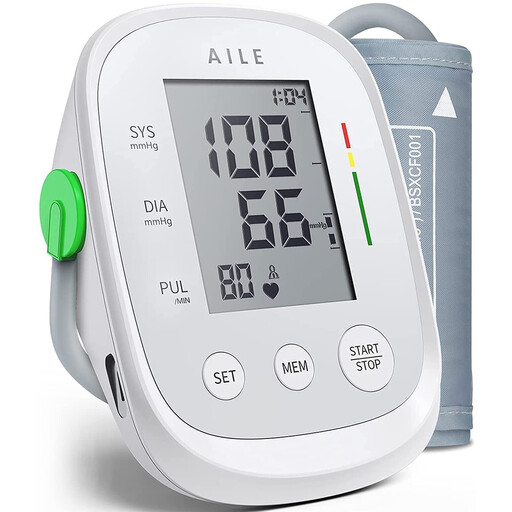
Why this product fits the profile: This model offers automatic measurement, a cuff for 22–42 cm and two user profiles. The operation stays focused on the essential functions.
The stated cuff width is clearly specified. What’s more, up to 99 memory slots per user are provided, so you don’t have to rely solely on manual note-taking.
22–42 cm cuff; two profiles with a total of 198 memory slots; power via USB or four AAA batteries.
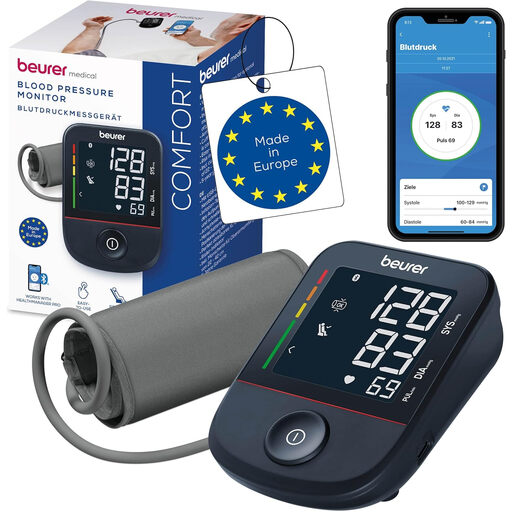
Why this product fits the profile: This device combines one-button operation, a large display, Bluetooth and an app connection. The cuff is designed for an upper arm circumference of 22–42 cm.
The app is an addition, not the only way to view readings. The device still has its own display and an automatic measurement function.
Bluetooth transfer to the HealthManager Pro app; arrhythmia detection; cuff position control and rest indicator.
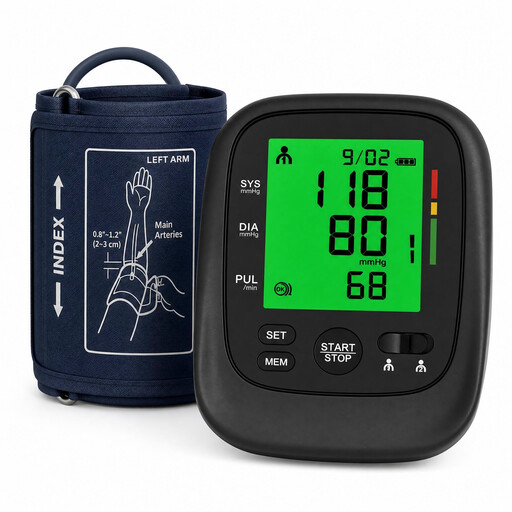
Why this product fits the profile: This automatic blood pressure monitor offers two user profiles with 120 memory slots each, an average of three readings, and both USB-C and battery operation.
The 22–42 cm cuff, movement detection and cuff position indicator address typical usability issues in family life.
Large LCD display measuring 63 × 81 mm; arrhythmia and movement detection; optional Bluetooth sync and voice function according to the product description.
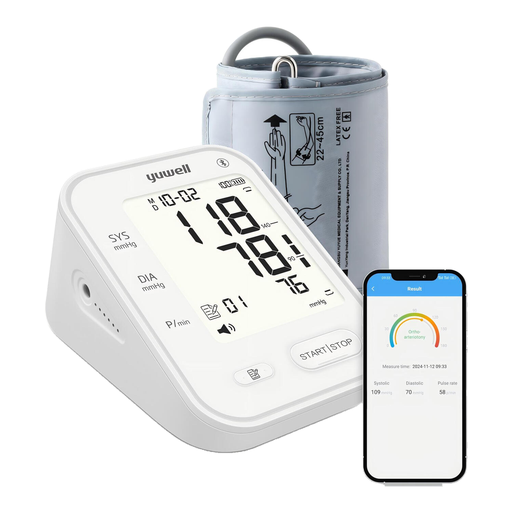
Why this product fits the profile: This model is aimed at people who want to manage their readings digitally and need a larger cuff for 22–45 cm.
The extended cuff range is clearly stated as 22–45 cm. The readings can also be viewed on the device itself and managed via Bluetooth.
Bluetooth app for iOS and Android; backlit display; rechargeable battery and voice output according to the product description.
We have put together a full, regularly updated list of products that fully meet these strict selection criteria and the safety regulations in force in the EU.
Before measuring, sit quietly for a few minutes. Place the cuff directly on your upper arm following the instructions. During the measurement, do not speak and keep your arm relaxed.
With battery-operated devices, batteries are an ongoing cost. So check whether AAA or AA batteries are needed, and whether a mains adapter, USB cable or rechargeable battery is included. An automatic shut-off function can reduce power consumption. The lifespan depends on usage, storage, battery care and following the manufacturer’s instructions. A general usage period cannot be stated for all devices.
That depends on your personal situation and your doctor’s recommendations. For comparable readings, try to keep the time of measurement, your sitting posture and your rest period as similar as possible. If readings are unusual or consistently high, it is worth getting a medical check-up.
No. Bluetooth is a convenience feature for users who want to store readings in an app or manage their history digitally. A device with a display and internal memory is sufficient if you record readings manually or only check occasionally.
A fixed lifespan cannot be guaranteed across the board. Pay attention to the manufacturer’s information, store the device in a dry, protected place, and avoid knocks and direct sunlight. If the cuff is damaged, the display is unclear, or readings are repeatedly unusual, do not simply continue using the device — have it checked and replace it if necessary.