
Lieferung heute & morgen

Qualitätsgarantie

Willkommens-Angebote freischalten: KOSTENLOSE Lieferung | Bis zu 80 % RABATT | Kostenlose 30-Tage-JoyPlus-Testphase
App herunterladen
An upper arm blood pressure monitor is more practical for many households than a wrist model, because when used correctly, measuring on the upper arm allows for well-comparable documentation. If you want to measure your blood pressure and pulse regularly, however, you shouldn't be guided solely by large displays, app icons or advertising claims.
A cuff that is too tight or too loose can affect the measurement and reduce comfort. The cuff size is particularly often overlooked when buying a blood pressure monitor for large upper arms. What matters is not your height, but the actual circumference of your upper arm.
Before buying, measure your arm circumference with a tape measure roughly halfway between your shoulder and elbow. Many models cover a range of 22 to 42 cm, with some versions reaching up to 45 cm. For significantly narrower or wider upper arms, a suitable additional cuff may be necessary.
An automatic blood pressure monitor with Bluetooth, an app and several analysis functions is not automatically suitable for every household. If the operation is complicated or your smartphone needs to be reconnected regularly, stored readings may remain unused.
For older people and those with impaired vision, a large display, clearly legible digits, few buttons and a straightforward instruction manual are often more important than additional menus. A voice output can make operation easier, but it does not replace checking the cuff position and your posture.
A blood pressure monitor with arrhythmia detection can indicate irregular heartbeats during measurement on certain devices. Such alerts are not a diagnosis. Colour displays for blood pressure classification are also for guidance only.
Readings should not be used independently to change a treatment or medication. If results are repeatedly abnormal or you have symptoms, medical advice is necessary.
The cuff is placed on the bare upper arm, while your arm rests relaxed at heart height. During the measurement, you should not speak and remain as still as possible. A rest period of about five minutes beforehand is recommended.
Check on your digital blood pressure monitor:
For a single person, a memory of 90 or 100 readings may be sufficient. In a family household, two separate user profiles make sense so that readings are not mixed up. Some devices also calculate the average of the last three measurements. This makes tracking your progress easier, but does not replace a medical assessment.
Battery-operated devices are flexible and can also be used on the go. Models with a USB port or a rechargeable battery reduce the need for battery changes. Check whether a mains adapter is included in the delivery or must be purchased separately.
For a blood pressure monitor for home use, also consider:
The following selection assigns models to different everyday situations based on specific features. Details of functions and what's included refer to the respective product descriptions.
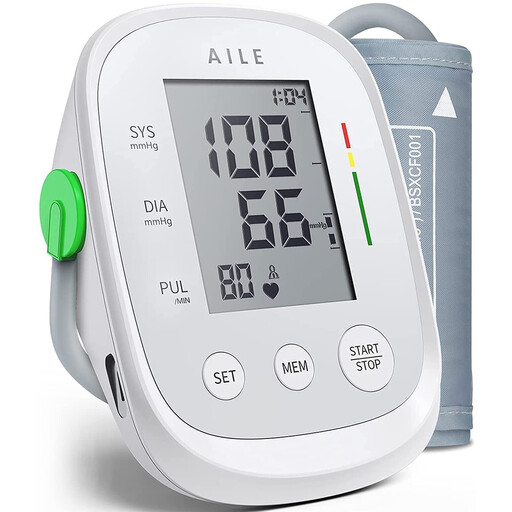
Why this product fits the profile: The automatic measurement, two user profiles and an upper arm range of 22 to 42 cm cover basic household requirements. Up to 99 memory slots are available per person.
The stated cuff range is clearly indicated. USB cable and battery operation offer two options for power supply; AAA batteries and mains adapter are not fully included according to the product information.
Two memory areas with a total of 198 readings and automatic average calculation of the last three values.
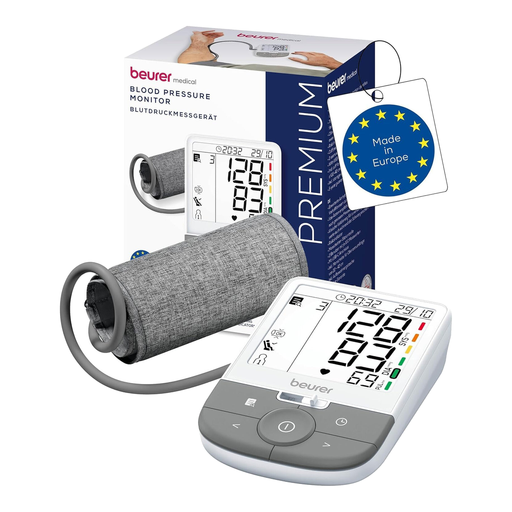
Why this product fits the profile: This model combines a backlit XL display, two memory areas with 100 slots each and app connectivity to HealthManager Pro, Apple Health, Samsung Health and Health Connect.
Rest indicator and cuff fit check point to important application steps. The extended arrhythmia detection is to be understood as a warning function, not a medical diagnosis.
Triple measurement, 7-day average and synchronisation via app; cuff for 22 to 42 cm.
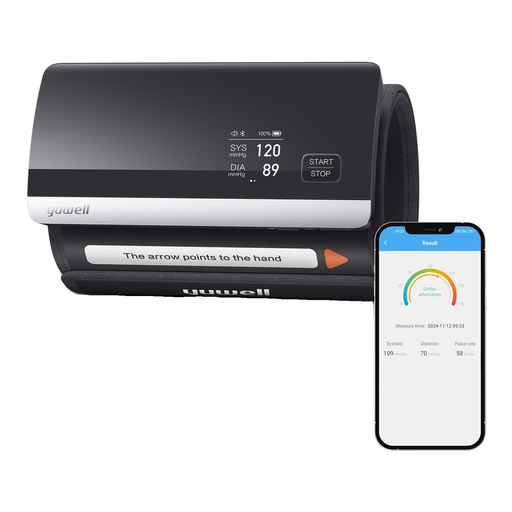
Why this product fits the profile: This model is aimed at users who want to document readings digitally and have a larger upper arm circumference. The cuff is specified for 22 to 45 cm, plus there is voice output and a rechargeable battery.
The large cuff range reduces the risk of an unsuitable standard size. Nevertheless, you should measure your own arm circumference before buying and check the app compatibility.
Bluetooth synchronisation, AFib warning function, voice output and 22 to 45 cm cuff according to the product description.
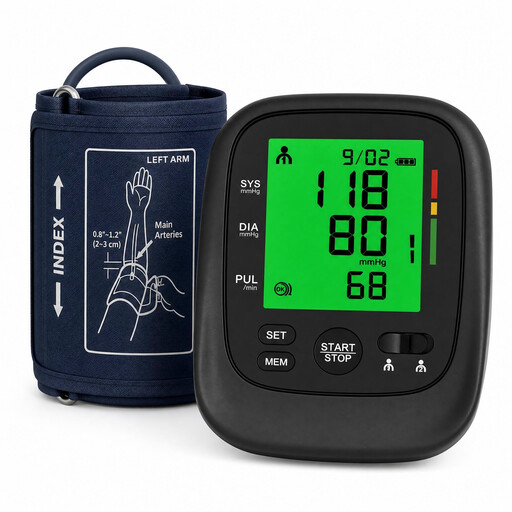
Why this product fits the profile: The 63 × 81 mm LCD display, two user profiles and 120 memory slots each are suitable for families who want to keep readings separate.
Cuff fit and movement alerts help with application. The voice output is optional; if you want to use Bluetooth, you should check the specific features of the chosen variant.
Large display, USB-C and battery operation as well as 2 × 120 memory slots with a cuff of 22 to 42 cm.
We have put together a complete, regularly updated list of products that fully meet these strict selection criteria and the safety regulations in force in the EU.
For the most comparable readings possible, a consistent routine is recommended:
The lifespan depends on the build quality, power supply, cuff and frequency of use. Batteries and rechargeable batteries are consumable items. The cuff should also be checked regularly for tears, loose Velcro areas or material changes. The manufacturer's specifications and the instruction manual are decisive.
With battery models, the main costs are for replacement batteries. USB or rechargeable devices can reduce these expenses, but require a charging option. For a realistic assessment, buyers should check whether batteries, USB cable and mains adapter are included in the delivery.
No. For regular single measurements, a clearly readable device with internal memory is sufficient. An app is useful if you want to document many readings over a longer period, sort them by user profile or share them digitally. Before buying, your smartphone's operating system, app availability and Bluetooth function must all be compatible.