
Lieferung heute & morgen

Qualitätsgarantie

Willkommens-Angebote freischalten: KOSTENLOSE Lieferung | Bis zu 80 % RABATT | Kostenlose 30-Tage-JoyPlus-Testphase
App herunterladen
An upper-arm blood pressure monitor is a practical way for many households to record readings regularly. The choice ranges from simple automatic blood pressure monitors to connected models with Bluetooth, an app and voice prompts. However, not every feature is useful for every need.
If you focus only on big promises such as “medical accuracy”, a particularly wide range of extra features or a strikingly low price, you can easily overlook crucial details. These include an unsuitable cuff, hard-to-read displays or a power supply that is impractical for everyday use.
The cuff must fit your upper-arm circumference. If it is too tight or too loose, it can affect the reading. Measure your arm circumference at the intended measurement point before buying. Many devices cover a range of 22 to 42 cm, while models with particularly large cuffs can sometimes accommodate 22 to 45 cm.
A blood pressure monitor with arrhythmia detection can indicate irregular heartbeats during a measurement. However, this function is only an indication. It is not a diagnosis, and repeated irregular readings should be assessed by a doctor. The same applies to devices that may detect atrial fibrillation.
A digital blood pressure monitor with an app can make monitoring and recording readings easier. However, the app, smartphone and operating system must be compatible. Also check whether readings are synchronised automatically, assigned to multiple users or exportable as a file. Without these functions, the app may not live up to expectations.
The cuff is one of the most important technical factors. It should be fitted to the bare upper arm, approximately level with the heart and in accordance with the operating instructions. During the measurement, sit still, do not speak and keep your arm still.
Models with different cuffs can be useful for households with several people. For example, the Braun ExactFit 3 BUA6150WE comes with one cuff for smaller upper arms up to 21 cm and another cuff for 33 to 43 cm. This is practical when users have significantly different arm circumferences.
A blood pressure monitor for seniors should have an easy-to-read display and as few operating steps as possible. Large digits, a backlight, colour-coded indicator scales or voice prompts can make the device easier to use. It is still important that systolic and diastolic blood pressure readings, as well as the pulse, are clearly shown separately.
One-button operation reduces the risk of operating errors. Additional guidance on cuff positioning or movement during the measurement can also be helpful, but it does not replace correct posture.
If you measure regularly, pay attention to the memory capacity. Separate memory areas are helpful for two people. Some models store 90 to 120 readings per user, while others offer 40 or 100 memory spaces per person.
An upper-arm blood pressure monitor with Bluetooth is suitable for users who want to manage readings on their smartphone over the long term. A rechargeable blood pressure monitor is practical for travelling, while battery-powered devices work independently of chargers. Check whether batteries, a USB cable, power adapter or mains adaptor are actually included in the package.
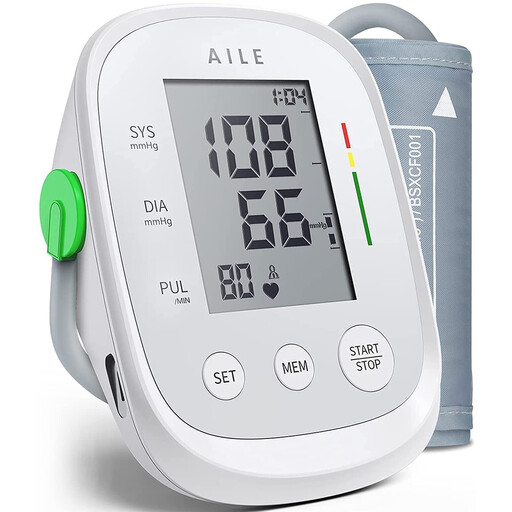
Why this product suits the profile: This automatic blood pressure monitor features a 22–42-cm cuff, two user profiles and 99 memory spaces per user. It can be powered via USB or four AAA batteries; according to the product description, the batteries are not included.
The defined cuff range and separate memory areas prevent readings from becoming unclear or being assigned to the wrong person in a family household.
Generous memory capacity, USB operation and automatic calculation of the average from three readings.
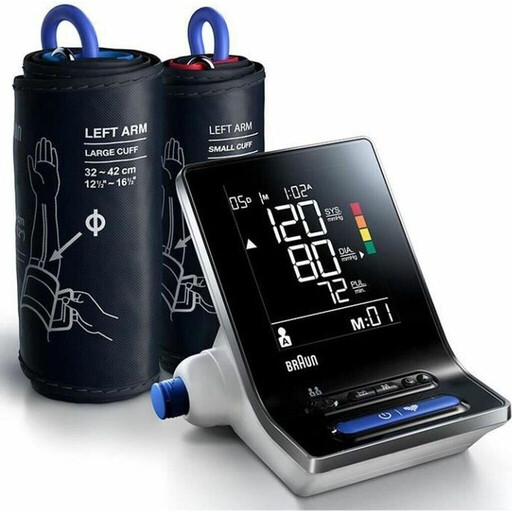
Why this product suits the profile: This model has an XL display, two user profiles, 40 memory spaces per user and two cuffs for different upper-arm circumferences.
The two cuffs reduce the risk of having to use a standard size that does not fit properly.
Three consecutive readings with an average value, an XL display and automatic detection of irregular heartbeats.
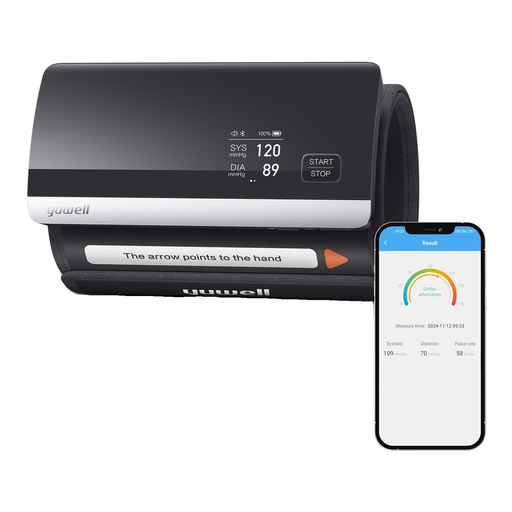
Why this product suits the profile: The 22–45-cm cuff, Bluetooth transmission, app connectivity, voice prompts and rechargeable battery are designed for regular use at home and on the go.
The wide cuff range addresses the common sizing pitfall, while the app and voice prompts make tracking readings and operating the device easier.
AFib indication according to the product description, Bluetooth synchronisation, voice function and a battery instead of regular battery changes.
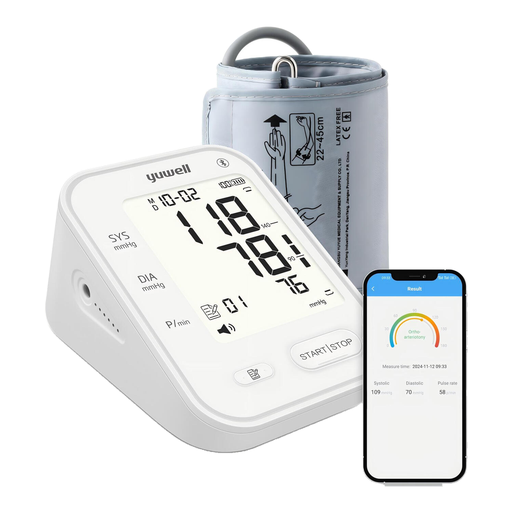
Why this product suits the profile: This model combines a 22–45-cm cuff with Bluetooth, app storage, PDF and CSV export, as well as a backlit display.
The product description specifies the usable cuff range and explains the export options, rather than promoting app connectivity only in general terms.
Data export as PDF or CSV, a wide cuff range and rechargeable power supply.
For comparable readings, it is advisable to follow a consistent routine:
With battery-powered devices, check whether replacement batteries are readily available. A USB or rechargeable model may be more practical when travelling, but it requires a suitable charging cable and regular recharging. For long-term use, you should also consider the cuff, instructions, app support and warranty terms.
A blood pressure monitor is designed to help monitor your health, not to provide an independent diagnosis or treatment. Do not change medication based on individual readings. If readings remain unusual or indicate irregular heartbeats, seek medical advice.
We have put together a complete, regularly updated list of products that fully meet these strict selection criteria and the safety regulations applicable in the EU.
Fit the cuff to your bare upper arm, with the lower edge a few centimetres above the crook of your elbow. Position the tube according to the instructions. Rest your arm comfortably at heart level. The exact procedure may vary depending on the model.
Its service life depends on the model, battery or batteries, cuff and care. Store the device in a dry place, protected from significant temperature fluctuations and in accordance with the manufacturer’s instructions. Do not continue using a damaged or stretched cuff.
Battery-powered models incur regular costs for AA or AAA batteries. Rechargeable devices instead require electricity for charging. Bluetooth models may also use an app that, according to the product description, is provided free of charge or by the manufacturer. Before buying, check that the app, smartphone and preferred health platform are compatible.