
Lieferung heute & morgen

Qualitätsgarantie

Willkommens-Angebote freischalten: KOSTENLOSE Lieferung | Bis zu 80 % RABATT | Kostenlose 30-Tage-JoyPlus-Testphase
App herunterladen
An upper-arm blood pressure monitor should be reliable and easy to use every day, with a clear display and a cuff that fits your arm. However, many buyers initially focus on terms such as “smart”, “precise” or “medical”. On their own, these marketing claims say little about practical suitability. The important factors are the technical specifications, a properly fitting cuff and straightforward operation.
A Bluetooth blood pressure monitor can transfer readings to an app automatically. This makes record-keeping easier, but does not automatically improve the measuring conditions. If you talk or move during the measurement, or fit the cuff incorrectly, you may get unusable readings – regardless of how advanced the app is.
Before buying, check the following:
Cuff size is one of the most important selection criteria. A cuff for an upper-arm circumference of 22 to 42 cm will fit many adults, but not everyone. People with particularly slender or larger upper arms may need a different model.
Measure your upper-arm circumference while relaxed and compare it with the manufacturer’s specification. A large display is of little use if the cuff does not fit correctly.
Many digital blood pressure monitors display a warning when they detect an irregular pulse. This arrhythmia detection can be helpful when keeping records, but it is not a medical diagnosis. Repeated warnings or unusual readings should be checked by a healthcare professional. Do not change your medication yourself based on a reading taken at home.
An automatic upper-arm monitor is fitted around the bare upper arm using the cuff. During measurement, your arm should be positioned at heart level. A wrist monitor is more compact and can be practical when travelling, but requires especially precise positioning.
For regular use at home, an upper-arm blood pressure monitor for home use is often easier to incorporate into a standardised measuring routine. A wrist model may be a sensible choice when portability and low weight are the main priorities.
Look for:
An upper-arm blood pressure monitor for seniors should also have a large display, high-contrast figures and as few operating steps as possible. Voice guidance can be useful for some users, provided it can be switched off.
An upper-arm blood pressure monitor with memory makes it easier to track readings over time. For households with two people, the 2 users function is useful because it keeps measurement records separate. Some devices can store, for example, 90, 99, 100 or 120 readings per user.
Calculating the average of the last three readings can make record-keeping more systematic. However, it does not replace a correct measuring routine. Also check whether the device runs on AAA or AA batteries, a USB cable, a mains adaptor or a rechargeable battery.
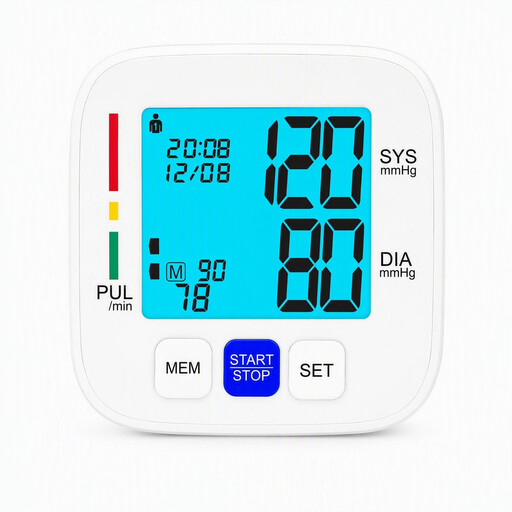
Why this product suits this profile: This model focuses on automatic daily measurements at home and offers two separate memories, each with space for 90 readings.
The 22–42 cm cuff and automatic average calculation help reduce common operating and record-keeping problems.
Two memories with 90 readings each, an average of 3 measurements and automatic switch-off.
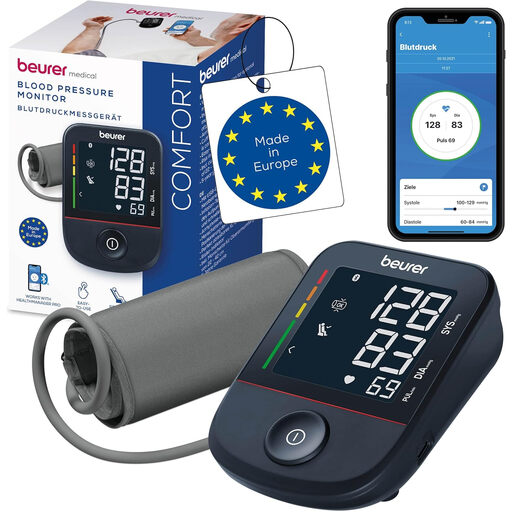
Why this product suits this profile: One-button operation, an extra-large display and Bluetooth connectivity make this model appealing to users who want to manage their readings systematically in an app.
The cuff-fit check and rest indicator provide additional guidance on correct use before measuring.
Cuff for 22–42 cm, Bluetooth, HealthManager Pro app and synchronisation with Apple Health, Samsung Health and Health Connect.
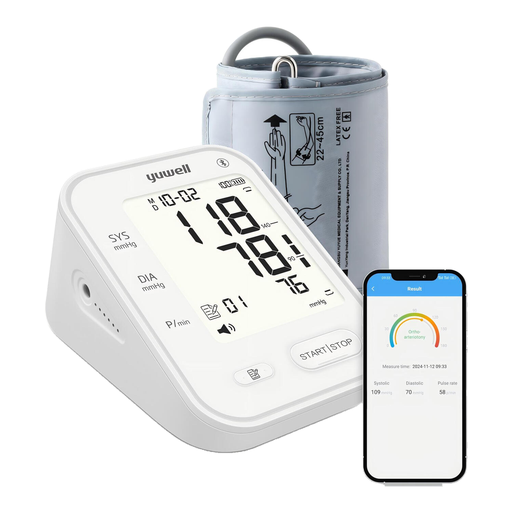
Why this product suits this profile: Designed for regular series of readings and users with larger upper arms, this model offers a 22–45 cm cuff and app connectivity.
The wider cuff size prevents buyers from choosing based solely on the display or app and overlooking the fit.
Bluetooth app, PDF and CSV export according to the product description, voice guidance and a rechargeable battery.
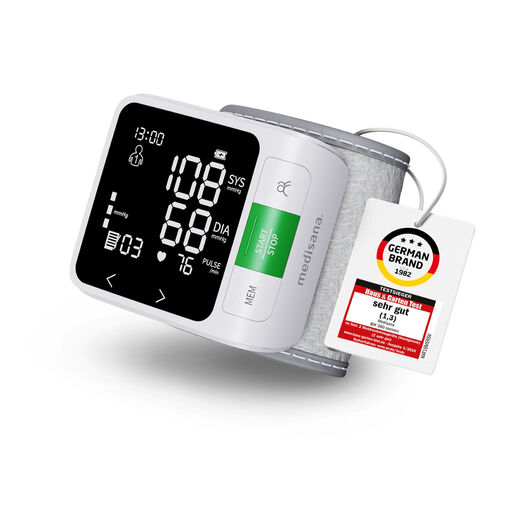
Why this product suits this profile: This wrist model is ideal for users looking for a compact device with Bluetooth, two user profiles and generous storage capacity.
The 199 memory slots for two people and the average calculation reduce the need for manual note-taking and help prevent readings from being mixed up.
Large LCD display, VitaDock+ app, arrhythmia warning and 199 memory slots for two users.
We have put together a complete, regularly updated list of products that fully meet these strict selection criteria and the safety regulations applicable in the EU.
The readings are for guidance only and do not replace medical advice. If you have persistently unusual readings, symptoms or repeated arrhythmia warnings, consult a doctor or other healthcare professional.
Its service life depends on the build quality, cuff, batteries and how the device is handled. Store the blood pressure monitor in a dry place, protected from heat and impacts. The cuff should not be folded or twisted unnecessarily. If there is visible damage or the readings are unclear, having the device checked or replacing it may be advisable.
Battery-powered models mainly incur the cost of replacement batteries. Devices with a USB connection or rechargeable battery can reduce these ongoing costs, but require a suitable cable or regular charging. Also check whether batteries are included with the product.
That depends on how the specific model is operated. One-button control, a large display, voice prompts and automatic data transfer can make it easier to use. Ideally, a relative should set up the initial connection with the app. Anyone who does not want to use an app should choose a device with sufficient internal memory.