
Lieferung heute & morgen

Qualitätsgarantie
App herunterladen
Kategorien
The increasing power demands of modern devices like laptops, tablets, and smartphones require adequate charging solutions. The USB Power Delivery (PD) standard has established itself as the universal interface for high-power electrical transmission. To fully leverage the potential of power adapters and devices that support 100 watts, a specifically rated 100W USB-C cable is a technical necessity. Such a cable is fundamentally different from standard USB-C cables, which are often limited to 60 watts (20V/3A).
This article examines the technical parameters relevant to selecting a 100W PD charging cable and presents a selection of models with distinct functional focuses.
The choice of a suitable cable should be based on an analysis of objective technical specifications. The following parameters are crucial for function and safety.
A cable designed to transmit 100 watts must be rated for a current of 5A at a voltage of 20 volts. The critical component for this is the integrated E-Marker Chip (Electronic Marker). This chip actively communicates with the charger and the device being charged. It transmits information about the cable's specifications, particularly its maximum current capacity. Without a correctly functioning E-Marker chip to signal its 5A capability, the power output will be limited to a maximum of 60 watts (3A) by the Power Delivery controller for safety reasons. Therefore, look for the explicit "100W" or "5A" designation in the product specifications.
Many high-power charging cables, including Type-C charging cables rated for 100W, are primarily designed for power transmission. They often use the USB 2.0 standard, which allows for a data transfer rate of up to 480 Mbit/s. This is sufficient for occasional data syncing or for using Android Auto or Apple CarPlay. For users who regularly transfer large files (e.g., video files), cables with USB 3.2 or Thunderbolt 3/4 specifications, which offer significantly higher rates, are required. However, for purely charging purposes, such as with a USB-C laptop charging cable, the USB 2.0 speed is not a functional drawback.
The durability of a cable is largely determined by its construction and the materials used.
The length of the cable should suit its primary use case. Short cables (approx. 0.2-0.5 m) are suitable for use with power banks or at clutter-free desks. Standard lengths (1-1.2 m) offer a good compromise for everyday use. Long cables (1.8 m and more) provide maximum flexibility when the power outlet is far away, but they can lead to a higher voltage drop, although this is minimal in high-quality cables.
The following products have been selected based on their specific technical features and use cases.
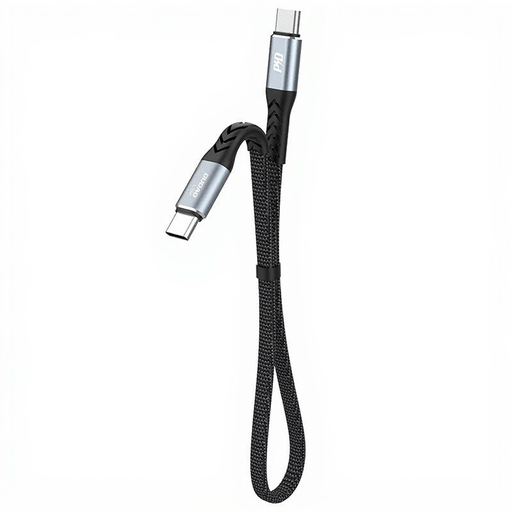
Product Feature Analysis: The Dudao L10C is a streamlined Power Delivery cable. At just 0.23 metres long, it is designed for specific scenarios where cable clutter is to be avoided. It supports the full 100W (5A) charging power and features a robust, flexible jacket. According to the manufacturer, special attention was paid to reinforcing the transition from the connector to the cable to minimise this common weak point.
Advantages:
Who it's for: Users looking for a minimalist and portable charging solution for on-the-go use or a very tidy desk. It is the ideal cable for charging a notebook right next to a docking station or a power bank without excess cable length.
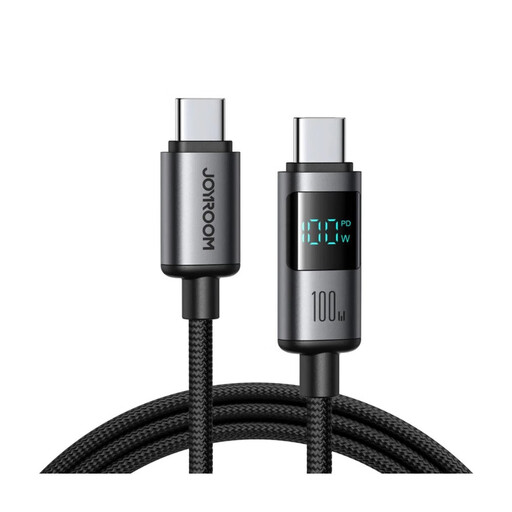
Product Feature Analysis: The JOYROOM S-A16 Pro distinguishes itself with an integrated digital display that shows the real-time power transfer in watts. This 1.2-metre fast-charging USB-C cable features a durable braided nylon jacket and aluminium alloy connector housings. It supports 100W Power Delivery and a data transfer rate of up to 480 Mbit/s (USB 2.0).
Advantages:
Who it's for: Tech-savvy users who want visual confirmation of their devices' charging speed. The display allows you to instantly verify the compatibility between the power adapter, cable, and end device, and to assess charging efficiency.
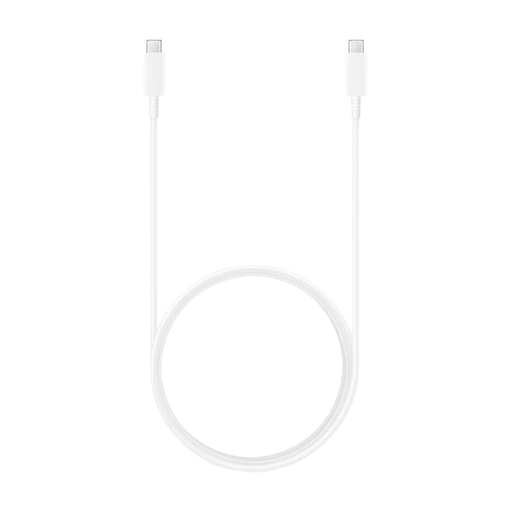
Product Feature Analysis: The Samsung EP-DX510 is a 5A charging cable that, according to the manufacturer's specifications, is designed for power transmission up to 100W (20V/5A). With a length of 1.8 metres, it offers an above-average reach. It also supports Super Fast Charging up to 45 watts, which is relevant for many Samsung devices. Data transfer is handled via USB 2.0. As a product from a major manufacturer, high compatibility within its ecosystem can be expected.
Advantages:
Who it's for: Users who need to bridge a significant distance between the power outlet and their device. It is a great choice for use in the office, living room, or while travelling, where the power source isn't always conveniently located.
The models presented here cover specific use cases. If you are looking for a cable with different specifications, such as a different length, special material properties, or a higher data transfer rate, you can find a wider selection in our USB-C to USB Cables category.
1. Can I safely use a 100W USB-C cable with my smartphone that only supports 25W? Yes, it is safe to use. The Power Delivery standard includes a communication process (handshake) between the charger, cable, and end device. The device only requests the power it can safely handle. Therefore, a 100W-capable cable and power adapter will only supply 25 watts to a 25W smartphone.
2. How can I identify a genuine 100W USB-C cable? Look for the manufacturer's explicit statements on the packaging or in the product description. Key terms are "100W", "20V/5A", or "PD 3.0/3.1". The crucial technical feature is the built-in E-Marker Chip, which confirms the cable's 5A capability.
3. Do I absolutely need a 100W power adapter for a 100W cable? To achieve the maximum charging power of 100 watts, all three components of the charging system must be rated for it: the end device (e.g., a laptop), the power adapter, and the cable. The cable itself does not generate power; it serves as the transmission medium. You can use a 100W cable with a weaker power adapter, but the charging power will then be limited by the adapter.