
Lieferung heute & morgen

Qualitätsgarantie

Willkommens-Angebote freischalten: KOSTENLOSE Lieferung | Bis zu 80 % RABATT | Kostenlose 30-Tage-JoyPlus-Testphase
App herunterladen
A USB-C car charger should reliably power your smartphone, tablet, dash cam or laptop while you're on the road. In practice, however, high wattage figures, unclear port descriptions and a lack of compatibility information often lead to the wrong purchase. What really matters isn't just the maximum power output, but how the USB-C port, charging protocol, vehicle voltage, cable and connected device all work together.
A car charger rated at 100 or 165 watts doesn't automatically deliver that power from every port. When multiple devices are connected, the power is usually shared. A PD car charger with 65 watts might, for example, offer up to 65W from one USB-C port, while an additional USB-A port has a different maximum.
So, check the following:
For a smartphone, 20 to 30 watts is often sufficient. A USB-C laptop, depending on the model, may need considerably more. Therefore, don't take the claim "suitable for laptops" at face value.
A QC 3.0 car charger won't charge every device at the same speed. Smartphones and tablets support different standards such as USB Power Delivery (PD), Quick Charge (QC), PPS, AFC or SCP. What's more, the charging cable must also be capable of transmitting the desired power.
A USB-C port without an explicit PD rating isn't automatically a high-power charging port. If you want to charge a modern smartphone or notebook, you should match the protocol supported by your device with the specifications of the charger.
A multi-port car charger with six or nine outlets is interesting for families, carpool groups or longer journeys. However, in a small vehicle, cable clutter, a bulky adapter or an awkwardly placed splitter can be a nuisance. A compact cigarette lighter charger with two ports is often enough for commuters.
Also, make sure the charger fits snugly in the 12-volt or 24-volt socket and doesn't obstruct the gear stick, your field of vision or any controls.
USB-C initially only describes the shape of the connector. For fast charging, the power profile and protocol are also important. USB Power Delivery is commonly used with modern smartphones, tablets and laptops. USB-A remains practical if you need to connect older cables, sat navs or accessories.
A USB-A and USB-C car charger is therefore a flexible choice for households with different cable types. If you only use modern USB-C devices, you can focus on a model with two USB-C ports.
A 12V 24V car charger is, according to the product information, suitable for vehicles with both electrical system voltages. This is particularly relevant for SUVs, vans, lorries, motorhomes and certain commercial vehicles. Before buying, you should check the stated input voltage against your vehicle handbook or the socket itself.
Don't confuse the output power with the vehicle voltage: 12V or 24V refers to the charger's input voltage, while 30W, 65W or 100W describes the possible charging power at the outputs.
Useful specifications include overcurrent, overvoltage, overheat and short-circuit protection. However, these don't replace careful use. A damaged charger, a loose connection or a kinked cable should not be used.
Metal or aluminium housings can feel robust, but what really matters are the manufacturer's specific details, ventilation and a secure fit in the socket. Don't cover a high-power charger with clothing, and avoid moisture and extreme heat in a parked vehicle.
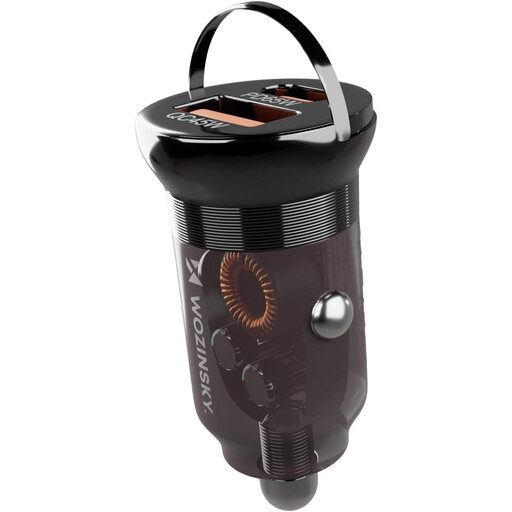
Why it fits: For commuters who want to charge a smartphone and occasionally a second device in the car.
The specifications list the port power separately: USB-C PD up to 65W and USB-A QC 3.0 up to 45W, rather than just a vague total figure.
Two ports, an aluminium-ABS housing and suitability for 12V and 24V vehicles according to the product data.
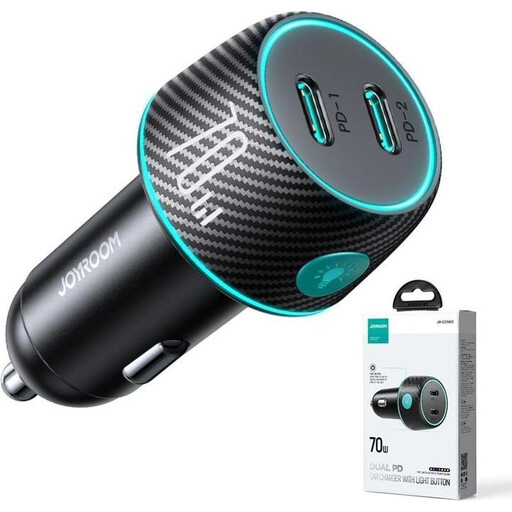
Why it fits: For people who want to connect two current smartphones, tablets or compatible USB-C devices at the same time.
The product data lists two USB-C PD ports and several supported protocols including PD3.0, QC3.0 and PPS.
Up to 70W total power, 12V/24V input and a switchable LED light according to the product description.
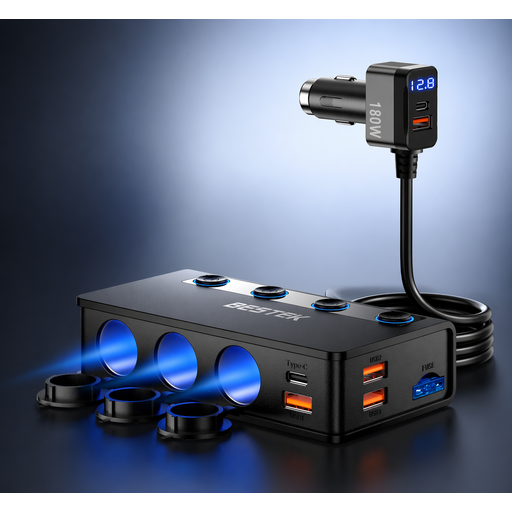
Why it fits: For family trips, motorhomes or teams who need lots of ports all at once.
The nine ports, the 12V/24V compatibility and the described power distribution are all clearly specified.
Two USB-C PD ports, four USB-A QC 3.0 ports and three additional cigarette lighter sockets.
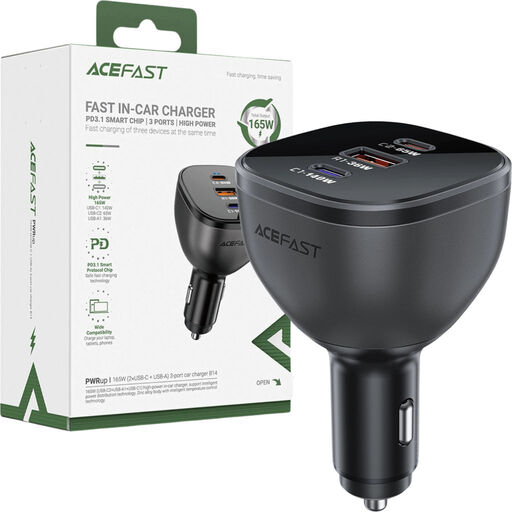
Why it fits: For high charging demands, provided your vehicle, cable and connected device support the power.
The maximum total power and its distribution across two USB-C and one USB-A port are clearly stated.
165W total power and 12V/24V input according to the product data; the actual output depends on the connected device.
Our full range of USB-C car adapters makes it easy to compare power, ports and vehicle compatibility.
That depends on the laptop's required input power, the charger's PD profile and the cable. A 65W model may be sufficient for compact notebooks, while more powerful devices need more. Check your laptop's technical specifications and the port power, not just the advertised total power.
Only if the product is explicitly designed for that voltage range. Many models in this selection list 12V/24V as their input. For special vehicles or non-standard sockets, you should check compatibility against your vehicle handbook before buying.
It's not possible to give a reliable lifespan. It is influenced by factors including frequency of use, heat inside the vehicle, mechanical stress, socket contact and cable quality. Storing it in a dry place, ensuring adequate ventilation and replacing it when you see visible damage can all help to ensure safe use.