SD and microSD users
If you copy videos from different-sized cards to a USB-C device, a reader with both slots can save you from having to swap adapters. Lexar and UGREEN offer SD and microSD readers.


For copying holiday videos at the kitchen table, a basic SD/microSD dual-slot reader is a good fit if it supports your cards and USB-C device. UHS-II is mainly worth considering if you have compatible cards and regularly transfer large files. A hub gives you extra ports or charging options, but is bulkier than a dedicated card reader. Advertised peak speeds are not guaranteed copy times, and a card reader is no substitute for an additional backup.
If you copy videos from different-sized cards to a USB-C device, a reader with both slots can save you from having to swap adapters. Lexar and UGREEN offer SD and microSD readers.
UHS-II is worth considering if you regularly transfer large video collections and your card, reader and destination device all support the right connection. The SD Association explains the different bus standards, while Lexar and TP-Link list UHS-II support for their respective dual-slot readers.
If you want to keep your holiday videos for good, a verifiable additional backup matters more than the advertised reader speed alone. Germany’s Federal Office for Information Security emphasises that you also need to be able to restore your data.
A good fit if: Your cards are mostly UHS-I and you want to read both SD and microSD cards.
Bear in mind: It won’t read a UHS-II card using UHS-II.
A good fit if: You regularly transfer large video files from compatible UHS-II cards.
Bear in mind: Your card and destination device also affect the transfer speed you can actually achieve.
A good fit if: You need extra ports or a way to charge devices at the kitchen table.
Bear in mind: A hub is bulkier than a dedicated reader; you may need a separate charger for passthrough charging.
| What matters | What to check before buying | Who is it important to? |
|---|---|---|
| Card and device compatibility | Check the card format, SDHC or SDXC support, and the port on your destination device. | If I’m reading SD and microSD cards from different cameras, I don’t want to have to hunt for another adapter. Around 36% of consumers name card compatibility as their main concern. |
| Speed when transferring large files | Compare the UHS standard supported by your card and reader, along with the data connection on your destination device. | If I regularly copy large video collections, I want to avoid unnecessary waiting. Around 29% of consumers prioritise transfer speed. |
| A backup you can use | Open the transferred videos on your destination device and plan another backup before reusing the card. | If I want to keep my holiday videos for good, I don’t want to rely on just one copy. Around 21% of consumers name secure archiving as their main concern. |
| Ports and keeping your desk tidy | Check which ports are free, how the cables will run and, for a hub, the requirements for passthrough charging. | If I’m connecting several devices at the kitchen table, I want ports to be easy to reach and to avoid unnecessary unplugging and reconnecting. Around 14% of consumers prioritise ports and ease of use at the table. |
Here, USB-C describes the connector, but it doesn’t determine the transfer speed on its own. The card standard, reader and data connection on your destination device all affect the copying process.
Check the UHS standard of your card and reader, as well as the data standard of the connection. Manufacturers’ maximum data rates are not guaranteed copy times.
A UHS-I reader won’t use the UHS-II interface. The SD Association explains that UHS-II has extra contacts and is backwards compatible through the first row of contacts.
If you regularly transfer large amounts of data and want to use the faster interface, make sure the reader supports UHS-II for the card format you need.
A card reader transfers files, but it doesn’t create an independent backup. Without another usable copy, faults or accidental deletion could put your videos at risk.
Open the transferred files on your destination device and plan another backup before deleting or reusing the card.
An independent backup requires extra storage space.
The Professional USB-C Dual-Slot Reader is designed for SD and microSD cards, including UHS-II.
The UA440C connects a USB-C port to SD and microSD slots via a short cable.
The 50706 is designed for users who want to read SD and microSD cards via USB-C or USB-A.
The 341 USB-C Hub A8346 combines SD and microSD slots with extra ports and passthrough charging.
The CONNECT USB-C 7-in-1 Multiport Hub AVC009btSGY is a hub option with SD and microSD slots, plus extra ports for your desk.
This selection includes USB-C card readers and hubs with SD or TF card slots. Some models also have USB-A, extra ports or a DVD drive.
 No image available
For a desk setup where you want to connect devices as well as read SD and TF cards.
SD and TF card reader; 3 × USB 3.0 at 5 Gbit/s; HDMI with 4K at 30 Hz; 100 W PD charging.
 No image available
For reading SD and microSD cards on devices with USB-C or USB-A.
Supports SD and microSD; USB 2.0 at up to 480 Mbit/s as stated by the manufacturer, not as a guaranteed copy time.
 No image available
For users who need an SD and TF card reader alongside an external DVD drive.
USB 3.0 and Type-C; SD and TF card reader.
 No image available
For a permanent desk setup that needs a network connection and extra ports as well as an SD card reader.
Dimensions: 22 × 11 × 3 cm; SD card reader; two HDMI 2.0 ports; RJ45 Gigabit Ethernet; 100 W charging.
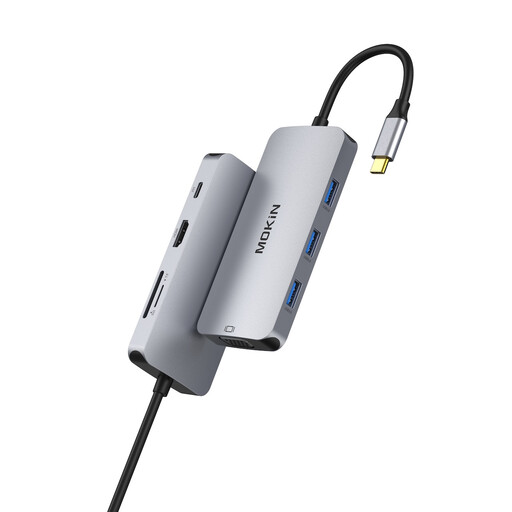 No image available
For a USB-C desk setup that combines card reading with extra video and USB ports.
SD and TF card reader; HDMI and VGA; 3 × USB 3.0; PD.
Not necessarily just to read it: the SD Association explains that UHS-II is backwards compatible through the first row of contacts. To use the faster UHS-II interface, both the card and reader need to support it; even then, the actual file transfer rate may be lower.
For a permanent archive, first check that you can open the transferred files and make another backup. Germany’s Federal Office for Information Security emphasises that you also need to be able to restore your data; the card reader alone is not a backup.
Check which card and extra ports you need, as well as the power requirements. According to the manufacturer, the charger for passthrough charging is not included with the Anker 341 A8346.
No. Germany’s Federal Ministry for the Environment states that waste electrical equipment must be taken to an authorised collection point, manufacturer or retailer obliged to accept returns. Whether retailers must accept items without a new purchase depends, among other things, on the size of the retailer and the dimensions of the device.