People recording on SD and microSD cards
If you use recorders with different card formats, make sure the reader explicitly supports the formats you actually use.


Choose a card reader based on your recorder’s card format and your destination device’s port. An SD slot is no substitute for a microSD slot unless microSD is explicitly supported. A compact reader is often enough for copying files; UHS-II matters mainly if you have compatible cards, while a hub may be useful if you need extra ports or charging. Check the copied files before deleting the recordings from the card.
If you use recorders with different card formats, make sure the reader explicitly supports the formats you actually use.
If you copy your recordings after a session at the hotel, check afterwards that the backed-up files open correctly.
If you need to connect other devices or charge your laptop while copying files, a hub with card slots could be a good option.
The BSI also considers whether data can be restored when discussing backups. For your recordings, that means not just waiting for the copying process to finish, but checking the files on the destination device too.
| What matters | What to check before buying | Who is it important to? |
|---|---|---|
| Compatible card format | Check your recorder’s card format against the SD or microSD formats explicitly supported by the reader. | If I work with different recorders, I don’t want to find out while travelling that the right slot is missing. Around 36% of consumers put supported card formats first. |
| Verifiable backup | Check that the destination device recognises the card and has enough free storage; open the files after copying. | If I want to reuse the card after backing it up, I want to be able to check the copy first. Around 29% of consumers prioritise a verifiable backup. |
| Copying time | Check the card standard, reader and host device together; don’t assume that maximum figures reflect actual copying time. | For large recordings, I want to keep an eye on transfer time, as long as the card and destination device are compatible with the reader. Around 21% of consumers focus on copying speed first. |
| Extra ports | Check whether the destination device supports USB-C data transfer and which hub ports or charging features you need. | If I also need my USB-C port for power or accessories, I don’t want to lose access to those connections while copying. Around 14% of consumers prioritise extra ports or a suitable charging option. |
The port alone doesn’t tell you how quickly the card slot can read. Lexar quotes a manufacturer reading speed of up to 312 MB/s for its model, depending on the card and system. Verbatim states that the card slots on the 32156 have a maximum read speed of 30 MB/s and write speed of 40 MB/s.
Check which card slot, card and standard the speed figures refer to.
If the card, card slot or host device is slower than expected, copying may take longer.
Your recorder and reader must support the same card format. For example, the Zoom H5studio manual specifies a microSD card; this doesn’t tell you what all field recorders use.
Check the card format used by your recorder and compare it with the reader’s specifications before buying.
Simply finishing the copying process doesn’t confirm that the expected files are present and readable on the destination device.
Check the file list and open a few audio files before deleting the original recordings or reusing the card.
Deleting files without checking risks losing recordings that may not be recoverable later.
The Professional USB-C Dual-Slot Reader is an option for SD and microSD cards, including UHS-II.
The specific 50706 model combines SD and microSD slots with USB-C and USB-A.
The 553 USB-C Hub is one option if you need ports beyond SD and microSD.
The Essentials Multiport Hub 32156 combines SD and microSD slots with other connections, including USB-C PD.
This selection includes USB-C card readers and hubs with SD, microSD or TF slots. If you want to back up a recorder card, check its format and your destination device’s connection against the product specifications before buying.
 No image available
The title lists an SD/TF card reader for USB-C devices; check that it supports your recorder’s card format.
Listed in the title: 3 USB 3.0 ports, HDMI with 4K@30Hz and 100 W PD charging.
 No image available
The title describes a USB-C adapter with a card reader; check your destination device’s connection and whether it supports your recorder card.
The product description lists SDHC, SDXC, microSDHC and microSDXC, as well as a USB 3.0 port.
 No image available
According to the title, this compact reader is designed for SD, microSD and SDHC cards; check the format against your recorder card.
The description also lists SDXC and USB 2.0 at up to 480 Mbit/s. This is an interface specification, not a guaranteed card copying speed.
 No image available
This dock could be a good fit if you need extra connections as well as a card slot; check that your device and card are supported.
The description lists SD and TF card readers that can read cards simultaneously, as well as USB-C PD up to 100 W.
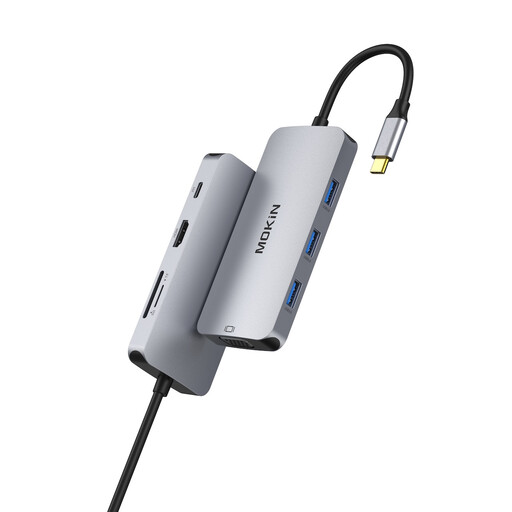 No image available
This hub combines card slots with other connections; check that your device has a full-function USB-C or Thunderbolt 3 port.
The title lists HDMI, VGA, three USB 3.0 ports, SD/TF and PD.
It depends on the card used by your particular recorder. For example, the Zoom H5studio manual specifies a microSD card; this doesn’t automatically apply to all field recorders.
Apple explains how to access connected SD cards and other external storage using the Files app. You’ll need a connector or adapter that’s compatible with your particular iPhone; also check that there’s enough storage available on the destination device.
Only delete the original recordings once you’ve checked on the destination device that the expected files are there and open correctly. The BSI also highlights the importance of being able to restore data from backups later.
For consumer purchases in Germany, the Verbraucherzentrale explains that the statutory two-year warranty applies to defects that were present when the goods were handed over, and is the retailer’s responsibility. Online purchases also generally come with a 14-day right to cancel; this is separate from any voluntary manufacturer’s guarantee.