For users with different recorder cards
If you transfer recordings from SD and microSD cards, check that the reader supports the formats you use. Two slots don’t necessarily mean you can use both cards at the same time.


First, choose a card reader that matches your recorder’s SD or microSD format and your target device’s connection. UHS-II is mainly relevant if your card also supports UHS-II and you’re copying larger amounts of data; with a UHS-I card, a speed boost isn’t guaranteed. If you’re copying to a smartphone, check file access too. If you’re using a laptop with few available ports, consider whether you need a hub.
If you transfer recordings from SD and microSD cards, check that the reader supports the formats you use. Two slots don’t necessarily mean you can use both cards at the same time.
If you want to copy files without a laptop, you’ll need to check that the connection, file access and requirements of your particular smartphone are all compatible.
If you regularly copy large volumes of recordings, it’s worth checking that the memory card’s UHS rating matches the reader’s capabilities.
Start with the card format and target device. Then consider whether a compatible UHS-II combination or extra laptop ports are important for the volume of recordings you need to transfer.
| What matters | What to check | Who should consider this? |
|---|---|---|
| Card format and file access | Check whether the recorder uses SD or microSD; confirm which card formats are supported and, if needed, whether the slots can be used simultaneously. | If I need to read a particular recorder card in the library, I want to be sure it fits the reader. Around 36% of consumers put card format support first. |
| Mobile file access | Check your smartphone or tablet’s connection, as well as its access to the card and file system. | If I’m copying to a mobile device without a laptop, I need more than just a compatible plug: file access has to work too. Around 29% of consumers prioritise copying to their mobile device. |
| Copying speed for large volumes | Compare the card’s UHS rating, the reader’s capabilities and the target device’s specifications. Don’t treat maximum speeds as guaranteed copying times. | If I regularly transfer large recordings, I want to know whether the card and reader support the same UHS interface. Around 21% of consumers put copying speed for large amounts of data first. |
| Extra laptop ports | Check available ports, power requirements and card format. An SD specification alone doesn’t confirm that there’s a separate microSD slot. | If there are few free ports on the library workstation laptop, a hub with a card reader and extra ports may be worth considering. Around 14% of consumers prioritise extra laptop ports. |
Actual transfer speeds also depend on the memory card and target device. TP-Link describes the UA440C’s up to 312 MB/s as a theoretical figure, not a measured rate for your recordings.
Check your recorder card’s UHS rating, and don’t treat manufacturers’ maximum speeds as guaranteed sustained performance.
Models differ: Transcend says you can’t insert two cards at the same time in the RDC3, while TP-Link states that the UA440C can access two cards simultaneously.
If you want to read or work with cards in parallel, check that this feature is available on the exact model you’re considering.
Apple sets out requirements for accessing external storage devices on an iPhone. The Zoom Q2n manual warns that formatting deletes stored data.
Back up existing recordings before considering a format. Check the connection, file system and target device first.
The UGREEN 50706 combines USB-C and USB-A with SD and microSD slots. It’s worth considering if you switch between devices with different USB connections.
The UA440C is a USB-C reader for SD and microSD cards, with UHS-II support when used with a compatible card.
The compact RDC3 is a USB-C reader for SD and microSD cards. According to Transcend, its SD slot supports UHS-I.
The Connect AVC008btSGY combines an SD card reader with extra laptop ports and USB-C PD pass-through charging. It’s particularly useful if a card reader alone isn’t enough.
The products below include USB-C card readers and hubs with SD or TF reading functions. Choose one based on your recorder’s card format and the ports you need on your target device.
 No image available
An option if you need extra ports on your laptop as well as a card reader.
SD and TF card reader; three USB 3.0 ports at 5 Gbit/s; 100 W USB-C PD charging; HDMI with 4K at 30 Hz.
 No image available
This adapter is described for use with an iPhone or iPad and an SD card. Check first that your specific device supports access to the card and its files.
USB-C hub with SD card reader.
 No image available
This version is worth considering if you switch between target devices with USB-C and USB-A.
SD, microSD, TF and SDHC card formats are listed in the product name; the title also mentions use with mobile devices and computers.
 No image available
This device may be useful if you need an external DVD drive as well as a card reader.
The product name specifies USB 3.0, Type-C and SD and TF card readers.
 No image available
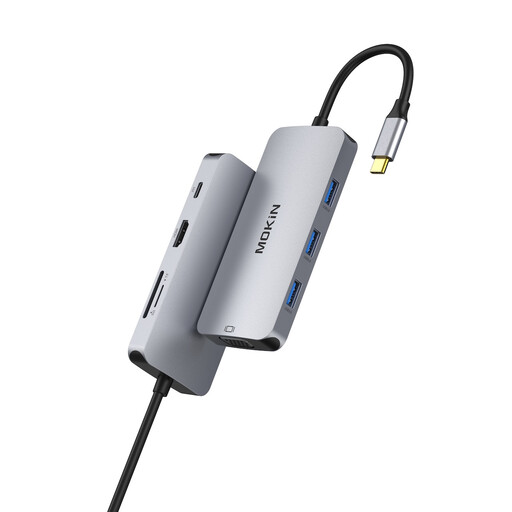
A hub option if you need extra video, USB or power connections while copying files on your laptop.
The hub has three USB 3.0 ports, HDMI, VGA, SD and TF slots, and USB-C pass-through. According to the description, your laptop needs a fully functional USB-C or Thunderbolt 3 port; MHL devices aren’t supported.
It may work if the iPhone’s connection is compatible with the reader. Apple explains how to access a connected SD card using the Files app and lists requirements for the partition and file system. Check your card with the specific iPhone before relying on it.
Check the copied files at their destination and eject the storage device before disconnecting it from your computer. Microsoft recommends safely removing the device to help prevent lost or damaged files; Apple also explains how to eject SD cards on a Mac.
For purchases made by consumers from a business, the Council of the European Union explains that faulty goods are covered by a legal guarantee of at least two years. These rights are separate from any additional manufacturer’s warranty; different rules apply to second-hand goods and private sales.
You can’t determine this just by choosing a card reader. If the recordings contain personal data and data protection law applies to how they’re processed, you may need an appropriate legal basis. The Federal Commissioner for Data Protection and Freedom of Information lists consent as one possible basis. Whether this applies to your recordings and how you use them depends on the circumstances.
Not for every recorder: the Zoom Q2n manual also explains how to use the recorder as a card reader via USB. Check your model’s manual and compare its connection with the one available on your target device.