Photographers short on space
If you regularly import photos from your camera, consider whether the reader, its cable or occupied neighbouring ports could make it harder to swap cards at your small desk.


First, check your camera’s card format and your computer’s USB-C data port. Then choose between a plug-in reader, a model with a cable or a hub. For UHS-II SD cards, a compatible reader can make use of the faster card bus; a UHS-I reader cannot. A cable makes it easier to position the reader, but takes up desk space. Choose a hub only if you need its extra ports.
If you regularly import photos from your camera, consider whether the reader, its cable or occupied neighbouring ports could make it harder to swap cards at your small desk.
Check whether your camera uses SD or microSD, or needs CFexpress Type A or Type B instead. These formats are not interchangeable.
If you often import large numbers of photos, choose a reader that supports UHS-II so your card can use the faster bus.
Start by comparing the card format and the position of your ports. Then consider whether UHS-II support or extra hub features are genuinely useful for your workspace.
| Consideration | What to check before buying | Who it matters to most |
|---|---|---|
| Easy access at your desk | Check where your computer’s port is, how much room there is beside other ports and where the card slot is positioned. | If the USB-C port is awkwardly placed, I want to reach the card without losing extra desk space. Around 40% of consumers prioritise easy access at their workstation. |
| The right card format | Compare the card label or camera manual with the formats explicitly supported by the reader. | If my camera uses CFexpress rather than SD, the reader needs to match Type A or Type B exactly. Around 30% of consumers put compatibility between their camera and the reader slot first. |
| Photo import speed | Check the UHS specifications of both the card and reader, as well as the data standard of your computer’s port. | When importing lots of UHS-II photos, I want to use the faster card bus while also taking my computer’s port into account. Around 20% of consumers prioritise photo import times. |
| Extra ports | Choose the hub features you need and check the card slot’s specification separately. | If I connect other devices as well as importing photos, I want to know whether I really need the hub’s extra ports. Around 10% of consumers prioritise additional ports at their workstation. |
A UHS-II card on its own isn’t enough: the reader must also support UHS-II to use the faster card bus.
Check the UHS specifications of the card and the specific reader separately.
CFexpress Type A and Type B have different form factors. Sony lists CFexpress Type A and SD for the MRW-G2; don’t assume this model supports Type B.
Check your camera’s full card type against the reader’s specifications.
The transfer rate quoted for USB data ports doesn’t tell you how quickly the SD card slot can read.
Choose a hub only if you need its extra ports, and check the card slot specifications separately.
Lexar offers USB-C readers for SD and microSD cards, including a model with a built-in cable and UHS-II support.
According to the manufacturer, the UGREEN 50706 is a compact reader for SD and microSD cards, with USB-C and USB-A connectors.
Sony describes the MRW-G2 as a reader for CFexpress Type A and SD cards.
According to the manufacturer, the SD 4.0 Card Reader combines SD and microSD slots with USB-C and USB-A.
The Anker 341 is a USB-C hub with SD and microSD slots, designed for workspaces where you need extra ports as well as a way to import cards.
This selection includes card readers, an external DVD drive with a built-in card reader, and USB-C hubs with SD or TF functionality.
 No image available
An option if you need an external DVD drive as well as the built-in SD/TF card reader.
The title mentions USB 3.0 and Type-C; the general USB transfer specification doesn’t confirm a particular card slot read speed. The description calls the device compact and mentions built-in cable storage.
 No image available
The description says it can import microSD cards and describes the device as compact and easy to carry.
USB-A and USB-C are listed in the product name; the description mentions a metal casing.
 No image available
A good fit if you need extra hub ports as well as SD/TF card import; the hub and cable will take up space on a small desk.
Features include 4K@30Hz HDMI, 100W PD charging and 3 USB 3.0 ports at 5 Gbit/s. The USB port specification doesn’t describe the card slot’s read speed.
 No image available
A hub option for importing SD cards if you also need several extra connections for your computer.
The product title lists HDMI, Ethernet, USB-A, USB-C and 100W charging. Its stated size of 22 × 11 × 3 cm means it needs its own space on your desk.
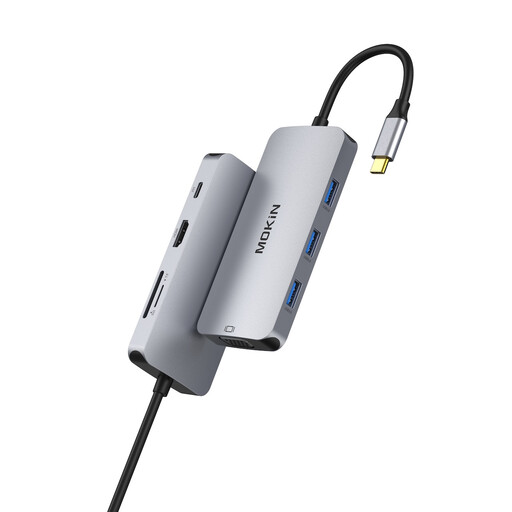 No image available
A good choice if you need connections for displays or peripherals as well as SD/TF card import; the extra ports and cable take up space.
The product title lists PD charging. A fully functional USB-C or Thunderbolt port is required; MHL mode is explicitly not supported.
No. A USB-C connector alone doesn’t tell you whether the reader is compatible with your card and computer port. Also check the card format and the reader’s UHS support. Lexar notes that its quoted speed depends on the card and system configuration.
Yes. If you want the card to use the UHS-II bus, the reader must also support UHS-II. The SD Association describes UHS-II as a bus with two data lines; actual transfer speeds also depend on the card and system.
Not necessarily: CFexpress Type A and Type B have different form factors. Check your camera’s card type against the reader’s stated compatibility; Sony lists CFexpress Type A and SD for the MRW-G2.
Wait for the copying process to finish, then, if the device appears as removable storage, use “Safely Remove Hardware and Eject Media” before unplugging it. Microsoft recommends safely removing devices to avoid data loss.