
Lieferung heute & morgen

Qualitätsgarantie

Willkommens-Angebote freischalten: KOSTENLOSE Lieferung | Bis zu 80 % RABATT | Kostenlose 30-Tage-JoyPlus-Testphase
App herunterladen
A USB-C fast charger should power your smartphone, tablet or laptop quickly. In practice, though, wattage isn’t the only thing that matters. A 65 W charger isn’t automatically the right choice for every device, while a compact 20 W model is already enough for many smartphones.
Three common misunderstandings can lead to the wrong purchase:
As a Joybuy Product Recommendation Officer, I assess product details against clear criteria: power, ports, charging protocols, compatibility and intended use.
The power you need depends on the device:
Your device limits its actual charging speed. A smartphone that accepts up to 25 W won’t automatically charge faster with a 65 W USB-C power adapter. If you’re choosing a multi-port charger, check how the power is shared between its ports.
USB Power Delivery, usually shortened to USB PD, is a widely used standard for USB-C connections. Depending on the profiles it supports, a Power Delivery charger can supply different voltages and currents.
PPS is important for compatible Samsung devices. Short for Programmable Power Supply, it allows the output to be adjusted more precisely. If you want to use Samsung Super Fast Charging, look for a PPS charger with a compatible USB-C output.
Some devices support Quick Charge, such as QC 3.0 or QC4+. However, a Quick Charge charger isn’t automatically the right choice for every smartphone. Before buying, check:
A cable included in the box can make choosing easier. For example, the JOYROOM model in our selection comes with a 1 m USB-C to USB-C cable rated at 60 W.
A GaN charger uses gallium nitride instead of conventional semiconductor technology. This can make it more compact than a conventional charger with a comparable power rating. That’s handy for travel, crowded extension leads and your desk. GaN technology alone, however, isn’t proof of quality. The specific power profiles and safety information still matter.
Also look out for:
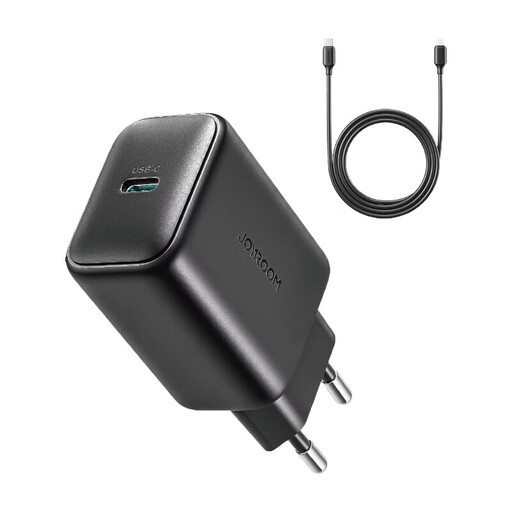
Why it suits this profile: With a single USB-C port and 25 W output, this charger is aimed at anyone who mainly wants to charge a smartphone. A 1 m USB-C cable is included.
The specifications clearly state the power output and support for PPS, PD and Samsung Super Fast Charging. This makes it easier to check compatibility before you buy.
25 W output, PPS and PD support, plus a USB-C cable in the box.
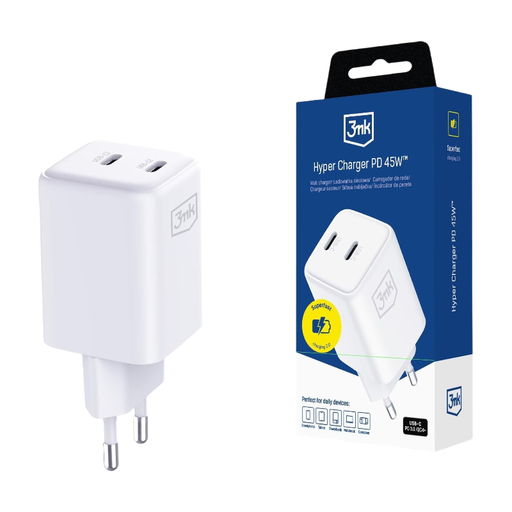
Why it suits this profile: Two USB-C ports, GaN technology and support for PD, QC4+ and PPS make it compatible with a range of modern devices. Its 45 W output also suits some tablets.
With two USB-C ports, you’re not limited to USB-A, making it easier to use current USB-C cables.
45 W total output, two USB-C ports and a compact GaN design, according to the product specifications.
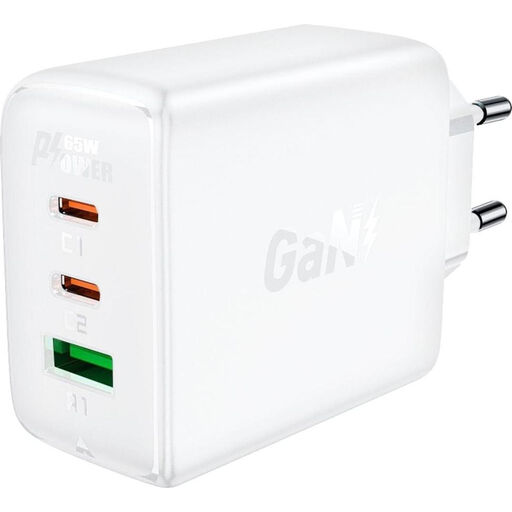
Why it suits this profile: With two USB-C ports and one USB-A port, this model is designed for anyone who wants to charge a smartphone, tablet and other accessories at the same time.
The total output and intelligent power distribution are clearly specified, making it easier to assess how it will perform with several devices connected.
65 W total output, three ports and GaN technology, plus PD, PPS and QC4+ support according to the product description.
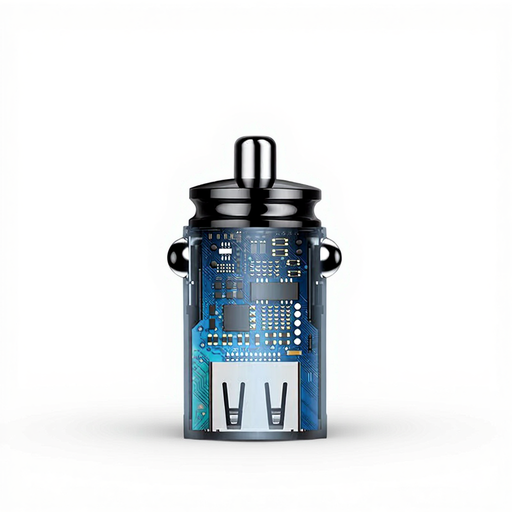
Why it suits this profile: This USB-C car charger has one USB-C port and one USB-A port. It’s designed for journeys and commutes, and lets you charge two devices at once.
The 30 W total output, PPS support and mix of ports are clearly listed. That way, you can choose based on the specifications, not just the design.
30 W output, a PPS chip, USB-C and USB-A ports, plus protection against overcurrent, overvoltage and short circuits.
We’ve put together a complete, regularly updated list of products that meet these strict selection criteria and fully comply with the safety regulations in force in the EU.
20 W to 25 W is enough for many smartphones. Tablets often need 30 W or more. For USB-C laptops, 45 W or 65 W are typical options, provided the device supports that level of power. Always check the manufacturer’s specifications.
In most cases, a compatible smartphone can use a higher-powered adapter, as long as it supports USB PD or a compatible protocol. The device only draws the power it needs. Even so, check the specifications for both your smartphone and charger before buying.
Its lifespan depends on build quality, how it’s used, heat build-up and how well you look after the cable and plug. Keep the charger dry and uncovered, and don’t use it beneath a cover. Stop using it if you notice visible damage to the casing or cable.