
Lieferung heute & morgen

Qualitätsgarantie

Willkommens-Angebote freischalten: KOSTENLOSE Lieferung | Bis zu 80 % RABATT | Kostenlose 30-Tage-JoyPlus-Testphase
App herunterladen
A USB-C fast charger with a retractable cable combines the power adapter and charging cable in a single housing. This saves space in your rucksack, reduces cable clutter on your desk and is suitable for smartphones, tablets and compatible laptops. However, models vary considerably in terms of power output, cable length, available connections and safety features.
If you focus only on a high wattage or the term “Fast Charger”, you may end up buying a charger that does not suit your particular combination of devices in everyday use. The following points will help you interpret the technical specifications correctly and avoid common buying mistakes.
A rating such as 65 W or 67 W generally refers to the charger’s maximum total output. If two devices are charged at the same time, the power may be distributed automatically between the integrated cable and the additional USB-C port.
A high output may be sufficient for a single laptop, while charging a smartphone and laptop simultaneously means less power is available for each device. You should therefore check the specifications for power distribution when using multiple ports before buying.
USB-C initially refers to the connector shape. Fast charging also depends on supported standards such as USB Power Delivery 3.0 or Qualcomm Quick Charge 2.0/3.0. The device being charged must support the relevant standard as well.
A USB-C fast charger may still charge an incompatible device, but it may only achieve a lower charging speed. The cable used with the separate port must also be suitable for the required power output.
A USB-C charger with a cable reel is practical because the cable disappears into the housing after use. However, the mechanism is not designed for forceful pulling, kinking or extending beyond its maximum length.
The cable should be pulled out slowly and straight. On a model with a cable length of up to 70 cm, the reach is sufficient for many sockets and desk setups, but not always for distant wall sockets or large hotel rooms.
Depending on the model, smartphones and tablets often require lower power outputs. Laptops, on the other hand, frequently need higher USB-C PD output. A 65 W GaN charger can therefore be a flexible solution for several device categories, provided that the laptop supports USB Power Delivery.
Pay attention to the following specifications:
A PD charger is worth considering for USB-C laptops and many current smartphones. A Quick Charge charger, on the other hand, may be particularly suitable for devices that support Qualcomm Quick Charge. Compatibility should be checked against the technical specifications of the device being charged.
An integrated retractable USB-C cable plus an additional USB-C port allows you to charge two devices from one socket. A dual USB-C charger is therefore suitable for users who want to combine, for example, a smartphone and tablet or a smartphone and laptop.
You should also check:
A compact travel charger should not only be small, but also provide sufficient power and be easy to handle. GaN technology, or gallium nitride, is used in many modern power adapters to enable a compact design and efficient energy conversion. Nevertheless, the precise dimensions and weight remain important.
Useful protective features include:
These features do not replace proper use. Damaged cables should not be used. A power adapter should also be kept away from damp environments and disconnected from the mains when it will not be used for an extended period.
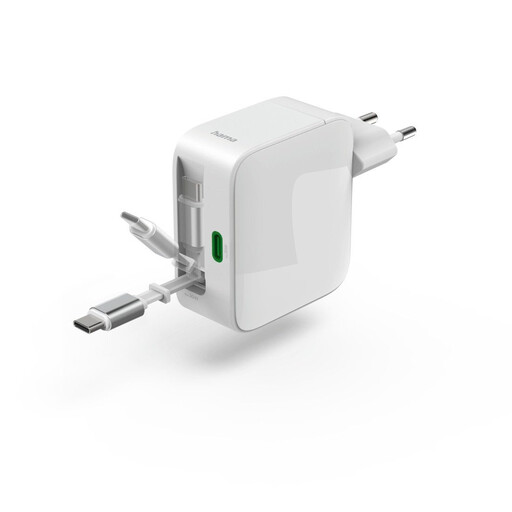
Why this product suits the profile: The power adapter combines an integrated USB-C cable with an additional USB-C port, covering typical smartphone, tablet and laptop use cases.
The technical specifications state a total output of 65 W, Power Delivery 3.0 and Quick Charge 2.0/3.0. The cable reel extends to a maximum length of up to 70 cm.
GaN construction, two USB-C charging options, Europlug, plus overcharge, overcurrent, short-circuit and temperature protection.
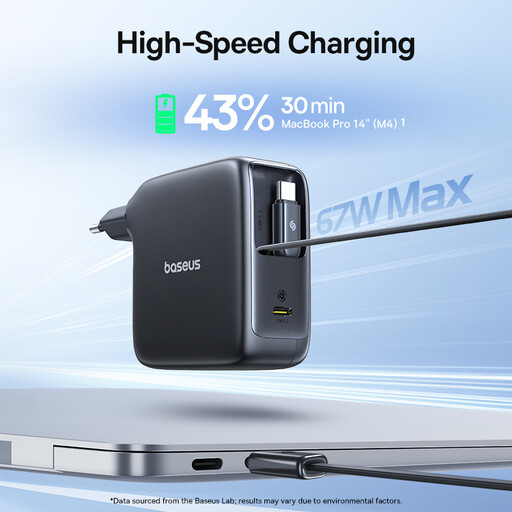
Why this product suits the profile: The specifications state a total output of 67 W, two retractable USB-C cables and a compact design with foldable plug contacts.
The design reduces reliance on separate charging cables. The device’s support for the relevant standard remains decisive for the actual charging speed.
67 W total output, two integrated USB-C cables and real-time temperature monitoring according to the product description.
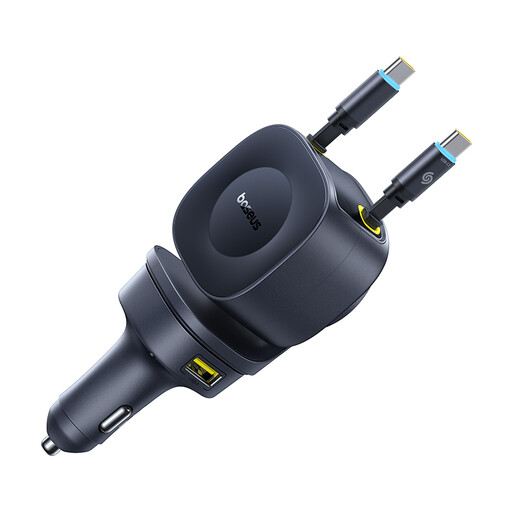
Why this product suits the profile: This model is designed for use in vehicles and connects to a 12–24 V DC supply. It offers several charging ports and an extendable cable.
The product data explicitly states that it is intended for use in cars, supports an input voltage of 12–24 V DC and features automatic power distribution.
Up to 60 W total output, three USB-C ports plus USB-A according to the specifications, as well as 180° vertical and 270° horizontal adjustability.
We have put together a complete, regularly updated list of products that fully meet these strict selection criteria and the safety regulations applicable in the EU.
A power adapter with a permanently integrated cable is particularly space-saving if you regularly charge the same USB-C devices. For changing between different devices, you should also check whether a separate cable is available for the second port. A laptop cable must also be designed to handle the required power output.
For travel within Germany and Europe, compact dimensions, a Europlug and an input voltage range of 200–240 V are practical features. A USB-C car charger with a retractable cable, on the other hand, is designed exclusively for the appropriate vehicle socket and must not be confused with a mains power adapter.
The service life of the cable reel depends greatly on how it is used. Do not pull the cable out abruptly; allow it to retract in a controlled manner and avoid putting strain on the USB-C connection. If there is any visible damage, stop using the product.
This is possible if the laptop supports USB Power Delivery and the charger provides sufficient power. 65 W may be enough for smaller USB-C laptops; check the laptop manufacturer’s specifications for the exact requirement. The available power may be reduced when two devices are connected.
Durability depends on the construction and how the cable is used. Retractable cables should only be extended to their intended length and must not be twisted or forced back into the housing. Damaged or frayed cables must not be used.
A power adapter may still draw a small amount of energy when idle. To keep standby consumption as low as possible, unplug it when you will be away or not using it for an extended period. With a car charger, you should also check whether the vehicle socket remains active when the ignition is switched off.