
Lieferung heute & morgen

Qualitätsgarantie

Willkommens-Angebote freischalten: KOSTENLOSE Lieferung | Bis zu 80 % RABATT | Kostenlose 30-Tage-JoyPlus-Testphase
App herunterladen
If you’re looking for a USB-C car charger, you’ll find plenty of models offering high wattage, multiple ports and fast-charging claims. The choice may seem straightforward at first, but the important differences often lie in the details. A high total wattage doesn’t automatically mean that a single smartphone, tablet or laptop will receive that much power.
Common buying mistakes come down to three things:
It’s worth checking the technical specifications before you buy, rather than relying on the prominently displayed wattage alone.
A PD car charger usually uses USB Power Delivery to negotiate the voltage and current between the charger and your device. The power actually available depends on the port you use and whether you’re using multiple ports at the same time.
For example:
The mix of ports matters too. A USB-A car charger is still useful for older cables and devices, while USB-C is increasingly used for current smartphones, tablets and laptops. A 3-port car charger with two USB-C ports and one USB-A port can therefore accommodate different generations of cables.
A 12V-24V car charger is designed for cars, SUVs, vans or lorries with compatible electrical systems. Not every model supports both voltage ranges, so check that this is clearly stated in the product description or user manual.
Before ordering, check:
An adapter that fits loosely may lose its connection while you’re driving. If it becomes unusually hot, the casing is damaged or it gives off an unusual smell, stop using it.
Depending on the model, support may also include QC, PPS, AFC, FCP or SCP, as well as PD. These standards aren’t the same across all smartphones and tablets. So, even if a charger is technically powerful, it may not charge every device at the fastest possible speed.
Also look for:
A fast car charger doesn’t need any special software setup. The power negotiation normally happens automatically. However, your device and cable still limit the charging speed you can actually achieve.
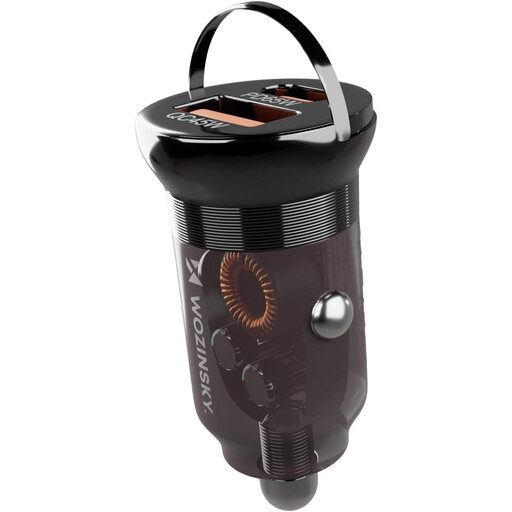
Why this product suits this profile: The dual-port adapter has a USB-C PD port offering up to 65 W, plus a USB-A port with QC 3.0. It’s a good fit for commuters who want to charge a current smartphone and a second device.
The product details list the output for USB-C and USB-A separately, as well as support for 12 V and 24 V vehicles. This makes it easier to work out whether it’s suitable than relying on an unclear total output figure.
65 W USB-C PD, an additional USB-A port, 12/24 V compatibility, and stated protection against overloading and overheating.
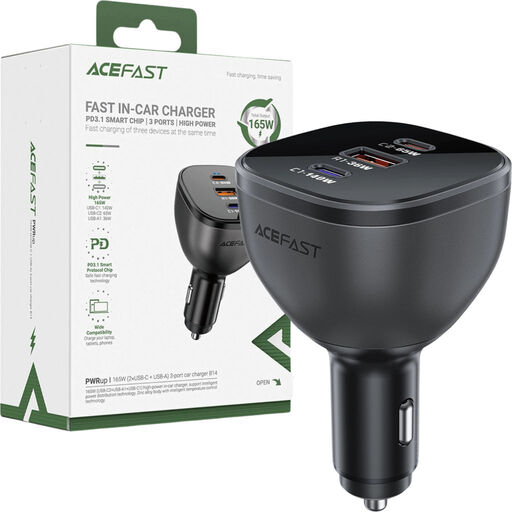
Why this product suits this profile: Two USB-C ports and one USB-A port cater for different cable types. Its stated total output of 165 W is appealing if you want to connect several devices during longer journeys.
The specifications explicitly state 12/24 V compatibility and list three ports. Before use, check the output ratings for each port against the requirements of your device.
165 W total output according to the product listing, two USB-C ports, one USB-A port, and use in 12 V or 24 V vehicles.
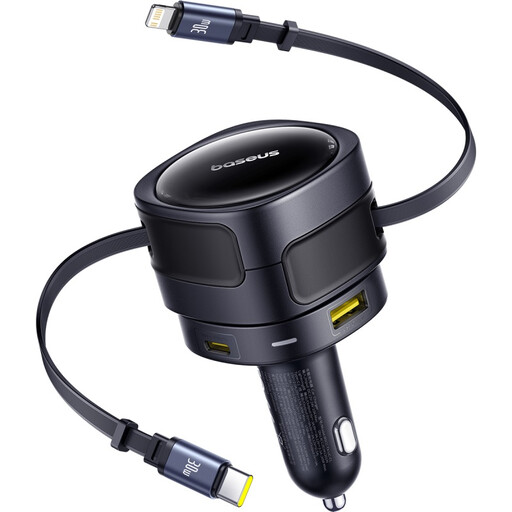
Why this product suits this profile: Built-in USB-C and Lightning cables, along with additional USB-C and USB-A ports, make this a practical choice for families and travellers who want to charge several types of device.
The maximum output and the limit for each output are stated. The automatic cable retraction helps keep loose cables out of the way inside the car, but it doesn’t remove the need to check for compatible charging protocols.
Up to 90 W total output, four ways to charge, and support for PD, QC, SCP and AFC according to the product details.
We’ve put together a complete, regularly updated list of products that meet these strict selection criteria and fully comply with the safety regulations in force in the EU.
It depends on the smartphone, cable, charging protocol and output power. A 30 W or 65 W port can charge a compatible device faster than a standard port. However, your smartphone won’t automatically draw the charger’s maximum output.
Only if the electrical voltage and plug type are compatible. Many models are designed for 12 V or 12/24 V. If you drive a commercial vehicle, lorry or motorhome, check the vehicle’s specifications carefully before buying.
That depends on the vehicle and the adapter. If the 12 V socket stays on when the ignition is switched off, a plugged-in charger may continue to draw a small amount of standby power. It’s therefore a good idea to unplug it if you’re leaving the vehicle parked for a long time.