For playing music stored on your computer, a USB DAC with a built-in headphone amplifier is a good choice if you want to connect your computer digitally via USB. A purely analogue amplifier requires a suitable analogue output. If you also want to connect active speakers, check whether their output is fixed or variable, and whether it’s muted when you plug in your headphones. Compare power ratings only for the relevant output and stated load, and start at a low volume when setting the level.
Which signal path is right for you?
Listening to music on your work computer
If you want to listen to music stored on your computer through wired headphones, the connection from your computer is key. iFi audio and FiiO offer USB DACs with built-in headphone amplifiers; the iFi Uno manual lists USB-C as the audio and power connection.
Owners of demanding headphones
Your headphones determine which connector and gain setting are suitable. FiiO quotes 1,400 mW at 32 Ω from the K11’s balanced output. This figure doesn’t apply across the board to other outputs or headphones.
Listeners with active speakers
If you want to use headphones and active speakers at the same workstation, output level and volume control matter. The iFi ZEN DAC 3 manual distinguishes between fixed and variable output; Pro-Ject says the Head Box S2 Digital has a fixed RCA output that is muted when headphones are connected.
What should you look for when buying?
USB DAC with headphone amplifier
A good fit if: Your music collection is on your computer and you want to send its digital audio signal via USB.
Things to consider: USB connections, operating system requirements, any drivers and power supplies vary by model.
Purely analogue headphone amplifier
A good fit if: You already have a suitable analogue output, such as one from a separate DAC.
Things to consider: For a digital-only connection to your PC, you’ll also need suitable conversion. The Pro-Ject Head Box S2 takes its signal via RCA.
| Priority |
What to check when buying |
Who is this important to? |
| Computer connection |
USB audio input, operating system requirements and any drivers. According to the manual, using the iFi Uno with a PC requires a driver download. |
If I’m playing local files on my work computer, I want the digital signal path to be compatible with the device. Around 36% of consumers say the computer connection is their top priority. |
| Headphone compatibility |
Check the connector type, usable output, gain setting, and the power rating with its corresponding impedance and output type. |
I want to choose a suitable connection and amplification for my existing headphones, rather than judging a power rating in isolation. Around 29% of consumers prioritise suitable headphone amplification. |
| Connecting speakers as well |
Check whether the RCA output is fixed or variable, and whether it is muted when you plug in headphones. |
If I also want to use active speakers at my desk, I want to know where to adjust their volume. Around 21% of consumers prioritise an additional speaker connection. |
| Space and setup |
Consider the dimensions, cable routing, power requirements and what’s included with the specific version. |
If space is limited, I want to work out in advance how many devices, cables and power supplies will be on my desk. Around 14% of consumers prioritise a space-saving setup. |
Common buying misconceptions
-
Treating the highest milliwatt rating as a universal benchmark
FiiO’s 1,400 mW rating for the K11 applies at 32 Ω from the balanced output. It doesn’t mean you’ll get the same power from other sockets or with every pair of headphones.
Compare ratings only when the output type and stated load match. First check which connector your headphones have.
-
Assuming an analogue amplifier can connect directly as a USB DAC
According to the manufacturer, the Pro-Ject Head Box S2 takes an analogue signal via RCA. For a purely digital connection from a PC, you’ll need a suitable analogue output or an additional conversion stage.
Plan the signal path from your computer, through the amplifier and to your headphones before choosing a device.
-
Assuming the rear output is always volume-controlled
According to its manual, when the iFi ZEN DAC 3 is set to ‘Fixed’, the rear output bypasses the volume control.
Before connecting active speakers, check the output mode and start at a low volume.
-
Assuming a microphone connection means unrestricted headset use
According to Fosi Audio Support, the K7’s microphone only works in USB input mode 1.0, not via Bluetooth or optical inputs.
If you want to use the same device for music and meetings, check the microphone connection and supported input mode separately.
Key brands at a glance
These examples highlight different connections and device configurations across individual product ranges; they don’t indicate that every product from a brand is suitable.
iFi audio
The UNO offers a compact USB DAC and amplifier setup; the ZEN DAC 3 adds headphone and analogue outputs.
- According to the UNO manual, audio and power run over USB-C; using it with a PC requires a driver download.
- The ZEN DAC 3 offers switchable gain and fixed or variable analogue outputs, according to its manual.
- In ‘Fixed’ mode, the rear output bypasses the volume control. This describes the device’s features, not an independently verified sound benefit.
FiiO
The K11 and K7 are desktop DACs with headphone amplifiers and additional connection options.
- FiiO lists USB, optical and coaxial inputs, two headphone sockets and three gain levels for the K11.
- The manufacturer’s 1,400 mW rating for the K11 applies at 32 Ω from the balanced output, not to every connection or pair of headphones.
Pro-Ject Audio Systems
The Head Box S2 is for analogue sources; choose the Head Box S2 Digital if you want a DAC built into the same device.
- According to the manufacturer, the Head Box S2 takes an analogue signal via RCA. The Digital version adds USB, optical and coaxial inputs.
- The Head Box S2 Digital’s RCA output is fixed and, according to the manual, is muted when headphones are connected.
Fosi Audio
The K7 is a desktop DAC with a headphone amplifier and microphone function for compatible workstation setups.
- Fosi Audio lists USB-C, optical and coaxial inputs, plus microphone, headphone and RCA connections for the K7.
- According to Fosi Audio Support, the microphone function is limited to USB input mode 1.0; it doesn’t work via Bluetooth or optical inputs.
Related products at Joybuy
These models represent an analogue amplifier chain and a USB DAC with a built-in headphone amplifier. Check which connection path suits your computer and existing audio output.
 No image available
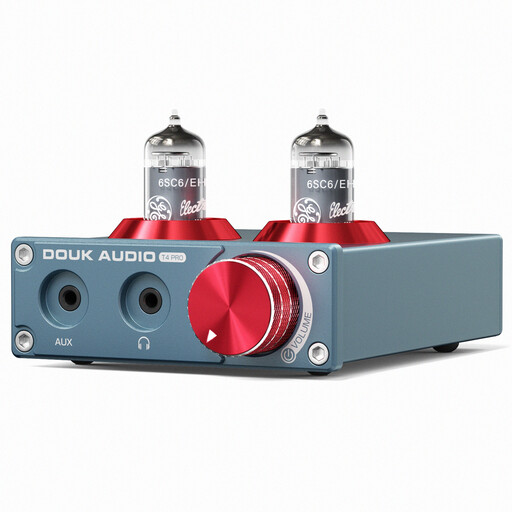
Douk Audio T4 PRO Mini Valve Tube MM Phono Amplifier GE5654
For an analogue playback chain; playing audio from a PC via AUX requires a suitable analogue audio output.
Described as an MM phono and desktop headphone amplifier; the model name includes GE5654.
View at Joybuy
 No image available
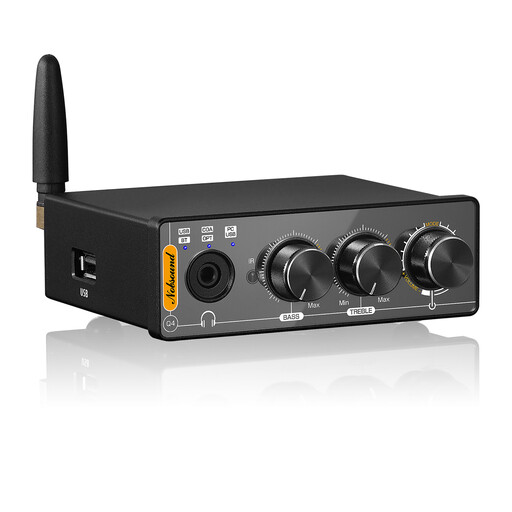
Nobsound Q4 USB Audio DAC with Bluetooth and optical input
For a digital computer connection with a built-in headphone amplifier; check whether USB or the optical input suits your source.
The product name lists Bluetooth, 24-bit/192 kHz, treble and bass controls, and a remote control.
View at Joybuy
Frequently asked questions
Do I need a separate DAC as well?
Not if you connect your computer digitally to a device such as the iFi UNO or FiiO K11: both are DACs with built-in headphone amplifiers. A purely analogue amplifier such as the Pro-Ject Head Box S2, on the other hand, needs a suitable analogue input signal.
How do I set up playback on my computer?
Connect the USB input specified for your model and follow the operating system and driver instructions. The iFi UNO manual requires a driver download for use with a PC. Set the volume low before listening for the first time.
How can I look after my hearing during long working days?
The World Health Organization recommends considering volume and listening time together. As an example, it gives an average sound level of 80 dB for no more than 40 hours a week and advises taking breaks. The position of a volume control alone doesn’t measure the sound level at your ear.
What rights apply when buying from a business seller in Germany?
According to information from the European Union, for faulty goods you generally have a legal right to a minimum two-year guarantee from the seller, starting from the date you receive them. Online purchases generally come with a 14-day right to cancel; exceptions and the specific terms of the contract should be taken into account. A voluntary manufacturer’s warranty is separate from this.


