If your existing headphone output reaches your preferred volume with your headphones without unwanted noise, lossless music alone is no reason to add another amplifier. For listening to music on a PC, a USB DAC with a headphone amplifier is a good choice if you want to combine the digital connection and amplification in one device. An analogue amplifier, on the other hand, requires a suitable DAC or line output. The right choice depends on your specific headphones, including their connector, sensitivity and impedance, as well as the space available for the device, cables and power supply. Power ratings only apply to the stated load and output socket.
Who listens at a desk?
PC music listeners short on space
If you listen to music on a laptop or PC, a combined DAC and headphone amplifier can fit two devices into one case. FiiO lists the K11 as measuring 147 × 133 × 32,3 mm, including its feet. You’ll also need to allow space for cables and the power supply.
Listeners with demanding headphones
Your choice should take into account the sensitivity, impedance and connector of your particular headphones. Compare power ratings only when they relate to the relevant load and output socket.
Listeners with an existing audio system
If you already use a DAC or an analogue line output, you can add a standalone analogue amplifier to your existing signal chain. If you have multiple sources or active speakers, the inputs and outputs you need are key.
What should you look for when buying?
Start by checking the signal path from your computer to your headphones. Only compare power ratings if the output and load match the connection you plan to use.
| Buying consideration |
What to check |
Who is it important to? |
| USB and desk space |
Check USB compatibility, as well as the device’s dimensions, cable clearance and power supply. FiiO lists the K11 as measuring 147 × 133 × 32,3 mm, including its feet, and requiring 12 V/2 A DC. |
If I listen to music on a PC and every centimetre counts, I want to plan for the connection, device and cables together. Around 36% of consumers prioritise a compact footprint and a digital PC connection. |
| Connecting your headphones correctly |
Check that the impedance, sensitivity and connector match the specifications for the output you’ll be using. FiiO lists different power ratings for the K11 depending on the socket and load. |
If I have demanding headphones, I want to know whether the socket and amplification are right for that particular model. Around 28% of consumers prioritise a suitable output and enough headroom to drive their headphones. |
| Controlling sensitive in-ear headphones |
Check for a low gain setting and volume control, and start listening at a low volume. The iFi manual recommends using the low PowerMatch setting with in-ear headphones. |
With sensitive in-ear headphones, I want to start quietly and adjust the volume with control. Around 18% of consumers prioritise low gain that’s easy to adjust. |
| Connecting additional sources |
Check the signal type for each source and make sure there’s a suitable output for your active speakers. An RCA line output is not a headphone socket. |
If I want to switch between sources or connect active speakers, I need the right inputs and outputs. Around 18% of consumers prioritise this connection flexibility. |
Avoiding common buying mistakes
-
Assuming lossless files guarantee better sound
A DAC converts digital signals; an analogue amplifier does not. Whether an additional device meets your needs depends on your source and headphones.
Start by testing your existing output with your headphones, then work out which part of the signal chain, if any, you’re missing.
An unnecessary extra device can take up space and need another power socket.
-
Comparing maximum power without checking the load and socket
The power ratings listed for the FiiO K11 vary depending on the headphone output and load. A single maximum figure won’t tell you whether the amplifier is right for a particular pair of headphones.
Only compare ratings for the output you plan to use and a suitable load. Also take your headphones’ sensitivity and connector into account.
-
Expecting an analogue amplifier to work as a USB DAC
The JDS Labs Atom Amp 2 has analogue inputs, while the FiiO K11 has a USB input. A standalone analogue amp can’t convert your computer’s digital USB signal on its own.
Map out the signal path from your computer to your headphones before you buy. You may need a separate DAC to use an analogue amplifier.
An additional DAC and more cables take up space and add to the signal chain.
-
Overlooking the power supply and space for cables
Requirements vary by model: FiiO lists the K11 as requiring 12 V/2 A DC. The iFi manual states that a separate DC power supply is not included with the ZEN DAC 3.
For the specific model, check what’s included, the required power supply and the depth available for the device and its rear cables.
A separate power supply can take up extra desk space and require another cable run.
Key brands at a glance
FiiO
The K11 is a desktop DAC with a headphone amplifier, designed for USB and other digital sources.
- FiiO lists three gain settings, along with USB, optical and coaxial inputs. Its dimensions are 147 × 133 × 32,3 mm, including the feet.
- FiiO states that the K11 requires 12 V/2 A DC and has no analogue line input. Power ratings depend on the load and output.
iFi audio
The ZEN DAC 3 is designed for a USB source and headphones. You can also connect active speakers if you have a suitable connection.
- According to the iFi manual, the device offers USB-C, 6,35-mm and 4,4-mm headphone outputs, and switchable gain.
- The manual does not list any other digital inputs. It also states that a separate DC power supply is not included.
Fosi Audio
The ZH3 is a desktop all-in-one for listeners who want to connect additional sources or speaker outputs as well as headphones.
- Fosi Audio lists an analogue RCA input, as well as RCA and XLR outputs.
- The manufacturer’s claims about sound and driving power don’t prove that the device is suitable for every pair of headphones.
JDS Labs
The Atom Amp 2 is an analogue headphone amplifier for use with a suitable DAC or line source you already own.
- JDS Labs lists 3,5-mm and RCA analogue inputs, along with two headphone sockets.
- The device has no USB audio input. If you’re looking at a specific offer in Germany, check the power supply version.
Joybuy product recommendation
The recommendation below covers an analogue connection: for PC music, your source must provide an analogue 3,5-mm signal. USB digital audio requires a separate DAC.
 No image available
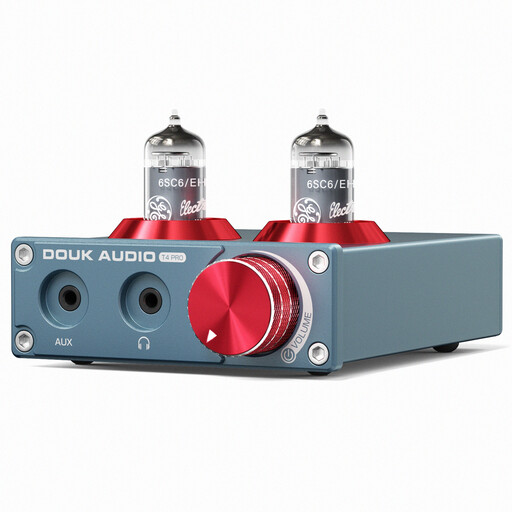
Douk Audio T4 PRO Mini Valve MM Phono Headphone Amplifier
The T4 PRO is suitable for a PC if its 3,5-mm output provides an analogue signal; the device does not accept USB audio directly.
- According to the product specifications: AUX and MM phono inputs, plus a 3,5-mm headphone output.
- Specified impedance range: 32–300 Ω.
- Specified output power: 150 mW at 32 Ω; suitability depends on your particular headphones.
- Dimensions: 95 × 117 × 30 mm.
View at Joybuy
Frequently asked questions
Do I need an external DAC or amplifier for lossless music?
No, not just because of the file format. What matters is whether your existing output can play your headphones at your preferred volume, without distracting noise. A purely analogue amplifier requires the source to provide an analogue signal.
How do I connect a USB DAC on a small desk?
Connect a compatible digital output on your source to the USB input, then plug your headphones into the appropriate socket. Check the power requirements for your specific model: FiiO lists the K11 as requiring 12 V/2 A DC. According to the iFi manual, the ZEN DAC 3 uses USB-C for audio and power, or a separate 5-V-DC power supply, which is not included. Start with the volume low.
What happens if a product develops a fault in Germany?
Your statutory rights relating to faulty goods are against the seller; a voluntary guarantee is separate. The Verbraucherzentrale says that the first remedy for a fault is supplementary performance, either repair or replacement.
What does the CE marking mean on a headphone amplifier?
For products covered by relevant harmonised EU legislation, the manufacturer uses the CE marking to declare that the product meets the applicable requirements. According to Your Europe, CE is not a sound or quality certification issued by a central EU body. The rules that apply to a specific device and power supply combination must be assessed on a product-by-product basis.
Can I put an old amplifier in household rubbish?
No. In Germany, old electrical equipment is collected separately. The Electrical and Electronic Equipment Act (ElektroG) covers, among other things, take-back and disposal.


