Which setup is right for you?

Interviews with two people at a table

If you want questions and answers to remain clear with both people sitting in the same places, position the microphone so it can pick up both sides. Use a test recording to decide whether one shared microphone is enough or you need separate inputs.

Interviews in different locations

In indoor spaces with varying noise levels, consider whether you can aim the microphone towards the person speaking and check the levels before the conversation. A short recording in the actual location can help you listen back to quieter replies.

Long interview sessions

If you’re recording long takes, check in advance that your recording device, software and connection will work throughout. Headphone monitoring and a saved test recording make it easier to check everything before the interview.

What should you look for when buying?

Directional USB microphone for one voice

Best for: one person speaking from close by and mostly from the same position.

Consider: With the same setup, the person sitting opposite may be picked up differently. Position the microphone carefully and test both voices in the room you plan to use. A cardioid polar pattern does not guarantee freedom from background noise.

Switchable polar patterns for a table

Best for: recording several people together with one microphone. According to CHERRY, you can switch the CHERRY UM 6.0 ADVANCED between cardioid and omnidirectional modes.

Consider: In omnidirectional mode, the model picks up sound from all directions, according to CHERRY, so room noise may also be more noticeable. Recording everyone together does not automatically mean you’ll get separate tracks.

Two microphones with a suitable recording setup

Best for: independently positioning and monitoring both sides of the conversation, or when a test with a table microphone fails to pick up one voice clearly.

Consider: Before you buy, check that your device and software can actually record from both inputs.

What you need What to check before buying Who should prioritise this?
Picking up both voices Test your seating arrangement with a sample recording; check which side to speak into and which polar patterns are available. If I’m interviewing two people opposite each other at a table, I want both questions and answers to be equally clear. Around 33% of consumers put both voices in the conversation first.
Taking room noise into account Test at the actual recording location at a normal speaking volume, then listen back to quieter replies. In different or noticeably noisy rooms, I want voices to take priority over background noise. Around 25% of consumers focus particularly on this.
Monitoring long recordings Select the input in your software, connect headphones, and record and play back a test. During long conversations, I want to spot problems with the input or levels early. Around 25% of consumers focus on monitoring while recording.
Connection and setup Check the connections, supplied cable and mount, as well as the input selected in your software. If I want to keep using my existing recording device and table, the setup needs to work with them. Around 17% of consumers pay particular attention to connections and setup.

Common pitfalls

  • Confusing an omnidirectional pattern with noise reduction

    According to the manufacturer, the CHERRY UM 6.0 ADVANCED picks up sound from all directions in omnidirectional mode. On its own, this doesn’t tell you how clearly voices will come through in a noisy room.

    When recording two people, compare both settings at the table you plan to use. Listen out for the quieter voice and the room noise.

  • Expecting a USB microphone to record for hours on its own

    A USB microphone alone does not save the interview. Recording also depends on the connected device and the software you use.

    Select the microphone as your input and save a full test recording on the device you plan to use for the conversation.

  • Applying reviews to similarly named models

    The COMPUTER BILD test covers, among other models, the RØDE NT-USB Mini and the Shure MV6. Its findings are not test results for the RØDE NT-USB+ or Shure MV7+.

    Before choosing, check the full model name and its features.

Microphone brands to consider

CHERRY

The UM 6.0 ADVANCED is worth considering if you’re weighing up prioritising one voice at the table or recording several people together.

  • According to CHERRY, the model has switchable cardioid and omnidirectional patterns, a gain control and a headphone socket.
  • In omnidirectional mode, it picks up sound from all sides, according to the manufacturer. This doesn’t guarantee clear interviews in noisy rooms.

Sennheiser

The Profile USB is an option for recording one voice from a specific direction, with easy-to-reach level controls.

  • According to Sennheiser, this model has a cardioid pattern, a gain indicator, a headphone socket and adjustable tilt.
  • If two people are sitting opposite each other, test the exact setup you plan to use.

RØDE

The NT-USB+ combines a directional USB setup with headphone monitoring.

  • RØDE lists a tight cardioid pattern, a headphone output and an included pop filter for the NT-USB+.
  • The COMPUTER BILD test mentions audible popping on the different NT-USB Mini model. This finding cannot be applied to the NT-USB+.

Logitech G

The Yeti is an option if you want a choice of switchable polar patterns.

  • According to Logitech G, the Yeti model mentioned offers several polar patterns, a gain control and latency-free headphone monitoring.
  • The features alone don’t show whether the microphone will suit your seating arrangement, so a test recording is still a good idea.

Shure

The MV7+ is a USB-C/XLR hybrid worth considering for recording one voice close up, with the option of moving to an XLR setup later.

  • Shure lists USB-C and XLR as connections on the MV7+.
  • An independent test describes audible background noise on the different MV6 model; this is not a test result for the MV7+.

Suitable products at Joybuy

The following Joybuy products are suited to interviews where one voice is the priority and a directional USB setup is preferred.
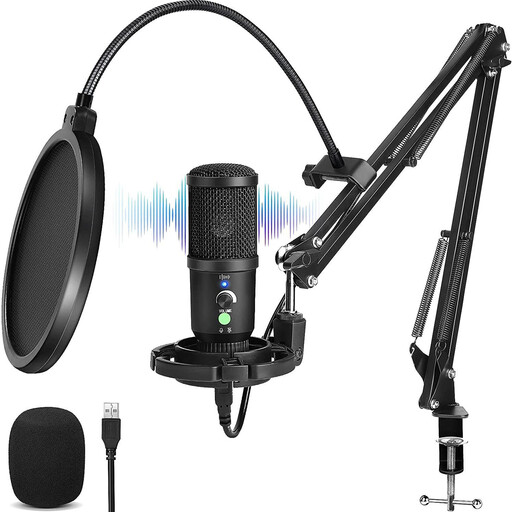
USB condenser microphone with cardioid pattern

USB condenser microphone with cardioid pattern

For interviews where one voice is the priority, a directional setup is a good choice. Test in advance to see whether both sides of the conversation are picked up clearly in your seating arrangement.

Listed features include a cardioid pattern and latency-free headphone monitoring.

View at Joybuy

Frequently asked questions

How can I avoid ending up with no usable audio after a long interview?

Select the microphone as the input in your recording software, record a short test of both sides of the conversation, then listen back to the saved file. Monitor the audio with headphones during the interview. The RØDE instructions say you may need to select the NT-USB+ as both the input and output device in your software. They don’t specify a general maximum recording time.

Do I need any additional accessories to use the RØDE NT-USB+ with a computer that only has USB-A ports?

Yes. According to RØDE’s instructions, you’ll need a USB-C to USB-A cable in this case. Check the connection on your specific recording device and what’s included in the box, rather than assuming the USB-A information alone means the plug will fit.

How should I handle plosive sounds and microphone positioning with the RØDE NT-USB+?

RØDE lists a removable pop filter for the NT-USB+ and advises pointing the marked front towards the person speaking. Test how well it works with a voice sample; this advice applies to the NT-USB+.

Can I secretly record a private community interview?

You can’t simply record a private conversation without authorisation: Section 201 of the German Criminal Code (StGB) covers the unauthorised recording of another person’s non-public spoken words. Before you start, check with everyone involved that you’re allowed to make the recording. Any later publication or sharing must be considered separately.

Does consent to an audio recording also cover storage and publication?

Not automatically. If personal data is processed within the scope of the GDPR, there must be a lawful basis for doing so. If that basis is consent, it must be informed, freely given and specific to the purpose, among other requirements, as explained by the German Federal Commissioner for Data Protection and Freedom of Information. So, clarify the purpose of the recording, how it will be stored and any planned sharing in advance.