Solo storytellers in a booth
If you record family stories in a fixed spot and can maintain a consistent distance and position relative to the microphone, a directional model for one speaker may suit you.


If you’re speaking alone, a directional USB microphone can be a good choice, provided you can sit close to it and keep a consistent position while recording. For two people facing each other, consider a microphone with a bidirectional mode; even then, both speakers need to be positioned appropriately, and you should check the levels in a test recording.
If you record family stories in a fixed spot and can maintain a consistent distance and position relative to the microphone, a directional model for one speaker may suit you.
If a family member is sitting opposite you, capturing both voices with one shared microphone matters more than pointing it towards just one person.
If you want to check the levels and room sound before a longer story, look for a headphone socket and check the controls available on the specific model.
A good fit if: you’re telling the story alone and can stay close to the microphone.
Bear in mind: leaning back often or changing your distance can make it harder to maintain a consistent position.
A good fit if: two people are sitting opposite each other and want to use one shared microphone.
Bear in mind: a bidirectional mode doesn’t guarantee balanced levels or separate audio tracks.
First decide whether you’ll be recording one person or someone opposite you. Then consider the microphone’s position and how you’ll monitor the sound in your room.
| What matters | What to check before buying | Who it matters to |
|---|---|---|
| Clear recording of one voice | Check the polar pattern, the distance you can realistically speak from and the mounting options; then listen to a test recording made in the room. | If you’re telling a longer family story alone from a fixed spot, the microphone needs to stay pointed towards your voice. Around 40% of consumers prioritise capturing a single voice. |
| Two voices on one microphone | Check the seating arrangement and bidirectional mode, then make a test recording with both people. | If a family member is sitting opposite you, you may want to record both voices with one microphone. Around 30% of consumers say recording two voices is their main priority. |
| Monitoring levels and sound | Check whether the specific model has a headphone socket and gain control. | If you want to listen back and adjust the levels before or during a longer story, direct monitoring is important. Around 20% of consumers put this at the heart of their decision. |
| Easy setup in a small space | Check what’s included, how it connects to your recording device and how much space it needs. | On a small booth table, the setup should take up little room and fit the mounting options you already have. Around 10% of consumers prioritise an easy setup. |
RØDE recommends positioning the PodMic USB close to the speaker. Recording a conversation between two people facing each other calls for a suitable setup; a bidirectional mode alone won’t automatically balance their levels.
Decide where everyone will sit first, then choose the recording mode and listen back to a test with both voices.
You may need to adjust the seating arrangement for two people.
Connectivity options don’t tell you which mount is included with the version you choose.
Check what’s included and how it can be mounted against the space available in your booth before choosing a desk stand or microphone arm.
Depending on your setup, you may need to buy a stand, microphone arm or suitable cable separately.
Features and polar patterns describe a model, but they don’t prove how it will sound with the ventilation and speaking positions in your booth.
Make a test recording with your usual seating arrangement and ventilation before recording a longer story.
The Profile USB is designed for a fixed storytelling spot, with a direct USB connection and controls on the microphone.
The PodMic USB offers USB-C and XLR connectivity for different setups and is designed for close-up recording of one voice.
The AT2040USB is a directional dynamic USB microphone designed for a fixed speaking position.
The UM 9.0 PRO RGB offers several selectable polar patterns for different recording situations.
The MV7+ is a USB-C/XLR option for close-up voice recording, with additional digital settings.
This selection includes directional USB/XLR desk microphones for a fixed speaking position, as well as a wireless lavalier set with two transmitters for conversations between two people.
 No image available
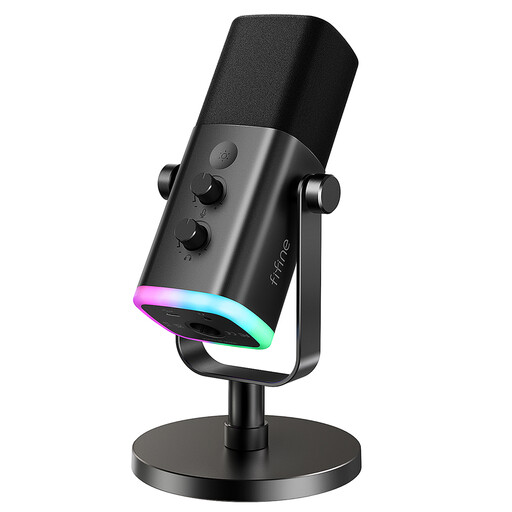
For one person in a fixed storytelling spot, if you want to point a desk microphone directly at your voice.
USB/XLR; the product title also lists a mute button, headphone socket and desk stand.
 No image available
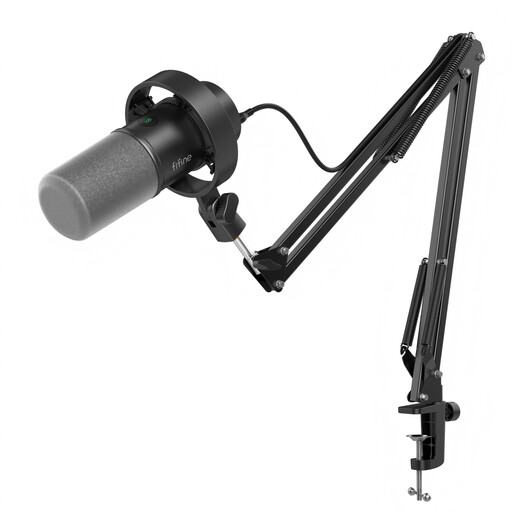
An option for a fixed position for one speaker, if you’d prefer to use a microphone arm rather than a desk stand.
The product title lists USB/XLR and a microphone arm. According to the product description, the C-clamp is designed for desks less than 2 inches thick.
 No image available
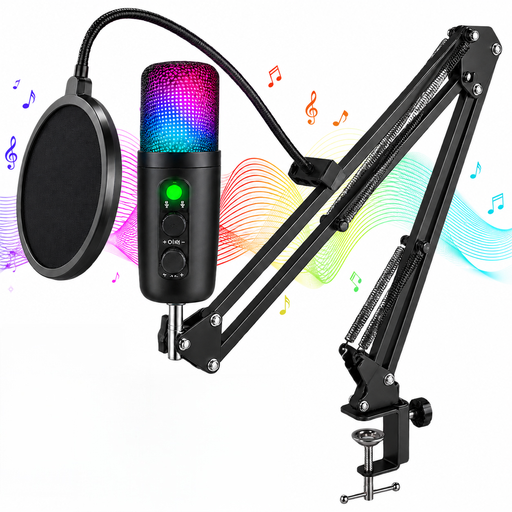
For voice recording on a PC, if a USB condenser microphone is compatible with your recording device.
The product title lists a Type-C adapter, a mute button and a 7-piece set.
 No image available
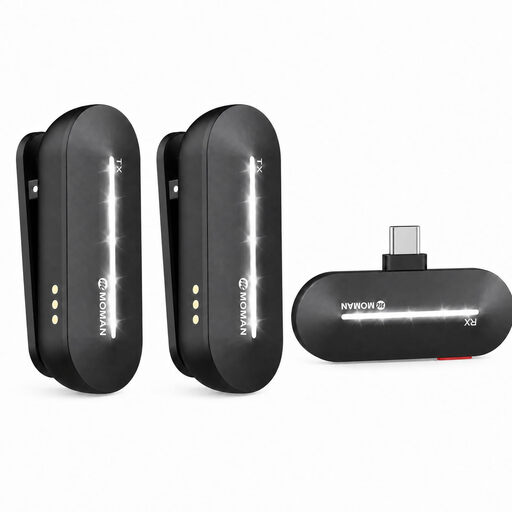
An alternative for two family members, if you want to record each person using their own lavalier transmitter.
The product title lists a wireless set with 2TX+1RX and USB-C. The receiver is designed for use with a compatible recording device.
 No image available
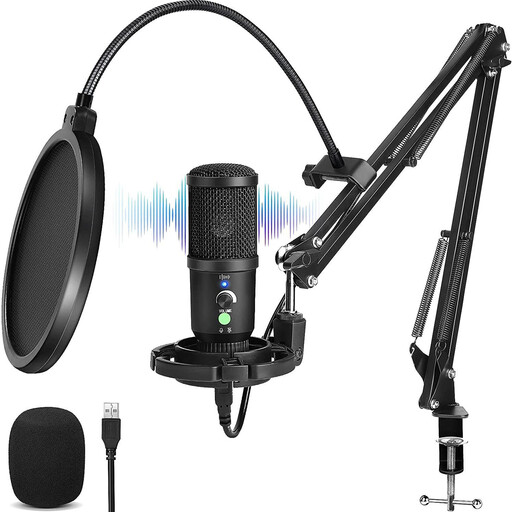
For a fixed position for one speaker, if you’re looking for a USB condenser microphone with a cardioid polar pattern.
Make a short test recording from the position you’ll actually be sitting in, and point the microphone towards the person speaking. For the PodMic USB, RØDE recommends a mouth-to-microphone distance of around 5–10 cm; for other models, follow the relevant instructions.
Not necessarily. According to their respective manufacturers, the Sennheiser Profile USB and RØDE PodMic USB can connect directly to a computer via USB. Check the connection and compatibility with your specific recording device.
Check what’s included with the version you choose against the space available and the mounting options in your booth. Sennheiser lists a desk stand and USB-C cable for the Profile USB described here; RØDE says the PodMic USB can be mounted on a stand or arm.
Under Section 201 of the German Criminal Code (StGB), recording another person’s private spoken words without authorisation is prohibited. So make sure everyone involved knows about the recording before the conversation; this doesn’t amount to blanket permission to share it later. The Federal Ministry of Justice lists this provision in the Act on the Protection of the Confidentiality of the Spoken Word.
When you buy from a retailer, you have statutory rights against the seller if the product is faulty; these are separate from any voluntary guarantee. The Verbraucherzentrale describes repair or replacement as ways of putting things right.