Speakers with a wide dynamic range
If your monologue shifts between a subdued and a powerful delivery, check the input level before recording with your quietest and loudest passages.


For a powerful historical monologue, a dynamic USB microphone is a sensible starting point if you speak close to it and keep your distance as consistent as possible, especially if your room has noticeable background noise. In a quiet room, a USB condenser microphone could also be a good choice. Record a quiet and a loud passage from your intended position, check the input level, and make sure the connection, headphone monitoring and accessories suit your setup. A directional microphone won’t eliminate room echo on its own.
If your monologue shifts between a subdued and a powerful delivery, check the input level before recording with your quietest and loudest passages.
If your recording space has noticeable noise or reflections, try different microphone distances and positions where you plan to perform the monologue.
If you want to record without a separate audio interface, check that the cable, stand and headphone connection are compatible with your device’s port and suit your space.
A good fit if: you speak close to the microphone and your room has noticeable background noise.
Bear in mind: you’ll need to keep your distance as consistent as possible while speaking; room reflections may still be audible.
A good fit if: you’re speaking in a quiet, well-set-up space and can position the microphone carefully.
Bear in mind: if your volume and position vary, set the level using your loudest passage and listen back for room sound.
| Buying priority | What to check | Who it matters most to |
|---|---|---|
| Levels when volume varies | Gain control or level display; make a test recording of your loudest passage. | If I deliver dramatic sections loudly and quieter passages softly, I want to check both in advance. Around 33% of consumers prioritise level control. |
| Room sound and distance | Test in your intended recording space to see if the microphone’s position and your speaking distance are practical throughout the performance. | If my room has noticeable reflections, I want to find a position where my voice doesn’t recede unnecessarily into the background. Around 27% of consumers prioritise room sound. |
| Plosives and articulation | Try the pop filter and microphone angle with emphatic passages. | If I emphasise consonants in my monologue, I want to spot distracting pops during a test recording. Around 20% of consumers focus on clear articulation. |
| Connection and monitoring | Check the USB connection, supplied cable, stand and headphone socket against the exact model variant. | If I want to record without a separate interface and monitor the sound directly, the setup needs to work with my devices. Around 20% of consumers prioritise this. |
Sennheiser advises checking the gain on the Profile using the loudest passage you plan to record. RØDE explains that directional microphones can still pick up background noise and reflections from the room.
Even a directional microphone can pick up reflections and background noise.
Listen to a test recording made in your actual recording space, and adjust the position and distance first.
A quiet test won’t tell you whether your loudest dramatic passage will overload the input.
Speak your loudest planned passage during the level test, then check a quiet section too.
What’s included and how you can connect the microphone varies between models and versions.
Before buying, check the full model name, device connection and the listed contents of the box.
For close-miked speech, the dynamic PodMic USB and condenser NT-USB+ are two options with different features.
The Profile USB Microphone is a condenser option for voice-over work in a well-set-up recording space.
The MV7+ is a USB-C/XLR option for close-miked speech if automatic level features are suitable for your delivery.
The AT2020USB-X is a USB condenser option for a quiet recording space where you can position the microphone carefully.
This selection includes dynamic USB microphones for close-miked solo voices, as well as USB condenser microphones for a well-set-up recording space.
 No image available
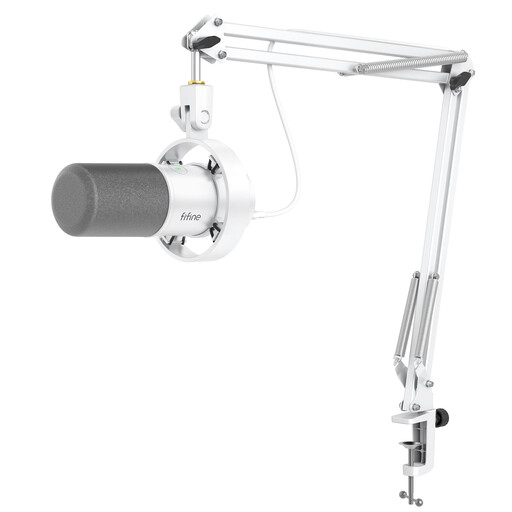
Listed as a dynamic USB/XLR microphone for voice recording, with a boom arm for positioning at your recording space.
Gain control and headphone socket; windscreen, shock mount and USB cable listed. The listing states that an XLR cable is not included.
 No image available
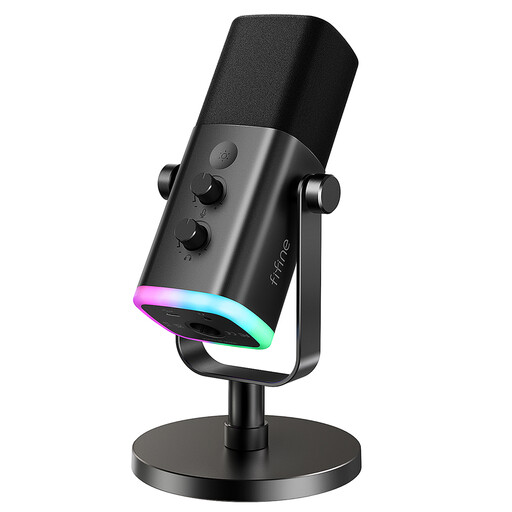
Listed as a dynamic microphone for voice recording; the desk stand lets you set it up without a separate boom arm.
Gain control, mute button and headphone monitoring for USB use; USB-C cable and windscreen listed. The listing states that an XLR cable and boom arm are not included.
 No image available
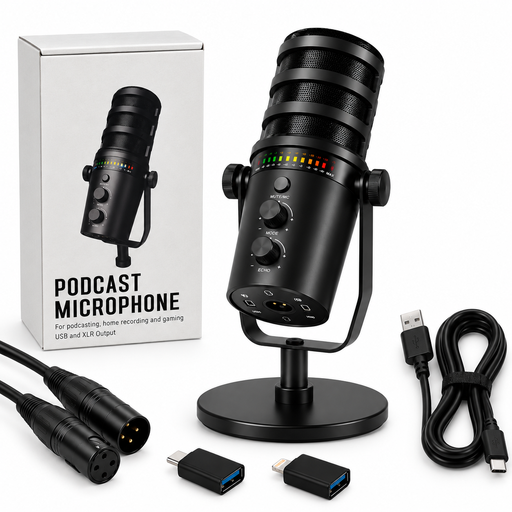
Listed as a dynamic USB/XLR microphone for one voice, designed for a fixed recording space with a desk stand.
The description lists USB-C/XLR connections, a USB adapter, gain control, mute function and headphone monitoring.
 No image available
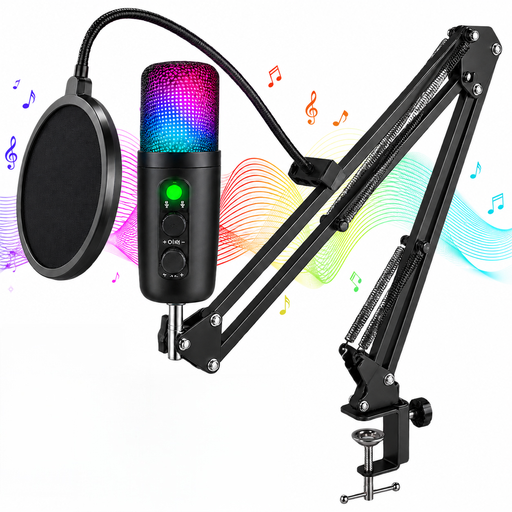
Listed as a USB condenser microphone for PC and streaming; a headphone socket and mute button are included.
The description mentions a USB connection and Type-C adapter.
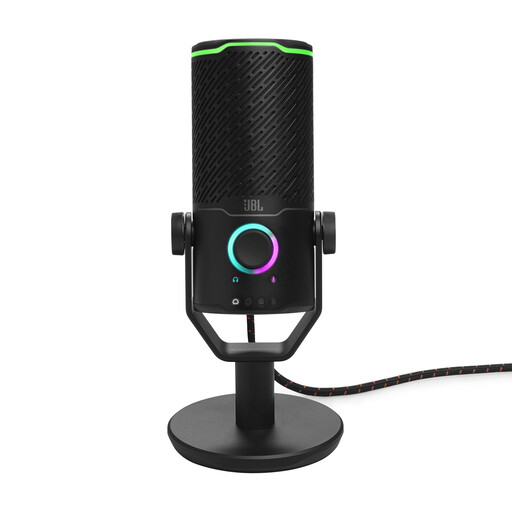 No image available
The description lists a cardioid pickup pattern for solo recording, alongside several selectable pickup patterns.
Direct monitoring, a dynamic compressor and VU meter are also listed.
Record a short, quiet passage and a deliberately loud one from your intended position. Position the microphone, check the input level, then listen back for plosives and room sound. Sennheiser points out that, with the Profile, a green indicator doesn’t rule out the level being too low.
No, check the specific device and cable. RØDE lists a USB-C-to-USB-A cable as included with the NT-USB Mini; devices with different connections may need a different cable or adapter. Then select the microphone as the input in your audio settings or recording app.
When you buy from a trader, EU consumer rules provide for a minimum two-year legal guarantee from receipt of the goods, with the seller responsible for resolving the issue. This is separate from any voluntary manufacturer’s warranty. For standard online distance purchases, the EU generally allows a 14-day withdrawal period from delivery, subject to exceptions and possible return costs.
Section 201 of the German Criminal Code (StGB) makes it a criminal offence to record another person’s private spoken words without authorisation. Make sure you have permission before recording someone in this situation. The law does not prohibit recording your own voice on your own.
Not necessarily. The German Patent and Trade Mark Office explains that speeches can also be protected works, and that copyright in Germany generally expires 70 years after the author’s death. Check the specific text and, where relevant, the rights to any translation or adaptation before publishing your recording.