Solo speakers in a reverberant room
You want to record clear poetry commentary from a fixed spot and can make some adjustments to the microphone position and the room.


For a clear poetry commentary recorded in a reverberant room, a directional microphone in a stable position close to you is a sensible starting point. No microphone can eliminate room reverberation on its own. A dynamic USB or USB/XLR model is a good option if you can speak close to the microphone; a directional condenser model is also worth considering if you position it carefully and test it where you plan to record. Also think about how you’ll manage quiet and emphatic passages, and which connections, stand and cables you’ll need.
You want to record clear poetry commentary from a fixed spot and can make some adjustments to the microphone position and the room.
You vary between quiet and emphatic passages and want to check the position and recording level with a test recording, rather than relying on claims about sound quality.
You want to record straight to your computer and need a suitable connection, a practical stand and, potentially, the option to monitor directly through headphones.
| What matters | What to check before buying | Who is it important to? |
|---|---|---|
| Clarity despite room reverberation | Polar pattern and close positioning; whether you can aim the microphone appropriately at your reading spot. | If I’m speaking alone from a fixed spot, I want my voice to be clear in the recording despite reflections. Around 42% of consumers prioritise making room reverberation less audible. |
| Quiet and emphatic passages | Accessible level controls; a test recording at different speaking volumes while keeping the microphone in the same position. | If I switch between quiet and emphatic passages when reading aloud, I want to be able to check both in a test recording. Around 25% of consumers care most about being able to control their reading performance. |
| Monitoring without mistaking echo for room reverberation | Headphone socket and monitor controls; listen to the saved recording separately as well. | If I want to monitor while recording, I need to be able to tell the difference between echo in my headphones and reverberation in the recording. Around 17% of consumers focus on sound monitoring while recording. |
| Simple setup | Connection and cable compatible with your device; included mount and any additional recording equipment you’ll need. | If I want to record on my computer without extra complications, the connection and setup need to work for my reading spot. Around 16% of consumers prioritise a straightforward recording setup. |
Even a directional microphone can pick up reflections of your voice. Shure points out that a microphone cannot improve the acoustics of a room.
First, test a close, correctly aimed position and improve your recording space if needed, rather than switching models based on a promise about sound quality alone.
You may need to put in extra work to get the positioning or room right.
If direct monitoring and playback of the recording track are both active at the same time, you may hear your voice twice in your headphones.
Check your monitoring routes and listen to the saved recording separately. RØDE recommends muting the track output in the software while recording if both monitoring routes are audible at the same time.
A polar pattern that captures sound from all directions isn’t automatically the right choice if you want to record a single voice clearly and close-up in a reverberant room.
For a single voice, start by testing the directional mode and your speaking position. Consider omnidirectional mode only if several people will actually be speaking around the same microphone.
An additional connection option doesn’t automatically mean the right cable and other recording equipment are included.
Check the exact version, the connection on your device, and the stand and cables. To record via XLR on a computer later, you’ll also need a suitable recording path, such as an audio interface or a suitably equipped mixer.
Depending on the bundle, you may need an additional mount, a suitable cable or an audio interface for the XLR connection.
The Q2U is a dynamic USB/XLR microphone designed for recording a single voice at close range.
According to Shure, the dynamic MV7+ is designed for close-mic voice recording and offers USB features for adjusting levels and processing the signal.
The compact NT-USB Mini condenser model offers a directional recording mode and a desktop stand; the dynamic PodMic USB offers USB and XLR.
The Profile USB Microphone is a directional USB condenser microphone for desktop use, with gain, mix and headphone controls.
According to the manufacturer’s website, the UM 6.0 ADVANCED offers USB, a gain control, a headphone socket and switchable polar patterns.
This selection includes dynamic USB or USB/XLR microphones for recording a single voice at close range, as well as directional USB condenser microphones for recording voice on a computer. Check the position at your reading spot and make a test recording in your own room: product features alone can’t predict how audible the room reverberation will be.
 No image available
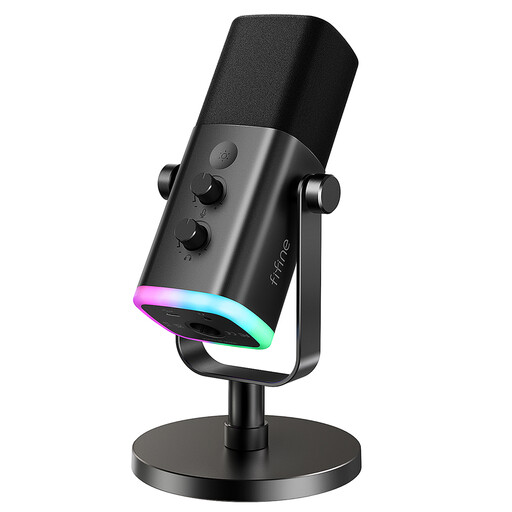
It’s an option for recording a single voice on your computer if you can speak close to the microphone.
Dynamic USB/XLR microphone with a unidirectional polar pattern; the recommended speaking distance listed is 2–6 inches.
According to the product description, the gain control and headphone volume control are available in USB mode. An XLR cable isn’t included.
 No image available
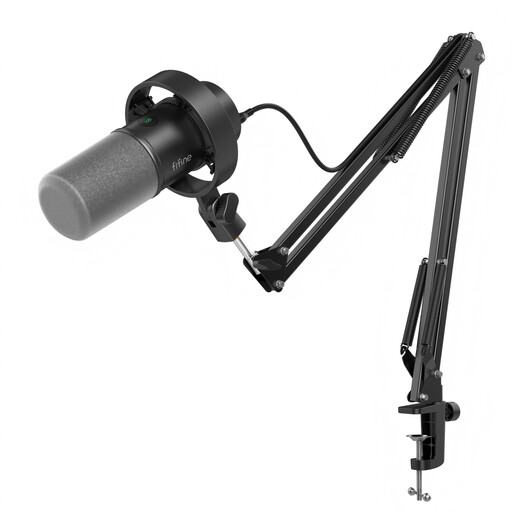
The included boom arm may be useful if you want to position the microphone close to you at your reading spot.
Dynamic USB/XLR microphone with a unidirectional polar pattern; the product description recommends a speaking distance of 2–6 inches.
The set includes a boom arm, clamp and USB cable. According to the description, the gain control, mute function and headphone monitoring are available in USB mode; an XLR cable isn’t included.
 No image available
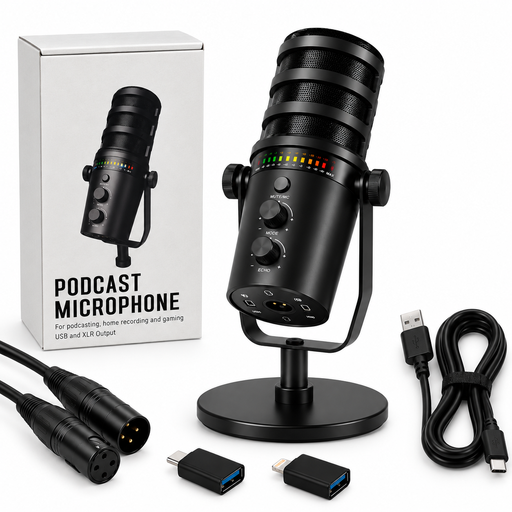
This set is an option if you want to record a single voice and place the microphone on a desk.
The product description lists a cardioid polar pattern, gain control, mute function and headphone output.
According to the description, the set includes a desktop stand as well as USB and XLR cables.
 No image available
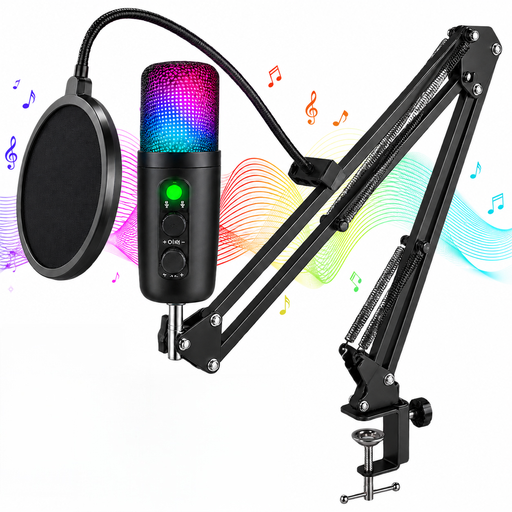
It may suit voice recording on a computer if you can position the microphone close to you and point it towards you at your reading spot.
The description lists a cardioid polar pattern, gain control, mute function and headphone monitoring.
The set described includes a scissor arm, shock mount and pop filter; a Type-C adapter is also listed.
 No image available
It may suit voice recording on a computer if you can position it directionally at your recording spot.
The product description lists a gain control, mute function and headphone monitoring.
The described package includes a scissor arm, shock mount and pop filter.
Even a directional microphone can pick up reflected speech. Shure points out that a microphone cannot improve the acoustics of a room. Check the distance and positioning in the place where you’ll actually record, and compare test recordings made there.
Not necessarily. If direct monitoring and playback of the recording track are both active at the same time, you may hear your voice twice in your headphones. In this situation, RØDE recommends muting the track output in the software while recording. Listen to the saved file separately to check for room reverberation.
To record via XLR on a computer, you’ll need a suitable analogue recording path, such as an audio interface or a suitably equipped mixer. You don’t need one for recording directly via USB; check which cables are included with the specific bundle.
Not simply because you’re commenting on the poem. The German Patent and Trade Mark Office explains that poems may be protected by copyright, which generally expires 70 years after the death of the author. Whether a particular use is covered by permission or a legal exception depends on the work and how you intend to use it; this does not mean you have blanket permission to recite an entire poem.