Two people chatting at the same table
If you both want to record in a single take, test your seating arrangement with a quick recording before starting a long conversation.


If both people are sitting at the same table and one shared audio track is enough, a suitably positioned microphone with the right polar pattern may do the job. If you want to edit each voice separately, or the speakers are sitting further apart, separate microphones with a suitable recording solution are a better choice. For long takes, remember to monitor the levels and make sure you have enough free storage. According to the Audacity Manual, the possible recording time depends, among other things, on the storage available.
If you both want to record in a single take, test your seating arrangement with a quick recording before starting a long conversation.
If you want to adjust the volume or edit out slips of the tongue for each person separately, plan for separate microphone inputs and suitable recording software.
If you’re recording longer study sessions, keep an eye on the levels and check that there’s enough space available in your chosen storage location before you start.
A good fit if: You’re sitting at the same table, one shared audio track is enough and your seating arrangement works in a test recording.
Consider: You won’t be able to edit each voice independently afterwards. A wider pickup pattern may also capture more room and table noise.
A good fit if: You want to set the levels and edit each voice separately. RØDE describes a multi-microphone set-up using supported microphones in RØDE Connect.
Consider: Your connections and software need to work together. According to the Audacity Manual, Audacity cannot record directly from two independent audio devices at the same time.
A good fit if: One person does most of the talking, or the second voice is recorded separately, and the main speaker is close to the microphone.
Consider: A second person outside the microphone’s preferred pickup area may sound too quiet.
| Buying priority | What to check | Who it matters most to |
|---|---|---|
| Pick up both voices | Choose a polar pattern that suits your seating arrangement; test both positions first. | When we’re recording two people at a table, both voices need to be clear on the shared track; around 31 % of consumers put this priority first. |
| Keep long takes under control | Check for a headphone socket and accessible level controls; make sure there’s enough free storage before you start. | For longer study sessions, I want to keep an eye on the levels and storage so the take isn’t interrupted unnecessarily; around 25 % of consumers prioritise being able to manage recording time. |
| Account for room noise | Make a test recording with both people in their intended positions and the usual background noise in the room. | If speech needs to stay clear despite room and table noise, testing in the actual space is important; around 25 % of consumers put this priority first. |
| Simple set-up | Check that your existing connections, cables and software work with your planned one- or two-microphone set-up. | If I want to get started without a complicated set-up, it needs to work with the computer I already have; around 19 % of consumers prioritise a straightforward set-up. |
Only tracks that have actually been recorded separately can be edited independently. A channel specification on its own doesn’t prove that this is possible.
Before buying, check the entire signal path for two inputs and the recording software, rather than relying on the number of channels alone.
Separate tracks may require a second microphone and a suitable recording solution, adding to the set-up work.
Seating positions and room noise affect how a shared recording sounds. A wider pattern may pick up more noise from the room as well as the voices.
Test how both people sound in their usual speaking positions at the intended table before recording a long take.
Audacity saves recordings to a drive, and the available storage limits how long you can record.
Before you start, check the storage location, available space and recording levels.
Longer recordings and project files need additional storage space.
According to CHERRY, the UM 6.0 ADVANCED and UM 9.0 PRO RGB offer different polar patterns for different set-ups.
The manual for the original HyperX QuadCast describes four polar patterns, including bidirectional and omnidirectional settings.
The NT-USB Mini is designed for a directional speaking position. RØDE also describes setting up supported multi-microphone configurations using RØDE Connect.
According to the manufacturer’s manual, the Profile USB is designed for a single speaker positioned in front of the microphone, with controls close at hand.
Shure describes the MV6 as a directional dynamic USB microphone for close-up speaking, with a headphone socket and automatic level adjustment.
USB microphone for a main speaker, with directional pickup.
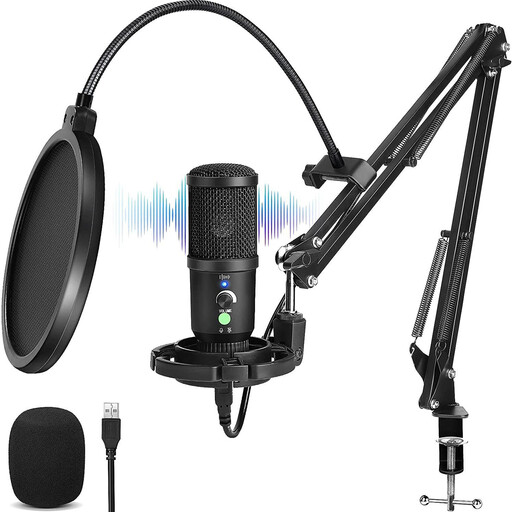 No image available
For a main speaker positioned in front of the microphone; bear its orientation in mind when recording a conversation.
Cardioid polar pattern; zero-latency monitoring.
Not directly as two independent audio devices: according to the Audacity Manual, Audacity records from one audio device at a time. Look for a solution specifically designed for multiple microphones; RØDE describes setting up supported microphones across channels in RØDE Connect.
Audacity doesn’t impose a general limit on recording time, but it does need free storage space. Choose your project and storage location before you begin, check how much space is available and listen back to a short test that includes both quiet and loud sections.
No. Two channels on a USB device don’t automatically mean you can edit two people separately. If you want to edit each voice independently, check that your set-up actually records separate tracks for each speaker.
Section 201 of the German Criminal Code makes it a criminal offence to record another person’s non-public spoken words without authorisation. Check that you’re entitled to make the recording before you start. The Data Protection Conference explicitly explains the need for prior consent for telephone recordings; this isn’t a blanket statement about every study conversation.
According to the Verbraucherzentrale, online purchases generally come with a 14-day right to cancel, starting from the conclusion of the contract or receipt of the goods; possible exceptions should be taken into account. The Verbraucherzentrale distinguishes statutory rights relating to faulty goods from a voluntary guarantee. The relevant contract terms and the specific circumstances will determine what applies.