What to consider when choosing
Start by planning your room and range of movement, then check peak levels and recording reliability with a full test take.
| Concern |
What to check before buying |
Who it matters to |
| Make your voice clear despite room reverberation |
Test the microphone type, polar pattern and position in the room where you’ll actually record. |
If I’m recording in a reverberant room, I want to be able to speak close to the microphone and keep a consistent distance without overemphasising the room sound. Around 33% of consumers prioritise room acoustics and clarity. |
| Control quiet passages and loud outbursts |
Speak the loudest passage, watch the level meter and listen back to the recording. |
If my monologue ranges from a whisper to an outburst, I need a level that can handle both extremes in the same take. Around 27% of consumers put controlling changes in volume first. |
| Save a complete long take |
Check you’ve selected the right USB input, headphone monitoring is working and there’s enough free storage; then export a backup. |
If I’m recording just one long run-through, I want to be sure the software is recording the right signal and there’s enough storage before I start. Around 20% of consumers prioritise a complete take they can check. |
| Freedom of movement and framing |
Film and listen back to your full range of movement; plan the mount, cable routing and microphone position. |
If I need to move around during an audition or use a wider shot, the microphone shouldn’t restrict my movement. Around 20% of consumers put freedom of movement first. |
For close-miking, Audio-Technica recommends positioning yourself directly in front of the microphone and within 200 mm. This guidance applies to the microphone described there and isn’t a rule for all USB microphones. For recording with Audacity, its guide recommends setting levels so peaks are around −6 dB. This is software guidance, not a general minimum level for microphones.
USB microphones at Joybuy
The selection includes microphones for fixed desktop or boom-arm positions, as well as a USB-C clip-on worn close to the body for recordings involving movement. For the clip-on, make sure your recording device is compatible.
 No image available
FIFINE K688CT USB/XLR Microphone Kit
Could suit a fixed, close speaking position if you want to monitor your monologue through headphones.
Dynamic USB/XLR microphone with boom arm, gain control and mute function. The description says headphone monitoring and microphone controls are available over USB; for a stronger input signal, it recommends a distance of 2–6 inches.
View at Joybuy
 No image available
Razer SEIRÉN V3 MINI White
Could be worth considering for directional desktop recording if you want to adjust the microphone angle to suit the camera and your speaking position.
USB condenser microphone with a supercardioid polar pattern and adjustable tilt stand. The description also lists tap-to-mute with an LED indicator.
View at Joybuy
 No image available
Dynamic USB-C/XLR Microphone Kit with Desktop Stand
An option to consider if you want to combine USB recording and headphone monitoring in a desktop setup.
The description lists USB-C and XLR outputs, a cardioid polar pattern, gain control, mute function and a 3.5 mm headphone socket. The kit includes a desktop stand and a thread for attaching it to a microphone arm.
View at Joybuy
 No image available
USB Condenser Microphone, 7-Piece Kit
Could suit a desktop setup if you’re planning to record over USB with headphone monitoring.
The product description lists a headphone socket for real-time monitoring, a mute function and a USB-C adapter. According to the description, the seven-piece kit includes a microphone, USB cable and adapter, among other items.
View at Joybuy
 No image available
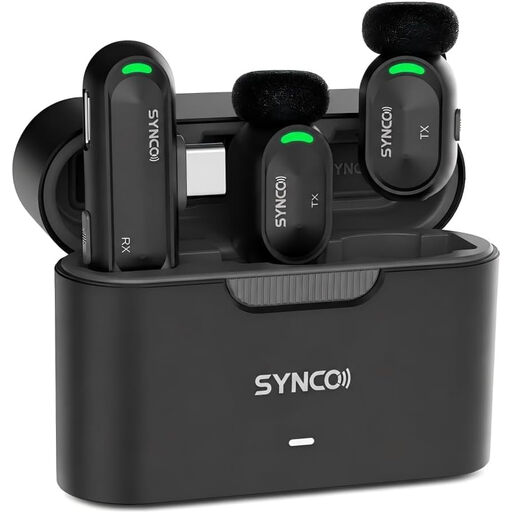
SYNCO SMIC AI Wireless Microphone
This clip-on microphone, worn close to the body, could work for a recording involving movement if a desktop microphone would restrict your range of movement.
The product description lists automatic voice-level adjustment. It specifies Android devices with USB-C and OTG enabled as a connection requirement.
View at Joybuy
Frequently asked questions
How do I prepare for recording a long monologue?
Select the right input in your recording software, check how much storage is available and test the loudest passage too. Audacity’s guide recommends setting levels so peaks are around −6 dB; listen back to the file afterwards and export a backup.
Do I need an audio interface as well as a USB microphone?
For direct USB recording on a compatible device, you don’t necessarily need a separate interface. Audio-Technica describes signal conversion as part of a USB microphone; check your device’s connection and make sure you have the right cable.
What should I test when moving in front of the camera?
Film and listen back to your full range of movement in the place where you plan to record. This lets you check that the distance and direction still work as you move, and that the mount, cable and microphone don’t get in the way of the shot.
Can I record other people during an audition in Germany?
Section 201 of the German Criminal Code (StGB) makes it a criminal offence to record another person’s words spoken in private without authorisation, as well as certain uses of such a recording. The Federal Government’s Laws on the Internet portal reproduces the provision. Don’t secretly record other people’s conversations; whether a particular recording is authorised depends on the circumstances. The provision does not generally prohibit recording your own monologue.
Can I simply record a public performance of a protected work?
Section 53(7) of the German Copyright Act (UrhG) requires the rights holder’s consent to record public lectures, performances or presentations of a work. The provision is published on the Federal Government’s Laws on the Internet portal. Whether it applies to your particular audition video, and what rights you need to share it, can’t be determined by your choice of microphone alone.


