Which setup is right for you?

Interviewers recording long one-to-one conversations

If you’re mainly recording the storyteller in a fixed position, think about the microphone’s direction, the recording level and how you’ll monitor the sound during a long take. The Oral History Association identifies preparation, interviewing, preservation and access as key parts of oral history work.

Interview teams with two important voices

If both the questions and the story need to be equally clear, consider the seating arrangement and recording setup together. Indiana University notes that background noise can make a recording unintelligible, while guidance from Oral-History.Digital focuses on the flow of the conversation.

Interviewers recording in busy workshops

If you can’t keep the recording space quiet, you’ll need to balance the voices, workshop noise and a comfortable microphone position. A test recording with the usual background noise will help you assess the specific seating position.

What should you look for when buying?

Consideration What to check before buying Who is this important to?
Clear storytelling voice Polar pattern, speaking side and a stable position; listen to a test recording at the location, in your usual seated position. If I want to record a single storyteller clearly in the actual workshop, positioning and a test recording matter to me. Around 33% of consumers have this as their main priority.
Level control during long takes Headphone output and accessible level or gain controls; record both quiet and loud sections, then listen back to the saved file. During a long take, I want to monitor the level and signal, then check that the file has actually been saved. Around 27% of consumers prioritise this kind of control.
Two clear voices Decide in advance whether the questions should be recorded and whether the voices need to be edited separately; test both seating positions. If the story and questions are equally important, I want to know in advance whether a shared track will do or if separate tracks are needed. Around 20% of consumers prioritise recording two important voices.
A suitable, straightforward setup Check the exact model and set name, device connection, mount and cable routing against the interview space. When setting up a permanent recording space, I want to make sure the microphone, connection and mount all work together without any surprises. Around 20% of consumers prioritise a straightforward setup.

Avoid common assumptions

  • Assuming a cardioid pattern guarantees two equally clear voices

    A microphone aimed at the storyteller won’t necessarily pick up the interviewer in the other seat just as clearly.

    Decide on the seating arrangement and whether you need separate tracks before choosing a model, then test every planned position.

    Assuming a dynamic microphone or noise processing will make your workshop noise-free

    A particular type of microphone won’t automatically eliminate workshop noise. RØDE recommends a speaking distance of around 5–10 cm for the PodMic USB. Shure’s information about noise processing is a manufacturer’s description, not a guarantee of performance in a specific room.

    Test your usual speaking position and the noise sources that will actually be present during the interview.

    Depending on the recording location, finding a quieter time or a different microphone position may require extra planning.

  • Confusing live monitoring with a safely stored long recording

    Monitoring describes how you listen to the sound; it doesn’t confirm that a complete file has been recorded and saved.

    Listen back to a saved test recording before the interview, and plan for power, storage space and file backups.

    A missing or incomplete file could waste an interview opportunity that’s difficult to repeat.

  • Assuming a microphone and a set include the same accessories

    A desk stand and a microphone boom arm aren’t the same accessory. Make sure you plan for a suitable mount if you’re setting up the RØDE PodMic USB.

    Check the full model and set name against your planned interview space.

    Depending on the version, you may need an additional boom arm, stand or suitable cable.

Microphone brands to consider

Sennheiser

The Profile USB is a directional condenser option for a fixed storytelling position. The Profile Streaming Set differs from the standalone microphone in its mounting hardware.

  • Sennheiser lists gain and mix controls, a level indicator, a headphone output and a desk stand for the standalone Profile USB.
  • Its cardioid pickup pattern won’t make it equally effective for two separate seating positions. Test movement at the table, room acoustics and seating distance at the recording location.

RØDE

The dynamic PodMic USB is designed for close-miked speech and offers USB or XLR connectivity. The NT-USB Mini is a compact USB condenser alternative with a desk stand.

  • RØDE lists a headphone output for the PodMic USB and recommends a speaking distance of around 5–10 cm for this model. The manufacturer describes the NT-USB Mini as offering direct monitoring.
  • Check whether you’ll find the close speaking distance comfortable throughout a long conversation. Monitoring alone doesn’t confirm that your recording software has saved a file.

Shure

The MV7+ is a USB-C/XLR option for a carefully positioned storyteller’s voice, and for buyers considering automatic level functions.

  • Shure describes Auto Level, digital noise processing and a 3.5 mm headphone connection as features.
  • Manufacturer claims aren’t an independent guarantee of performance in a particular workshop. Also check the stand configuration and the system requirements for the apps you use.

Logitech G

The Yeti Nano is an option if you want to switch between recording one directional voice and capturing everyone around the table on a shared track.

  • The manufacturer lists cardioid and omnidirectional modes. Omnidirectional mode picks up sound from all directions.
  • This may also capture room and workshop noise. Neither setting records voices on separate, independently editable tracks.

Audio-Technica

The AT2020USB-X is another directional USB condenser option for a quiet, permanent recording space.

  • Audio-Technica lists headphone monitoring, a mix control, mute function and desk stand.
  • The product information is from a US-market page. Before buying, check that the version on offer has the same features and included accessories.

USB microphones at Joybuy

These USB voice-recording options from Joybuy vary in design, connection and mounting hardware, among other things.
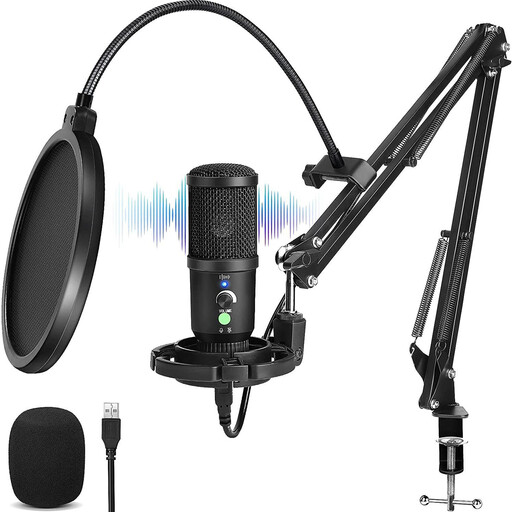
USB cardioid condenser microphone

USB cardioid condenser microphone

For recording one directional voice in a fixed position; test the position and level before a long conversation.

Cardioid condenser microphone with gain control and headphone monitoring.

Described as including a desk stand and boom arm.

View at Joybuy
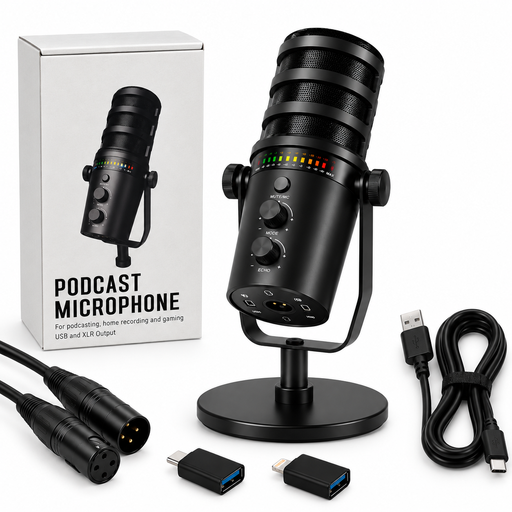
Dynamic USB/XLR microphone set with desk stand

Dynamic USB/XLR microphone set

For recording one focused voice, if you can test the position at the table beforehand.

Dynamic cardioid microphone with USB-C and XLR outputs, plus headphone monitoring.

Includes a desk stand, gain control and mute function.

View at Joybuy
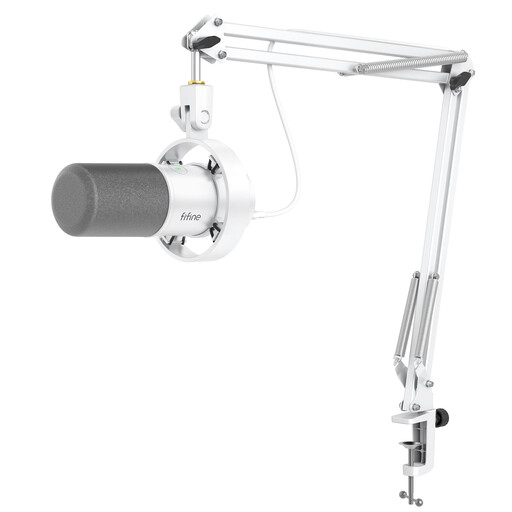
FIFINE K688CTW dynamic microphone with boom arm, white

FIFINE K688CTW dynamic microphone, white

The included boom arm can be positioned at your recording space; check that you’ll find your chosen position comfortable throughout a long conversation.

Dynamic microphone with USB and XLR connections, gain control and headphone socket.

The product description states that an XLR cable isn’t included.

View at Joybuy
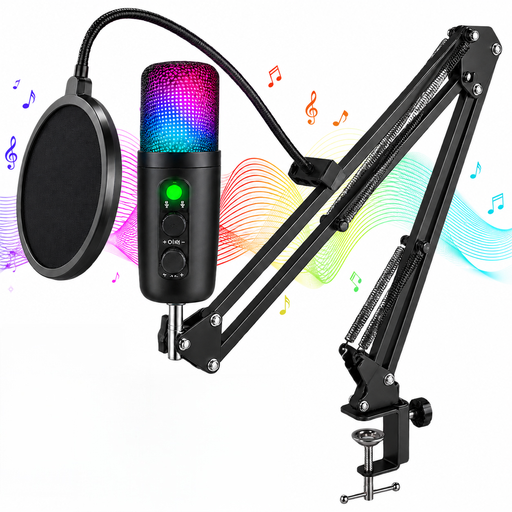
USB condenser microphone with Type-C adapter and headphone socket

USB condenser microphone with Type-C adapter

For USB voice recording, if you want to test headphone monitoring with the device you plan to use.

Condenser microphone with mute function, headphone socket for monitoring and Type-C adapter.

Described as a seven-piece set.

View at Joybuy

Frequently asked questions

Is one USB microphone enough for both the storyteller and interviewer?

One microphone may be enough for a shared track if a test recording captures both seating positions clearly. If you need to edit each voice independently, plan for two microphone positions and check that your full recording setup can produce separate tracks. Omnidirectional mode alone won’t do this.

What should I test before a long interview?

Position the microphone at the actual seat, record a test with both quiet and loud sections and typical movement, then listen back to the saved file. Also check the power supply, available storage and backup method for your recording device. Headphone monitoring alone doesn’t confirm that a file has been saved.

Which file format is suitable for conversations you plan to archive?

The Oral History Association recommends using uncompressed standard formats such as WAV or Broadcast WAV for audio, where possible. This is a recommendation for your archiving workflow, not something a USB microphone can guarantee on its own.

What should I bear in mind when it comes to accessories and repairs?

Check whether the specific version includes a desk stand or boom arm, a suitable cable and headphones. If there’s a defect, distinguish your statutory rights against the seller from a voluntary warranty. The Verbraucherzentrale explains the difference in its information, dated 28 September 2026.

Can I simply record and publish a conversation about local crafts in Germany?

No. Buying a microphone doesn’t give you blanket permission to do so. Section 201(1) of the German Criminal Code makes it an offence to record another person’s non-public speech without authorisation, as well as certain uses of that recording. The German Federal Ministry of Justice lists the provision on its “Gesetze im Internet” website. Get agreement from everyone involved before recording. You’ll also need an appropriate legal basis under Article 6 of the GDPR to process personal data; the Federal Commissioner for Data Protection and Freedom of Information explains the possible legal bases. Discuss the purpose, storage and planned publication explicitly with the storytellers, as the legal position depends on the circumstances of the specific project.