Quiet solo narrators
If you’re recording a book review on your own in a quiet room, you can check soft-spoken words as you monitor the audio directly.


In a quiet, treated room, a cardioid USB condenser microphone with direct headphone monitoring is an obvious choice for recording a soft voice. If you can hear echo or background noise, a dynamic microphone for close-miking may be better suited to your recording environment. Either way, keeping a consistent distance, recording a test take and setting your levels carefully will help.
If you’re recording a book review on your own in a quiet room, you can check soft-spoken words as you monitor the audio directly.
For voice recordings at home where you can hear echo or everyday background noise, a microphone designed for close-miking may be worth considering.
If you’re reading and commenting on longer passages, an easy-to-reach level control and direct monitoring can make it easier to stay in control while recording.
Best suited to: Speaking on your own in a quiet, treated room when you want to record soft-spoken passages with care.
Trade-off: Its greater sensitivity can also pick up echo and background noise more clearly.
Best suited to: Rooms without acoustic treatment, where you can speak consistently close to the microphone.
Trade-off: It’s important to keep your mouth in the same position; getting too close can emphasise bass and plosive sounds.
| Priority | What to look for when buying | Who is it important to? |
|---|---|---|
| Recording a soft voice clearly | Check the specific model’s cardioid polar pattern, gain control and direct headphone monitoring; test the quietest passage in your own room. | If I want to hear quiet sentence endings clearly, I check the controls and monitoring during a test take. Around 36% of consumers put clear, quiet speech first. |
| Echo and background noise | Compare recordings in the room you’ll actually use; a microphone type alone can’t replace a quieter room. | If I can hear echo in my room or everyday noise comes through, clear solo recordings are my main priority. Around 29% of consumers say room echo and background noise are their biggest concern. |
| Keeping levels under control during long takes | Check the specific model’s direct monitoring, easy-to-reach controls and, where available, automatic level features. | If my volume changes as I read and comment, I want to hear my levels and any interference directly. Around 21% of consumers put staying in control during longer recordings first. |
| Setup and what’s included | Check the accessories and connections included with the exact variant, as well as its compatibility with your recording device. | If I want to get started without lots of extra accessories, I look for a stand, pop filter and the right connection. Around 14% of consumers prioritise a straightforward setup. |
A condenser microphone can pick up echo and background noise as well as quiet details in your voice.
Record a quiet test take in the room you’ll actually use before settling on a microphone type.
Depending on the room, you may need to spend more time on positioning, room acoustics or editing.
With directional close-miking, the result also depends on keeping your position consistent in relation to the microphone.
Plan an easy-to-reach setup and listen out for bass, breathing and plosive sounds when monitoring.
RØDE lists the older NT-USB as discontinued and names the NT-USB+ as its successor. Don’t assume that features of the Elgato Wave:3 MK.2 also apply to an earlier version of the Wave:3.
Compare the full model name, connections, what’s included and the generation of its features.
The dynamic USB/XLR MV7+ is designed for solo voice recordings where level adjustment and monitoring are important.
The NT-USB+ is a cardioid USB condenser option for voice recording in a quiet environment.
The AT2020USB-X combines USB-C, a cardioid polar pattern, direct headphone monitoring and a desk stand for solo recordings.
The Q2U is a dynamic USB/XLR model for close-miked voice recordings, including in untreated rooms.
The Wave:3 MK.2 combines a USB condenser capsule with Auto Gain and built-in signal processing.
This selection includes microphones for close-miked voice recordings, as well as a wireless lavalier set. For each model, check that its connections, controls and setup suit your recording room and device.
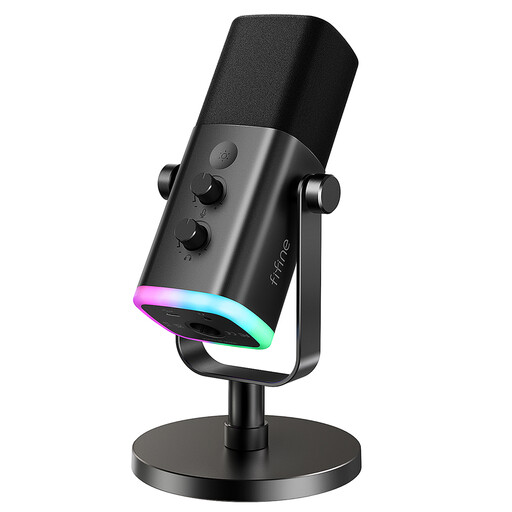 Image unavailable
For close-miked voice recordings, the product description recommends a distance of 2 to 6 inches.
The specifications list a dynamic directional capsule. In USB mode, they include a gain control and headphone monitoring; a windscreen, mute function and desk stand are also listed.
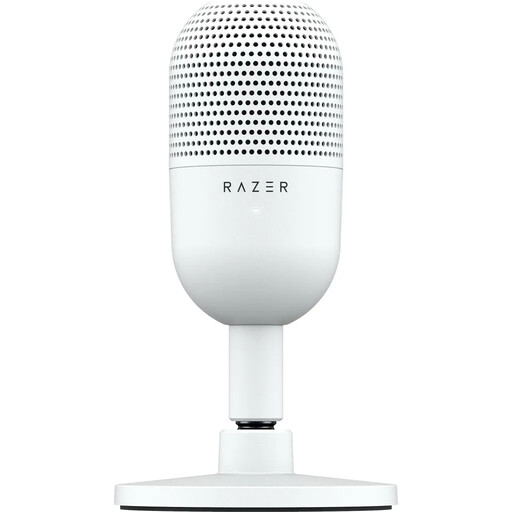 Image unavailable
As a USB condenser microphone with a supercardioid polar pattern, it’s worth considering for desk recording focused on your voice.
The specifications list USB-C, tap-to-mute with an LED indicator, a tiltable stand and built-in shock absorption to reduce vibrations.
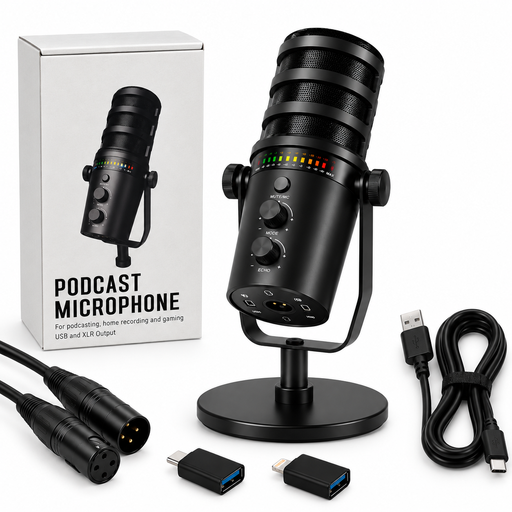 Image unavailable
The specifications list a headphone socket for real-time monitoring, which can help you hear the levels and any interference during a test take.
The set is also listed as including a mute button and desk stand. Before recording, check that the connection is compatible with your device.
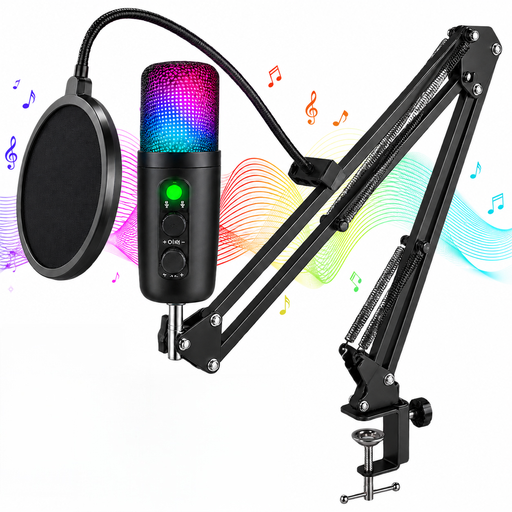 Image unavailable
The product specifications list a cardioid polar pattern, as well as a gain control and headphone monitoring in USB mode.
The package is listed as including a desk stand and an XLR cable. Before buying, check which connections you need for your recording setup.
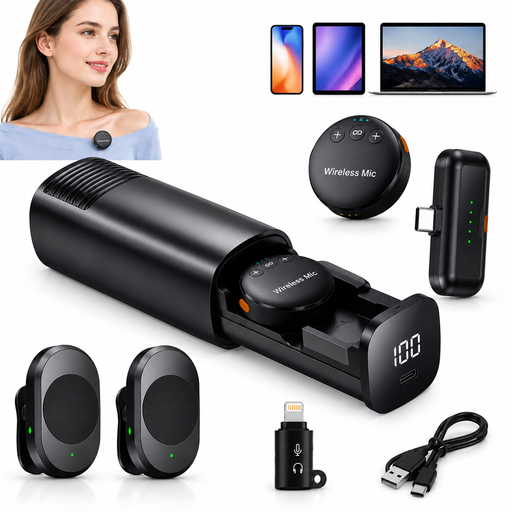 Image unavailable
This is listed as a wireless lavalier microphone set with two transmitters.
The specifications list USB-C and Lightning connection options, as well as real-time monitoring. Check that the connection option is compatible with your recording device.
Choose a quiet spot with as little echo as possible, keep a consistent distance and listen to a test take through headphones. Adjust your distance or levels if sentence endings are hard to hear or emphasised words sound distorted.
It depends on the exact variant. According to RØDE, the NT-USB+ comes with a pop filter and desk stand; Audio-Technica lists a desk stand and USB cable for the AT2020USB-X. Check which connection is right for your recording device. For iOS devices with Lightning, RØDE lists a suitable cable, sold separately.
Your statutory rights against the seller are separate from any voluntary manufacturer’s guarantee. The Verbraucherzentrale says that online purchases generally come with a 14-day right to cancel; the conditions and exceptions applying to your specific purchase should be checked.
Section 51 of the German Copyright Act (UrhG) allows quotations from published works only to the extent justified by the purpose of the quotation. A book review therefore doesn’t automatically justify reading aloud from passages of any length; consider the specific extract and how it is used.
Section 201 of the German Criminal Code (StGB) makes recording another person’s non-public speech without their consent a criminal offence. If anyone else can be heard in your review, get their agreement before recording; the same issue doesn’t arise in the same way when you record your own voice alone.