Choral rehearsal in a noisy room
You want to capture the voices clearly despite household noise and room acoustics. Microphone placement and a short test recording are important first steps.


For a choral rehearsal in a noisy flat, start by deciding where to position the microphones and what you want to record. Shure recommends using the fewest microphones necessary for choirs. A test recording at the actual recording location can help you assess the choir and the room noise. A USB stereo mix is suitable when a single overall sound is all you need; separate USB tracks make later adjustments easier, while an SD recorder lets you record without a computer running. None of these recording options will remove interference that has already been picked up by the microphone.
You want to capture the voices clearly despite household noise and room acoustics. Microphone placement and a short test recording are important first steps.
You need an overall impression of the sound after rehearsal and want to decide whether a simple stereo mix will do the job.
You want to edit the microphones or accompaniment separately later, or record without a computer running. In that case, the number of USB tracks and, where relevant, an SD recording function are key.
For a choral rehearsal in a noisy flat, microphone placement and your recording goals are the first things to consider when choosing how to record. Shure recommends using only as many microphones as necessary to capture a choir.
| What you need | What to check before buying | Who is this important for? |
|---|---|---|
| Capture the choir and room noise | Test microphone placement at the recording location and plan for only the microphone inputs you need. If you’re using condenser microphones, check whether phantom power is required. | If I’m recording in a flat where sound carries easily, I want to capture the choir clearly despite room and household noise, so I’ll test the microphone position first. Around 40% of consumers prioritise capturing the choir over room noise. |
| Quick stereo recording | Check which signals are actually sent over USB and whether the overall mix suits your recording plan. | If I mainly need an overall impression after rehearsal, a pre-set stereo mix may be enough. Around 30% of consumers prioritise a quick overall recording. |
| Edit separate tracks | Compare the number of microphone inputs you need to use at the same time with the channels that can be sent independently over USB. | If I want to balance the choir and accompaniment separately later, I need independent recording tracks, not simply more mixer channels. Around 20% of consumers prioritise this kind of separate editing. |
| Record without a computer | Check whether the device saves separate tracks to an SD card, and test the storage media in advance. | If I don’t want a laptop running at the recording location, I’ll look for a standalone recording function and plan to test it with the storage media. Around 10% of consumers prioritise recording without a computer running. |
A mixer processes the signals from the microphones. It doesn’t change which sounds are picked up at the recording location.
First, test a small number of suitably positioned microphones in the intended location. Then decide how many inputs you need.
According to the manufacturer, the Behringer XENYX 1204USB sends a stereo copy of the main mix over USB. The Allen & Heath ZEDi-10 offers USB with four inputs and four outputs, according to the manufacturer.
Check exactly which signals can be recorded independently over USB for the model you’re considering.
Section 77 of the German Copyright Act (UrhG) covers performing artists’ exclusive right to record their performance on a sound carrier. Section 201 of the German Criminal Code (StGB) covers the unauthorised recording of privately spoken words.
Before the rehearsal, agree with everyone involved what will be recorded and who will receive the file.
The AG06MK2 is worth considering for a compact recording setup that needs no more than two microphone inputs at a time.
The XENYX 1204USB is worth considering if you need a pre-set USB stereo mix and extra analogue mixing options.
The ZEDi-10 combines an analogue mixer with a USB recording option for multiple sources.
The LiveTrak L-8 is worth considering for rehearsals where you want to record separate tracks to SD or use USB recording.
According to Tascam, the Model 12 offers a more extensive USB and SD multitrack recording setup for more complex recording plans.
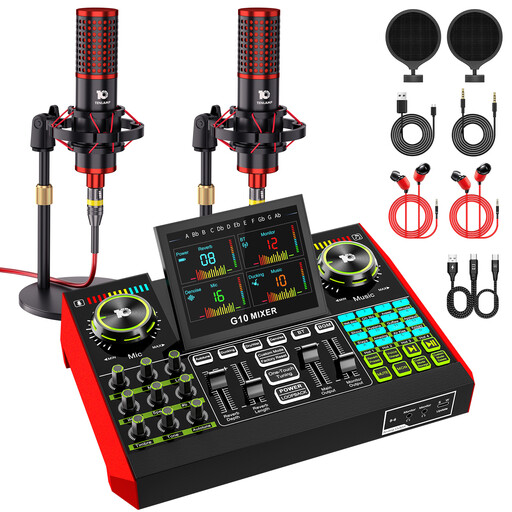
A Joybuy product option with an audio mixer or sound card and two microphones for a test recording.
 No image available
For a test recording with two microphones; check that the connections match your planned recording setup before buying.
The kit includes two 3.5 mm condenser microphones, according to the product name. The product description says the sound card supports PC, Mac and mobile devices.
It depends on the choir’s arrangement and the recording location. Shure recommends using the fewest microphones necessary for choirs and says that placement and direction are key. Test the balance with the actual choir before deciding on a fixed number of channels based on the number of singers.
Check whether your microphones need phantom power and whether the inputs you plan to use provide it. Yamaha lists +48 V for both microphone inputs on the AG06MK2. Check the connections and levels, and make a test recording before you start.
Allow for microphones, stands, cables and, if necessary, a suitable SD card to match your setup. Tascam Europe lists the Model 12 as discontinued, so check availability and support for the specific listing if you’re considering this model.
There’s no straightforward answer. Under Section 77 of the German Copyright Act (UrhG), performing artists have the exclusive right to record their performance on a sound carrier; Section 201 of the German Criminal Code (StGB) covers the unauthorised recording of privately spoken words. Agree with everyone involved in advance about the recording and how it will be shared. Any other rights involved will depend on the material and how it is used.
For noise caused by people, the German Environment Agency refers to state law, local rules and house rules. Check the requirements for your location and home rather than applying rules for specific outdoor equipment to a choral rehearsal.