
Lieferung heute & morgen

Qualitätsgarantie

Willkommens-Angebote freischalten: KOSTENLOSE Lieferung | Bis zu 80 % RABATT | Kostenlose 30-Tage-JoyPlus-Testphase
App herunterladen
By Joybuy Product Recommendation Officer, 28 July 2026
Whether for seasonal storage of duvets, maximising suitcase space when travelling, or general household organisation—the desire for more storage space is a familiar problem. Vacuum storage bags promise a simple solution by drastically reducing the volume of textiles. But not all products deliver on their promise. Many buyers find that their compressed bags are full of air again after a short time, or that the material fails after the first use.
This guide reveals the three most common pitfalls when buying vacuum storage bags and explains which technical features you need to look for to find a durable and functional solution to your space problem.
Before you invest in a set, you should be aware of the typical weaknesses that often only become apparent after purchase, rendering the product useless.
To avoid the problems mentioned above, you should base your selection on objective technical parameters. These three features are crucial for the functionality and longevity of vacuum storage bags.
Look for products explicitly made from a composite material of Polyamide (PA) and Polyethylene (PE).
The airtightness of a vacuum bag depends significantly on two components:
Choosing the right method depends on your intended use.
Here are some product recommendations tailored to different needs that meet the quality criteria mentioned above.
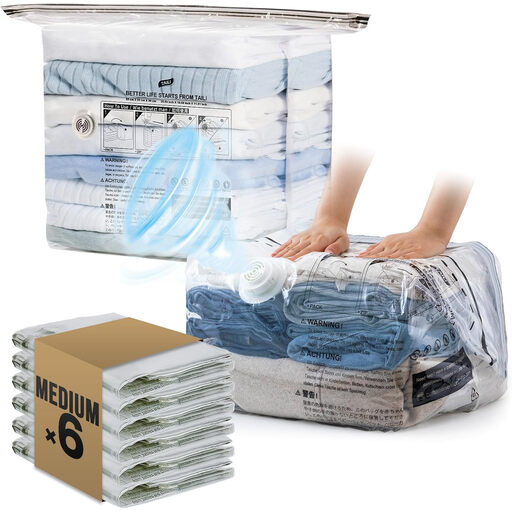
Why This Fits Their Persona: Ideal for those who want to create maximum space in their carry-on or backpack without needing extra equipment like a pump. The cube shape adapts well to the form of a suitcase.
This model completely avoids the 'impractical pump' trap, as it works purely by hand-pressing. The patented valve lets air out, but not back in.
Features the patented ESY SHRINK air valve for manual compression. The PA+PE material is tear-resistant and designed for travel.
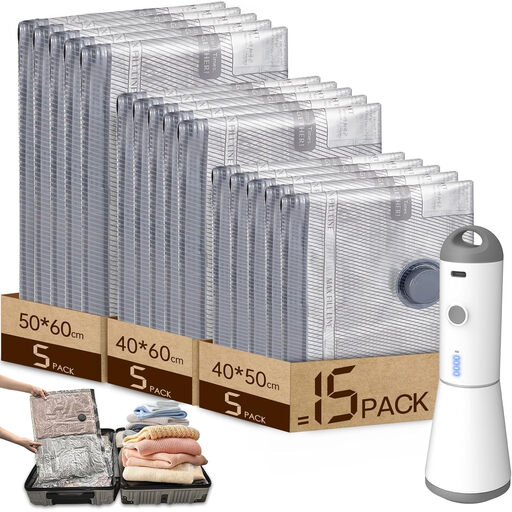
Why This Fits Their Persona: Perfect for families or individuals looking for an all-in-one solution for storing seasonal clothing, bedding, and blankets. The set includes various sizes and an easy-to-use pump.
Addresses the problems of leaks and material brittleness with a tear-resistant PA+PE material and a double-zip seal. The cordless pump solves the compatibility issue.
Comprehensive set with 15 bags in 3 sizes and a compact, cordless pump that removes air in about 30 seconds. Protects against moisture, dust, and bacteria.
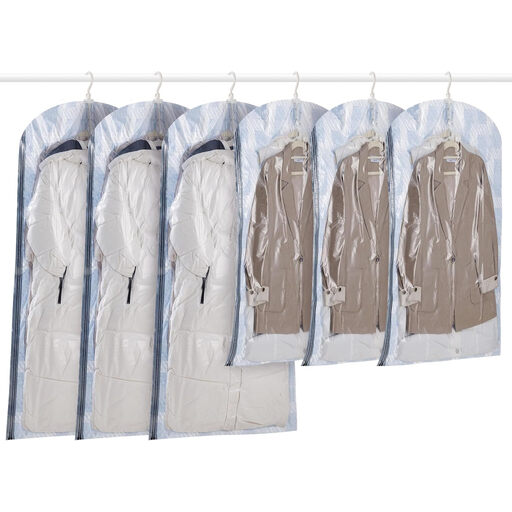
Why This Fits Their Persona: Specifically designed for vertical storage in a wardrobe. Ideal for storing suits, long coats, or dresses in a protected, space-saving way without creasing them.
Solves the problem of creasing delicate garments, which can occur with flat vacuum bags. The integrated hook system is a well-designed, specialised solution.
A five-hook design allows for storing up to five garments per bag. The set includes long and short bags for different types of clothing.
We have compiled a complete, up-to-date list of products that meet these strict selection criteria and comply with current regulations.
1. How long do vacuum bags hold the air? The duration for which a bag holds its vacuum strongly depends on the quality of the material, valve, and seal. High-quality bags made from a PA+PE composite with a tight double-zip seal can hold the vacuum for several months, sometimes up to a year. It is good practice to check the bag 24 hours after sealing to ensure there are no slow leaks.
2. Can you reuse vacuum bags? Yes, most modern vacuum bags are designed to be reusable. Durability depends on the material thickness (PA+PE is advantageous here) and careful handling. Avoid overfilling the bag and contact with sharp objects like zippers or buttons to prevent perforations.
3. Are vacuum bags suitable for down jackets or duvets? Using them for down products is possible but requires caution. It is recommended to limit compression to about 50% of the original volume to avoid permanently damaging the structure of the down and feathers. Some special vacuum garment bags are designed to better protect the shape of down coats. Always observe the care instructions from the textile manufacturer.