
Lieferung heute & morgen

Qualitätsgarantie
App herunterladen
Kategorien
The efficient use of limited storage space is a key challenge in many households. The seasonal storage of textiles like duvets, winter coats, or summer clothing, in particular, consumes valuable space in wardrobes, cellars, or attics. Vacuum storage bags offer a technical solution to reduce the volume of textiles by up to 80%. They also protect the contents from moisture, dust, moths, and odours. This article analyses the technical criteria relevant to selecting vacuum storage bags.
The functionality and durability of a vacuum storage bag are determined by its material composition, sealing mechanism, valve design, and form factor.
Material quality is crucial for the bag's tear resistance and airtightness. The most common and proven material combination is a laminate of Polyamide (PA) and Polyethylene (PE).
A multi-layer PA+PE construction offers robust protection against external elements and mechanical stress, which is advantageous for repeated use.
The seal is a potential weak point for air leakage. Models with a double-zip closure offer a higher degree of airtightness compared to single-zip versions. An included sealing clip (slider) is often used to ensure both sides of the zip lock together securely along the entire length. This minimises the risk of leaks and ensures long-lasting compression.
Air is extracted through a valve. There are two primary designs:
The shape of the bag should be tailored to its intended use.
Based on the technical criteria above, we present three models with different primary applications.
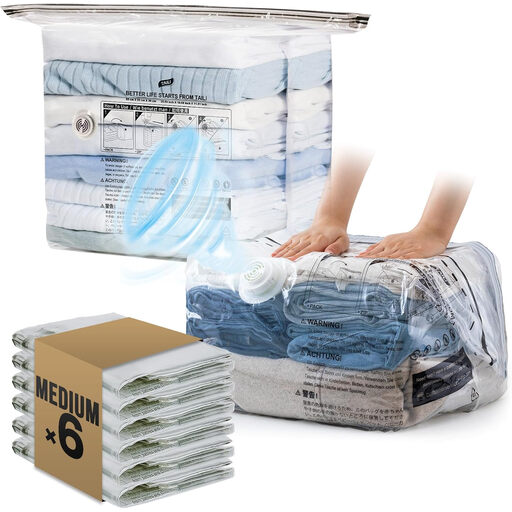
Why we recommend this product: This model is optimised for use without a vacuum cleaner. The patented ESY SHRINK air valve allows for compression using only hand pressure. Its cubic shape, measuring 63.5 x 48.3 x 28 cm, is sized to fit into most standard carry-on suitcases, filling the space without gaps.
Pros:
Who it's for: This set is a practical solution for travellers looking to maximise suitcase space (travel vacuum bags). It is also suitable for individuals seeking a straightforward storage solution without needing extra equipment.
View Details for the TAILI Cube Vacuum Bag
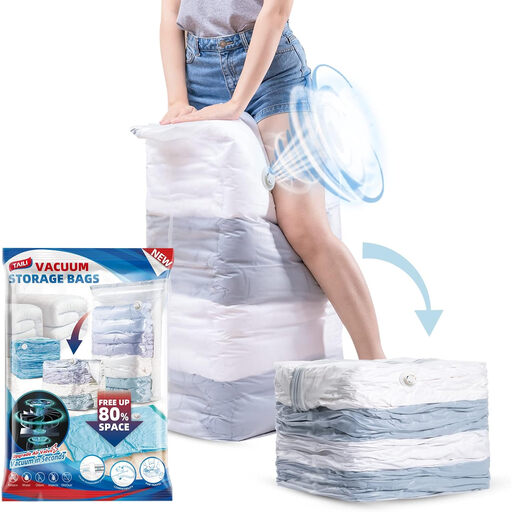
Why we recommend this product: Measuring 78.7 x 101.6 x 38.1 cm, this vacuum bag for duvets offers a very large capacity. The self-standing cubic structure makes it significantly easier for one person to fill. The capless valve is compatible with any standard vacuum cleaner, allowing for rapid air extraction.
Pros:
Who it's for: Ideal for households storing bulky textiles like winter duvets, pillows, and thick clothing. Thanks to its stackability and high capacity, this model is also an excellent choice for moving or organising storage spaces.
View Details for the TAILI Jumbo Cube Vacuum Bag
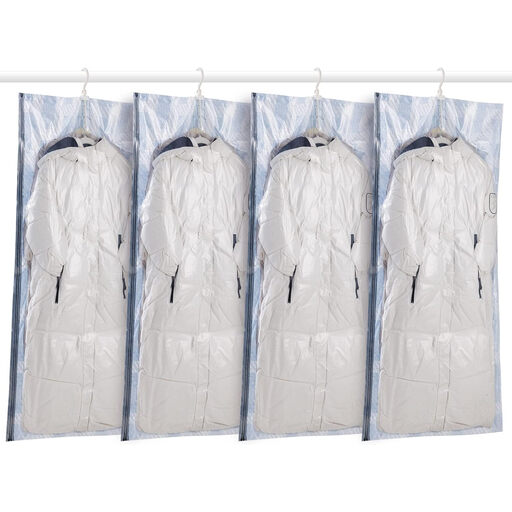
Why we recommend this product: This system solves the problem of storing long garments. Instead of folding coats or suits, they are hung on the integrated five-hook system. This utilises the vertical space in a wardrobe and preserves the shape of the clothing. The design is specifically engineered to avoid over-compressing delicate down or feather fillings.
Pros:
Who it's for: Individuals with limited wardrobe space who want to store seasonal outerwear like jackets, coats, suits, or long dresses in a space-saving way that preserves their shape.
View Details for the TAILI Hanging Vacuum Bags
Vacuum bags are an effective method for volume reduction. However, depending on your specific needs, other storage organisation systems may also be suitable. For an overview of various solutions, from fabric boxes to under-bed storage containers, visit our Storage Bags for Organisation category.
1. How long do vacuum bags hold the air? The length of time a vacuum bag remains airtight depends on the material quality (PA+PE laminate) and the integrity of the seal (double-zip) and valve. High-quality bags can maintain the vacuum for several months up to a year. It is recommended to check their condition every six months.
2. Can you use vacuum bags without a vacuum cleaner? Yes, there are two options. Some compression bags are designed for manual use, where air is expelled by firmly rolling or pressing the bag. Other models, like the featured TAILI travel bag, have special manual-press valves that simplify the process.
3. Do vacuum bags damage clothing or duvets? For most textiles like cotton, synthetics, or wool, vacuum sealing is safe. For materials with a delicate structure, such as down or feathers, excessive compression should be avoided as it can damage their loft. For such items, hanging vacuum bags that do not fold the clothing, or using only moderate compression, is a better choice. Leather and fur should not be vacuum-sealed.