
Lieferung heute & morgen

Qualitätsgarantie

Willkommens-Angebote freischalten: KOSTENLOSE Lieferung | Bis zu 80 % RABATT | Kostenlose 30-Tage-JoyPlus-Testphase
App herunterladen
Overflowing wardrobes and a lack of storage for seasonal textiles like winter jackets or duvets are common problems in many households. Efficiently organising the available space is crucial for maintaining order and protecting clothes from dust, moisture, and moths. Vacuum storage bags for clothes offer a solution for volume reduction, while classic garment covers focus on protecting delicate items.
This article introduces various approaches to space-saving storage and explains the key features you should look for when making your selection. We compare different types of storage bags for clothing to help you make an informed decision.
Before you decide on a product, you should consider a few fundamental criteria that determine its functionality and longevity.
The material is crucial for protecting your textiles. For vacuum bags, a combination of Polyamide (PA) and Polyethylene (PE) is common. This material blend offers high tear resistance and an effective barrier against air and moisture, which is essential for maintaining the vacuum. For simple garment bags, where the primary goal is protection from dust and dirt, PEVA (Polyethylene Vinyl Acetate) is often used. This material is water-repellent, flexible, and frequently transparent or translucent, making it easy to identify the contents.
The sealing system is the most critical component of a vacuum bag. A double-zip seal provides greater security against air leaks than a single seal. The valve, through which the air is extracted, should also be high-quality. Modern turbo valves with sealing caps or self-sealing mechanisms are designed to minimise air loss over a long period. For a simple garment cover, a sturdy zipper is sufficient to keep the contents secure.
Consider what you want to store and where:
Here, we present a selection of products that meet different requirements for storing clothing and textiles.
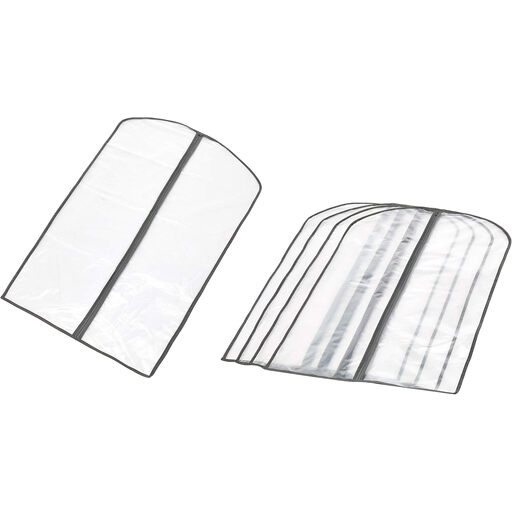
Why This Product Stands Out This set from ANQI is not a vacuum solution but a classic garment bag. It focuses on protecting clothing from external elements like dust and moisture without compressing the volume. The translucent PEVA material allows you to quickly identify the contents without having to open the bag.
Advantages:
Who Is It For? Individuals looking for a straightforward and effective solution to protect delicate or seldom-worn garments in the wardrobe without needing to compress them.

Why This Product Stands Out The Grifema vacuum bags are designed for maximum volume reduction. According to the manufacturer, the volume of textiles can be reduced by up to 80%. The material combination of Polyamide (PA) and Polyethylene (PE) ensures the necessary robustness and airtightness. With a size of 100 x 80 cm, they offer ample space for bulky items.
Advantages:
Who Is It For? Households that need to store large quantities of duvets, pillows, blankets, and seasonal clothing in a minimal amount of space. Also suitable for travellers looking to optimise their luggage volume.

Why This Product Stands Out These hanging vacuum bags from TAILI combine volume reduction with the convenience of storage on a clothes rail. The integrated hook allows you to compress coats, suits, and dresses directly in the wardrobe. A special feature is the colour-changing zipper, which visually indicates whether the bag is sealed correctly.
Advantages:
Who Is It For? People with limited space on their clothes rail who want to store long garments like coats, suits, or dresses in a protected and compressed state throughout the off-season.
The products featured here cover specific use cases. If you are looking for different sizes, sets, or special types of storage bags, you can find more alternatives in our broader category.
? Discover a wider selection of poly bags for clothing here
The length of time a vacuum bag remains airtight depends on the quality of the material, zipper, and valve. High-quality bags made from a PA+PE blend with a double-zip seal can maintain the vacuum for several months. It is recommended to check the condition of the bags every 4-6 months, especially for long-term storage.
Yes, it is possible, but with caution. Down and feathers need a certain amount of air to maintain their loft and insulating properties. It is recommended not to compress down products by 100%. Only extract about 60–70% of the air, so the feathers are not crushed.
Most vacuum bags are designed for use with a standard vacuum cleaner, as this is the fastest and most efficient method. However, some products are also compatible with manual hand pumps or even come with one. This is particularly useful for travel or when a vacuum cleaner is not available.